
Walk around Culver City and you will eventually encounter one: a sidewalk pushed upward by tree roots, cracked concrete, a deteriorating curb, or a corner that is difficult to navigate with a wheelchair, walker or stroller.
That led me to a very simple question:
How much would it cost to fix Culver City’s sidewalks and curbs?
I went through Culver City’s own public records looking for an answer.
I found something interesting.
The City clearly spends money repairing sidewalks and curbs. There are projects, contracts and budgets for this work.
What I could not find was one simple, current citywide number answering:
How much would it cost to repair all of Culver City’s deficient sidewalks and curbs?
I think we should know.
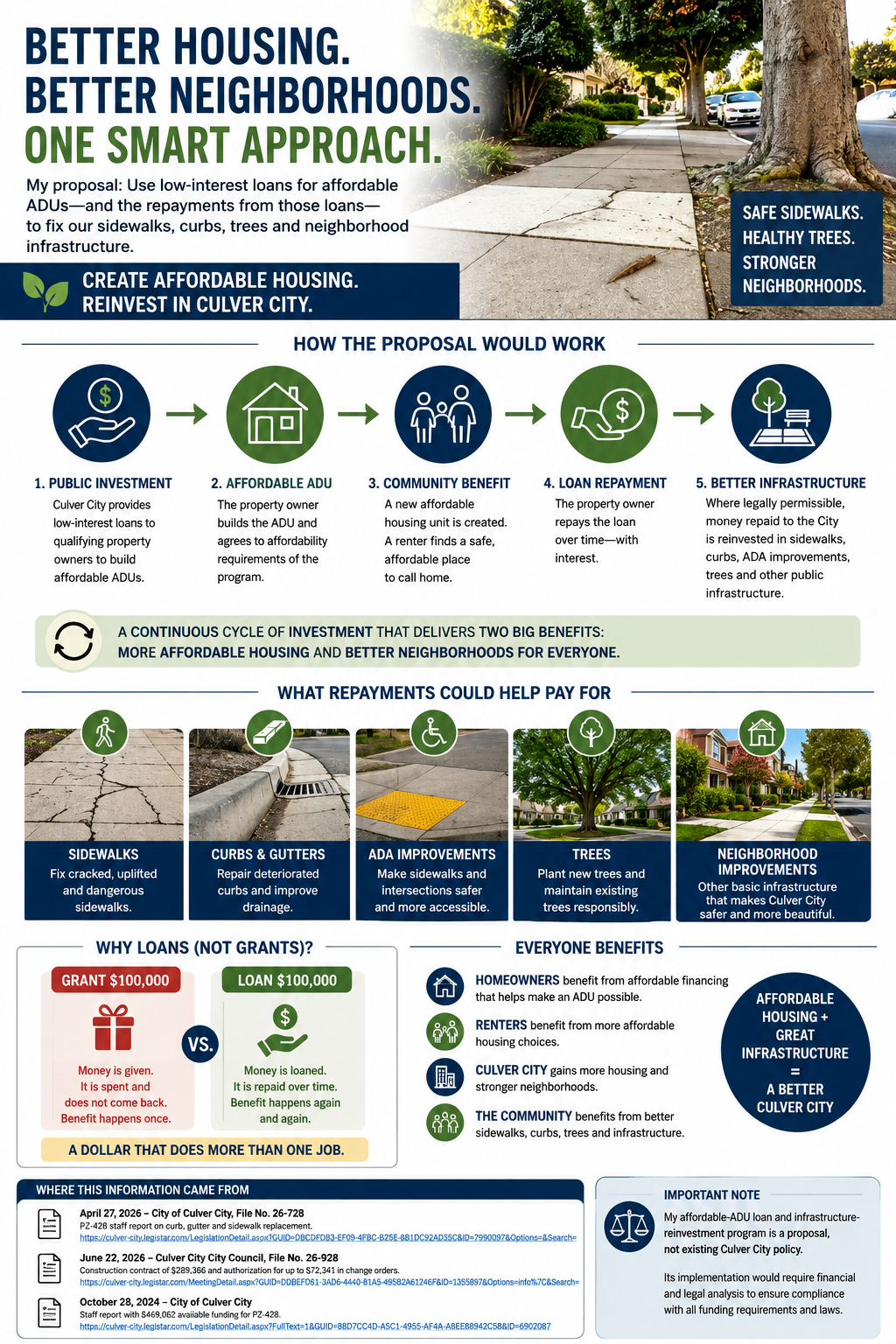
And I have an idea for how affordable housing policy could eventually help us pay for better sidewalks, curbs and trees at the same time.
What Is Culver City Doing Now?
Culver City already has a Capital Improvement Program project called PZ-428 — Curb, Gutter, Sidewalk Replacement.
According to an April 27, 2026 City staff report, the Public Works Department receives requests about broken and uplifted sidewalks, curb ramps, driveway approaches and portions of streets.
City employees investigate these locations and assess the potential hazards. The Engineering Division also groups locations together for larger repair projects.
According to the City, locations are prioritized based on factors including:
severity;
available funding; and
previous maintenance.
The report also identifies tree-root intrusion as a major cause of sidewalk uplift.
Source: City of Culver City, April 27, 2026, File No. 26-728.
Read the official City staff report
How Much Are We Spending?
The numbers give us some idea of the scale of the work.
For the 2026 PZ-428 project, City staff initially estimated a project cost of approximately:
$416,000
After the bidding process, the June 22, 2026 City Council record shows a construction contract of:
$289,366
The City also authorized up to:
$72,341
for possible change orders.
That means the construction contract plus the maximum authorized change orders could reach approximately:
$361,707
Source: Culver City City Council, June 22, 2026, Item C-11, File No. 26-928.
See the official City Council meeting record
And This Isn't Just a 2026 Problem
Go back to October 2024 and we find another substantial construction project.
The contract was $533,762, with authorization for up to another $133,440 in change orders.
That project included sidewalk, curb-ramp and driveway-approach work under PZ-428, as well as concrete-pavement work under another capital project. Therefore, it would not be accurate to call the entire contract sidewalk spending.
The City's funding table attributed $469,062 in available funding to PZ-428.
Source: City of Culver City, October 28, 2024.
Read the official City staff report
So we know something important:
Culver City is already spending hundreds of thousands of dollars at a time repairing sidewalks, curbs and related infrastructure.
But that still doesn't answer the larger question.
What Would It Cost to Fix Everything?
This is the number I want Culver City to determine.
The City's public records tell us about individual projects.
They tell us about contracts.
They tell us how repairs are prioritized.
But I could not find a simple, current citywide estimate telling residents what it would cost to bring our sidewalks and curbs into good condition.
Without a comprehensive current assessment, I don't think we should guess whether the answer is $5 million, $10 million, $20 million or something else.
Let's find out.
Step One: Inspect the Entire City
I propose that Culver City conduct a citywide sidewalk and curb condition assessment.
It doesn't need to be complicated.
Inspect our sidewalks.
Identify damaged locations.
Grade them by severity.
Measure the concrete that needs replacement.
Identify tree-root conflicts.
Determine where accessibility improvements are needed.
Count deficient curb ramps.
Estimate the cost of the work.
Then publish the information online.
Residents should be able to easily answer:
How much sidewalk needs repair?
How much curb needs repair?
How many ADA improvements are required?
How many locations are being damaged by tree roots?
How much would it cost to repair the most dangerous locations?
How much would it cost to repair everything?
How much are we spending each year?
At our current rate, how long would it take?
Those aren't unreasonable questions.
They are basic management questions.
But Then Comes the Harder Question: How Do We Pay for It?
This is where I think we can connect two problems that are usually discussed separately:
Affordable housing and public infrastructure.
I have proposed a different approach to creating some affordable housing in Culver City.
Rather than relying only on very expensive large housing developments or giving public money away through grants, I propose that Culver City explore providing low-interest loans to qualifying property owners to build ADUs that become affordable housing.
An ADU — accessory dwelling unit — can be a backyard home, converted garage or another qualifying residential unit added to an existing property.
Under my proposal, Culver City would help a property owner finance the construction through a low-interest loan.
In return, the resulting ADU would have to meet affordability requirements established by the program.
The property owner would then repay the money.
And that's where the second part of my proposal begins.
Affordable Housing That Eventually Helps Pay for Infrastructure
I don't want the story to end when the ADU gets built.
As those loans are repaid, I propose that the money coming back to the City be directed, where legally permissible, toward improving public infrastructure throughout Culver City.
That could include:
Sidewalks.
Curbs and gutters.
Trees.
ADA accessibility.
Other basic neighborhood infrastructure.
Think about the cycle:
Public investment → Affordable ADU → Loan repayment → Public infrastructure
Instead of choosing between affordable housing and maintaining our neighborhoods, let's explore whether we can design a program that helps accomplish both.
Here's a Simple Example
Imagine, purely for illustration, that Culver City provides a qualifying homeowner with a $100,000 low-interest loan to help construct an ADU.
The homeowner agrees that the ADU will meet the affordability requirements of the program.
The ADU gets built.
Now Culver City has another affordable housing unit.
But the $100,000 wasn't simply given away.
It was loaned.
Over time, the homeowner repays the principal and whatever interest the program requires.
Under my proposal, if the funding source and law permit it, money returning to the City could then help pay for sidewalks, curbs, trees and other public infrastructure.
So the original public investment can create more than one benefit.
A property owner gets help creating an ADU.
A renter gets an affordable place to live.
Culver City gets another housing unit.
The loan gets repaid.
And the community ultimately gets better infrastructure.
That is what I mean by making public money work harder.
Why Loans Instead of Simply Giving Money Away?
This is an important distinction.
Suppose the City gives a property owner $100,000 as a grant.
The property owner receives $100,000.
The public money is spent.
Now compare that with a properly structured $100,000 low-interest loan.
The property owner still receives the financial help necessary to build the affordable ADU.
But there is a repayment obligation.
Over time, money comes back.
That creates an opportunity to use the same public capital for another public purpose.
A public dollar shouldn't have to do only one job if we can responsibly design it to do more.
Housing Growth and Infrastructure Should Be Connected
There is another reason I think these ideas belong together.
New housing doesn't exist in isolation.
The people living in that housing use our sidewalks.
They drive on our streets.
They walk under our trees.
They use our parks.
They cross our intersections.
They depend on our infrastructure.
As Culver City adds housing, we should also be thinking about the infrastructure required to support additional residents.
That is why I don't think the conversation should be:
Affordable housing or better infrastructure?
I think the better question is:
How can our affordable-housing strategy also help us build better infrastructure?
Everyone Should Benefit
This is particularly important to me.
When public money is invested, I want to ask:
Who benefits?
Under this proposal, the homeowner benefits because low-interest financing helps make construction possible.
The renter benefits because another affordable home becomes available.
The City benefits because another housing unit is created.
And as the loan is repaid and eligible money is reinvested into public infrastructure, the broader community benefits too.
The resident who never builds an ADU can benefit from a repaired sidewalk.
The senior walking around the neighborhood can benefit.
The parent pushing a stroller can benefit.
The child walking to school can benefit.
The person using a wheelchair can benefit.
The homeowner can benefit from a better-maintained neighborhood.
The renter can benefit.
Everyone uses public infrastructure.
Affordable housing and great neighborhoods shouldn't be opposing goals.
We should be looking for ways to accomplish both.
Trees Should Be Part of the Plan Too
The City's own sidewalk report identifies tree-root intrusion as a major source of sidewalk uplift.
That means we shouldn't think about sidewalks and trees as completely separate issues.
We need both.
We need healthy trees and a healthy urban canopy.
And we need safe sidewalks.
That requires better planning of tree species, root systems, planting locations, sidewalk design and maintenance.
Simply cutting down trees whenever roots damage concrete isn't a long-term strategy.
Neither is repeatedly replacing concrete without addressing why it keeps being damaged.
A comprehensive infrastructure plan should consider sidewalks, curbs and trees together.
There Is an Important Legal Limitation
I also want to be clear about something.
Not every affordable-housing dollar can legally be used for sidewalks, curbs or trees.
Some state, federal and local funding sources have restrictions on how the original money — and sometimes money repaid to a program — may be used.
Those restrictions must be respected.
That means the design of this program matters.
Before creating it, Culver City would need to determine what funding sources could legally capitalize the loan program and whether repayments could subsequently be directed toward broader public infrastructure.
If a funding source requires repayments to remain dedicated to affordable housing, then those rules must be followed.
But if Culver City can legally structure discretionary funding so that the initial investment helps create affordable housing and the repaid money can subsequently improve public infrastructure, I think we should explore doing exactly that.
This proposal would therefore require careful financial and legal analysis before implementation.
Let's Put the Numbers in Front of Residents
Ultimately, I would like Culver City residents to be able to visit the City's website and see something this simple:
QuestionAnswerSidewalks requiring repair_____Curbs requiring repair_____ADA improvements required_____Tree-related sidewalk problems_____Estimated total repair cost$_____Current annual repair spending$_____Affordable ADUs created through loan program_____Outstanding ADU loans$_____Annual loan repayments$_____Amount available for infrastructure$_____Infrastructure projects completed_____
Then residents could actually see whether the program is working.
Before Asking for More Money, Let's Make Existing Money Work Harder
Whenever government identifies a large problem, the conversation frequently moves quickly toward another tax, fee or assessment.
Sometimes additional revenue may be necessary.
But that shouldn't always be the first answer.
Before asking residents for more money, I want Culver City to ask:
Can we use the money we already have more intelligently?
Can a public investment generate a repayment instead of simply disappearing as an expenditure?
Can that repayment create another public benefit?
Can affordable housing policy also contribute to better neighborhoods?
Those are the kinds of questions I think City Hall should be asking.
Sidewalks Aren't Exciting. But They Matter.
Sidewalks aren't glamorous.
But we use them every day.
Children walk to school on them.
People walk their dogs on them.
Parents push strollers on them.
People run and exercise on them.
Older residents depend on them.
People using wheelchairs, walkers and other mobility devices need them to be accessible.
Trees make those same streets cooler, greener and more pleasant.
Curbs and gutters help define and maintain our streets.
These are basic pieces of a functioning city.
This Is Also About Transparency
One thing I continue to discover while running for Culver City Council is that an enormous amount of useful information exists inside City staff reports, agendas, budgets and Capital Improvement Program documents.
But residents shouldn't have to become municipal-document detectives to understand what is happening in their own city.
I could find individual sidewalk projects.
I could find contracts.
I could find estimates.
I could find explanations of how repairs are prioritized.
But I could not find one simple, current answer to the question:
How much would it cost to fix Culver City's sidewalks and curbs?
If that number exists, residents should be able to find it.
If it doesn't exist, let's calculate it.
Then let's develop a long-term plan to pay for it.
My Approach
The concept is actually pretty simple:
Create affordable housing.
Use low-interest loans to help qualifying property owners create affordable ADUs.
Get the public investment back.
Require repayment rather than simply giving the money away, when that structure is appropriate.
Reinvest in the community.
Where legally permissible, use returning funds to help repair sidewalks, improve curbs, address accessibility and plant and maintain trees.
Show residents the results.
Publish how much money went out, how many affordable units were created, how much money came back and exactly where that money was reinvested.
That's the cycle I want to explore:
Affordable housing → Repayment → Better infrastructure → Better neighborhoods
We need affordable housing.
We also need safe sidewalks, healthy trees, good curbs and well-maintained neighborhoods.
Why not design public policy so that, over time, the same investment helps us achieve both?
Where This Information Came From
The descriptions and dollar amounts concerning Culver City's existing sidewalk program come from official City of Culver City records. The affordable-ADU loan and infrastructure-reinvestment program described above is my proposal, not an existing Culver City policy.
April 27, 2026 — City of Culver City, File No. 26-728
This City staff report describes PZ-428, explains how sidewalk repairs are identified and prioritized, discusses tree-root problems and provides the approximately $416,000 project estimate.
June 22, 2026 — Culver City City Council, File No. 26-928
This City Council record provides the $289,366 construction contract and authorization for up to $72,341 in change orders.
See the official City Council meeting record
October 28, 2024 — City of Culver City
This staff report provides information about an earlier construction contract involving PZ-428 and another concrete-pavement capital project, including $469,062 in available PZ-428 funding.
Read the official City staff report
What Is Existing Policy and What Am I Proposing?
I want to make the distinction very clear.
Culver City's sidewalk and curb repair program exists today. The figures above come from City records.
My proposal is different: explore a low-interest loan program that helps qualifying property owners create affordable ADUs and structure the program, where legally permissible, so that money repaid from those loans can subsequently be invested in public infrastructure such as sidewalks, curbs, accessibility improvements and trees.
That proposal would require legal and financial analysis before implementation.
But the objective is simple:
0 Comments