
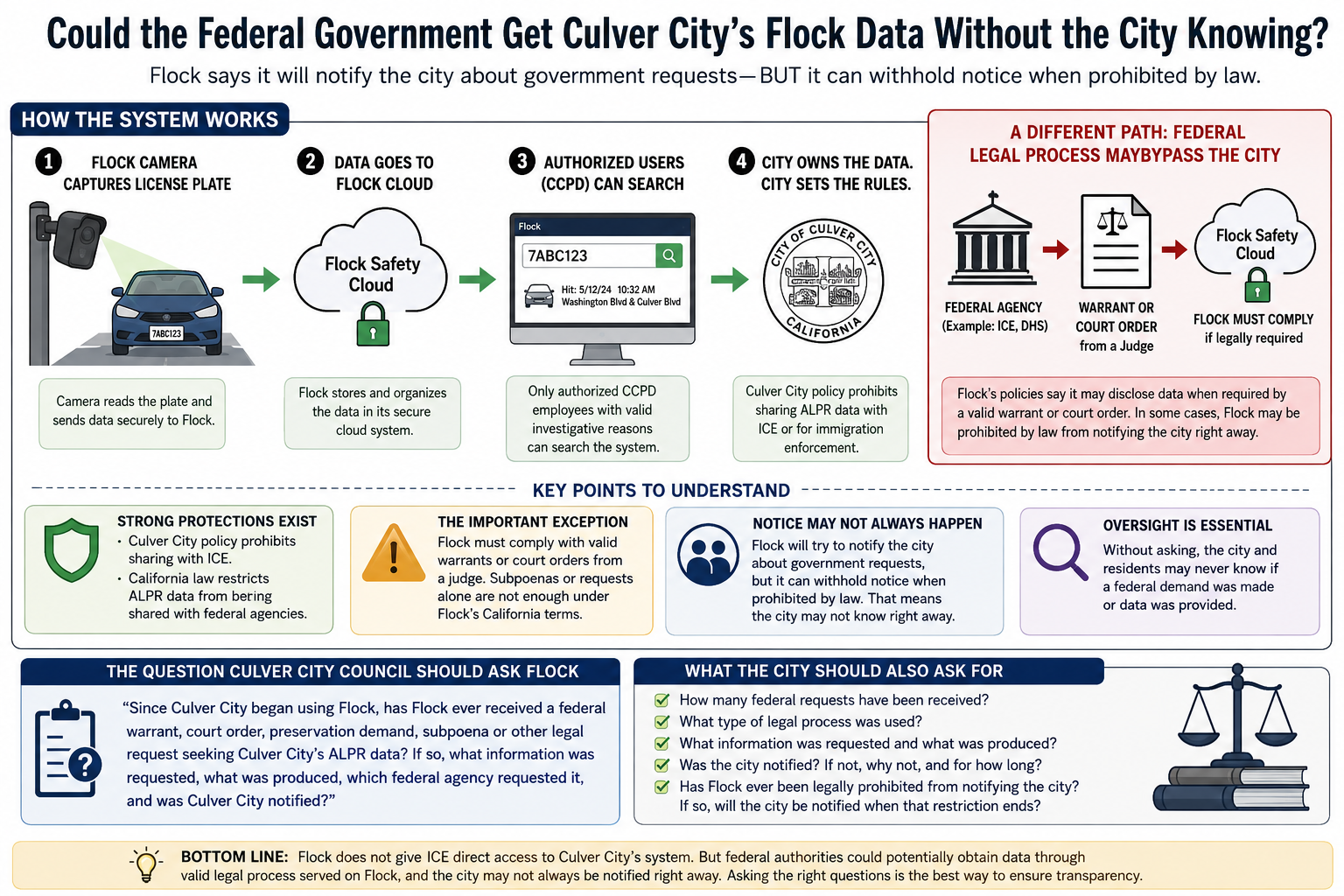
Many Culver City residents are concerned about Flock license plate cameras and immigration enforcement.
The obvious question is:
Can ICE access Culver City's Flock cameras?
But that may not be the most important question.
A better question is:
Could the federal government legally demand Culver City's Flock data directly from Flock—and could that happen without Culver City immediately knowing about it?
The answer is more complicated than a simple yes or no.
And Flock's own legal documents help explain why.
First, what is Flock?
Flock Safety operates automated license plate reader cameras, commonly called ALPRs.
When a vehicle passes one of these cameras, information about that vehicle can be captured and transmitted to Flock's cloud-based system.
Police departments can then use authorized accounts to search the system for vehicles as part of investigations.
Culver City uses Flock cameras.
But here is an important point:
The information isn't simply sitting on a computer inside the Culver City Police Department.
Flock operates the technology and cloud platform used to process and store the information.
That distinction becomes extremely important when discussing the federal government.
Culver City says it will not share this information with ICE
Culver City's policy is clear.
The Culver City Police Department's ALPR policy says its administrator will not share ALPR information with Immigration and Customs Enforcement, or ICE, or agencies conducting immigration-enforcement or removal operations.
California law also places significant restrictions on sharing ALPR information outside California.
Those are meaningful protections.
So the concern should not be presented as:
"Culver City is giving its Flock information to ICE."
There is no basis for making that accusation simply because Culver City operates Flock cameras.
The more interesting issue involves something entirely different.
What if the federal government doesn't ask Culver City?
Suppose a federal agency wants particular license-plate information.
Instead of asking:
CULVER CITY → "Give us the information."
what happens if the government goes directly to:
FLOCK → "Give us the information."
That distinction matters because Flock possesses and operates the technological platform.
And Flock has published policies explaining how it handles government demands for information.
Flock's own policy contains an important provision
Flock has what it calls an Evidence Policy.
That policy addresses government and law-enforcement requests for information.
Flock says that when it receives a government request, it will make reasonable efforts to notify the affected customer.
In Culver City's case, that customer could be the city or its police department.
That sounds reassuring.
But then comes the important exception.
Flock says customer notification can be withheld when notification is prohibited by law.
In very simple terms:
Flock generally says it will try to tell the customer about a government request.
But:
There may be legal circumstances in which Flock cannot immediately tell the customer.
That distinction deserves the public's attention.
Think about it like a bank
Imagine that you keep important documents in a bank's safe-deposit box.
You tell the bank:
"Do not voluntarily give my documents to the federal government."
The bank agrees.
That is meaningful protection.
But now imagine federal investigators obtain a valid court order requiring the bank to produce something.
That is a completely different situation.
The bank isn't voluntarily deciding to cooperate.
The government is using the legal system to compel it.
Now imagine the legal order also prevents the bank, at least temporarily, from telling you about the demand.
You could potentially have:
Federal government
↓
Legal process
↓
Private company holding the information
↓
Information produced pursuant to that process
while the owner of the information may not immediately know about the request.
That is the concern Culver City should examine.
Flock's California terms make this even more important
Flock also publishes special legal provisions applicable to California customers.
Those provisions provide substantial protections.
Among other things, Flock's California provisions contemplate disclosure when Flock is required to provide information pursuant to a qualifying warrant or court order issued by a state or federal judge or magistrate.
That is very different from giving ICE routine access to Culver City's Flock account.
But it also means we should be careful about making the absolute statement:
"The federal government can never obtain Culver City's Flock data."
The more accurate statement is:
Culver City prohibits voluntary sharing with ICE, and California law provides substantial additional protections. But those protections should not be confused with a guarantee that federal authorities could never obtain information through valid compulsory judicial process.
Does this mean ICE currently has access?
No.
This distinction is extremely important.
Nothing about these provisions establishes that ICE currently has direct access to Culver City's Flock system.
Nothing about them establishes that Flock has secretly provided Culver City's information to ICE.
And nothing about them establishes that such a federal request has ever occurred involving Culver City.
Those would be factual claims requiring evidence.
The concern is different:
Does a legal pathway potentially exist through which the federal government could seek information directly from Flock?
Flock's own policies indicate that compulsory legal process is something the company anticipates and has procedures for handling.
Why wouldn't Culver City necessarily know?
This may be the most important part.
Flock says it makes reasonable efforts to notify customers when government agencies seek their information.
But its Evidence Policy recognizes circumstances in which notification may be legally prohibited.
Therefore, there is at least a theoretical distinction between these two statements:
"Culver City didn't authorize the disclosure."
and
"No disclosure occurred."
Those statements are not necessarily equivalent.
Likewise:
"The City Council was never informed of a federal request."
does not necessarily prove:
"Flock never received a federal request."
That is why asking Flock directly becomes important.
This isn't necessarily a "loophole"
Calling this an "ICE loophole" could actually obscure the issue.
A loophole suggests somebody is secretly exploiting a mistake in the law.
A valid warrant or court order is different.
It is part of the judicial system.
If a federal judge issues a legally enforceable order requiring a private company to produce information, complicated questions can arise concerning federal authority, California privacy protections, the customer's contractual rights and the company's legal obligations.
The public deserves to understand that distinction.
The concern isn't necessarily:
"Flock has secretly built a backdoor for ICE."
The question is:
"What happens when federal legal authority meets a privately operated database containing information belonging to a California city?"
That is a much more serious and precise question.
The question Culver City should ask Flock
This issue can be addressed without speculation.
The Culver City Council can simply ask Flock.
And the question should be extremely specific:
Since Culver City began using Flock, has Flock ever received a federal warrant, court order, preservation demand, subpoena or other legal request seeking Culver City's ALPR data? If so, what information was requested, what information was produced, which federal agency requested it, and was Culver City notified?
Flock should also be asked:
Has Flock ever been legally prohibited from notifying Culver City about a government demand involving Culver City's information?
And:
If Flock cannot presently answer because a legal restriction prevents disclosure, will Flock notify Culver City when that restriction expires?
Those answers would tell residents far more than simply asking:
"Does ICE have access?"
Council should also ask for numbers
Culver City could ask Flock to provide a report showing:
the number of federal requests involving Culver City data;
the federal agencies making those requests;
the type of legal process used;
how many requests Flock challenged or rejected;
how many resulted in information being produced;
whether Culver City was notified;
how long any notification was delayed;
and whether Flock is presently prohibited from revealing any requests.
If legally permissible, that information could then be reported publicly.
There is an even bigger policy question
Culver City has considerable control over what Culver City employees do with the system.
The City Council can establish policies.
The police chief can restrict officers.
The city can prohibit sharing.
The city can audit police searches.
But once information exists on infrastructure operated by a private technology company, another question emerges:
What control does Culver City retain when Flock itself receives compulsory federal legal process?
That is the question that deserves an unequivocal answer.
The bottom line
Residents concerned about immigration enforcement should understand what we know—and what we don't know.
Culver City prohibits sharing its ALPR information with ICE for immigration enforcement.
That is important.
California provides significant additional legal protections for ALPR information.
That is also important.
There is no evidence presented here establishing that ICE currently has direct access to Culver City's Flock system.
But there is another issue that should not be ignored.
Flock's own policies contemplate government demands for customer information, including qualifying warrants and court orders. Flock also recognizes circumstances in which it may be legally prohibited from immediately notifying its customer about such a request.
That means the public discussion should move beyond:
"Does Culver City share Flock data with ICE?"
The next question should be:
"Has the federal government ever gone directly to Flock for Culver City's data?"
And if the answer is no, Culver City should obtain that answer directly from Flock, in writing.
If the answer is yes, residents deserve to know what happened to the fullest extent the law permits.
Because when a city entrusts sensitive information to a private technology company, good oversight requires understanding not only what the city can do with the information—but what can happen to that information outside the city's direct control.
0 Comments