
When voters are asked to approve a school bond, the number on the ballot can sound simple.
$40 million.
$106 million.
$358 million.
But what does that number actually mean?
Where does the money come from?
Who pays it back?
How much interest do we pay?
How long does the debt last?
And where can a Culver City property owner actually see the cost?
I decided to find out.
I started with my own property-tax bill and then looked at Culver City Unified School District's financial statements and bond records.
The answer is more complicated—and much more interesting—than simply saying, "The voters approved a $358 million bond."
First: What Is a Bond?
A bond is borrowed money.
Suppose CCUSD needs $80 million to renovate schools.
The District could try to save $80 million before beginning construction.
Or it can borrow the money.
One way a government borrows money is by selling bonds to investors.
The basic transaction looks like this:
Investors lend CCUSD money
↓
CCUSD receives money now
↓
CCUSD spends it on authorized school facilities
↓
Property owners pay additional property taxes
↓
Those taxes repay principal and interest
↓
Investors get their money back
The important word is interest.
If the District borrows $80 million, it doesn't necessarily repay only $80 million.
It repays the principal plus the cost of borrowing the money.
Principal vs. Interest
These two words appear constantly in bond documents.
Principal
The amount borrowed.
Interest
What the borrower pays investors for lending the money.
Think about a mortgage.
If you borrow $500,000 to buy a house, the $500,000 is the principal.
But over 30 years you will normally pay considerably more than $500,000 because you're also paying interest.
Government bonds operate on the same basic principle.
Who Pays CCUSD's General Obligation Bonds?
Property owners.
CCUSD's June 30, 2025 audited financial statements explain that its general-obligation bond liabilities are paid through property-tax collections administered by Los Angeles County.
For Measure CC specifically, the audit states that the bonds are payable from ad valorem property taxes.
"Ad valorem" simply means:
Based on property value.
More precisely, it means the property's taxable assessed value, which can be very different from its current market value.
The County is required to levy the additional property taxes necessary to pay the principal and interest when they become due.
So when voters approve a general-obligation school bond, the District receives borrowing authority.
Property owners provide the tax revenue used to repay that borrowing.
Culver City's School Bond History
CCUSD has several generations of school debt.
They overlap.
That means a property owner today can be helping repay debt associated with school financing undertaken many years ago while simultaneously beginning to pay debt from a newer bond.
Let's go through them.
Measure T — 1996
Culver City voters approved Measure T on November 5, 1996.
It authorized:
$40 million
in general-obligation bonds.
The money was intended to renovate and upgrade school facilities.
CCUSD issued the original Measure T bonds in three installments:
1997: $10 million
1998: $20 million
1999: $10 million
Those original bonds were later refunded.
What Does "Refunded" Mean?
It doesn't mean taxpayers received a refund.
In government finance, refunding generally means replacing existing debt with new debt.
It's similar to refinancing a mortgage.
In 2005, financing associated with the older bonds was restructured through the Culver City School Facilities Financing Authority.
The current CCUSD audit identifies the resulting:
Series 2005 Financing Authority Revenue Bonds.
Original issue:
$38.23 million
Interest rates:
3.75%–5.50%
Balance remaining as of June 30, 2025:
$19.745 million
Final maturity:
August 1, 2033
So financing connected to school facilities debt originating decades ago remains on CCUSD's books today.
Measure CC — 2014
Culver City voters approved Measure CC on June 3, 2014.
Measure CC authorized:
$106 million
in general-obligation bonds.
The money was authorized for repairing, upgrading, acquiring, constructing and equipping District facilities.
CCUSD ultimately issued the $106 million through three series.
Measure CC Series A
Issued:
$26.5 million
Interest rates:
2%–5%
Balance remaining June 30, 2025:
$16.085 million
Final maturity:
August 1, 2044
Measure CC Series B
Issued:
$53 million
Interest rates:
3.25%–5%
Balance remaining June 30, 2025:
$47.820 million
Final maturity:
August 1, 2043
Measure CC Series C
Issued:
$26.5 million
Interest rates:
3%–8%
Balance remaining June 30, 2025:
$23.465 million
Final maturity:
August 1, 2034
Add those together:
Original Measure CC bonds issued: $106 million
Principal still outstanding as of June 30, 2025:
$87.370 million
That's more than a decade after voters approved Measure CC.
And some of that debt extends until 2044.
Measure E — 2024
Then came Measure E.
Culver City voters approved Measure E in March 2024.
The measure authorized CCUSD to issue:
Up to $358 million in general-obligation bonds.
This is an important distinction.
CCUSD did not immediately borrow $358 million.
The voters authorized the District to borrow up to that amount.
The District can issue the bonds in separate groups, known as series.
The First Measure E Borrowing
CCUSD issued the first Measure E series on September 25, 2024.
Amount borrowed:
$80 million
CCUSD's Measure E Citizens' Bond Oversight Committee reports an overall interest rate of:
3.84%
The District's audited financial statements list the stated coupon rates on individual maturities as:
4%–5%.
Those aren't contradictory numbers. The 3.84% figure is the reported overall borrowing rate for the issuance, while individual bonds within the series carry stated coupon rates between 4% and 5%.
The final maturity is:
August 1, 2054.
So some of the first Measure E debt can remain outstanding for approximately 30 years from issuance.
And remember:
Measure E authorized $358 million.
Only:
$80 million
had been issued in this first series.
That means additional Measure E bonds can be issued later.
We cannot know today what interest rates those future bonds will carry because they haven't been sold yet.
What Do We Currently Owe?
CCUSD's June 30, 2025 audit gives us an unusually clear snapshot.
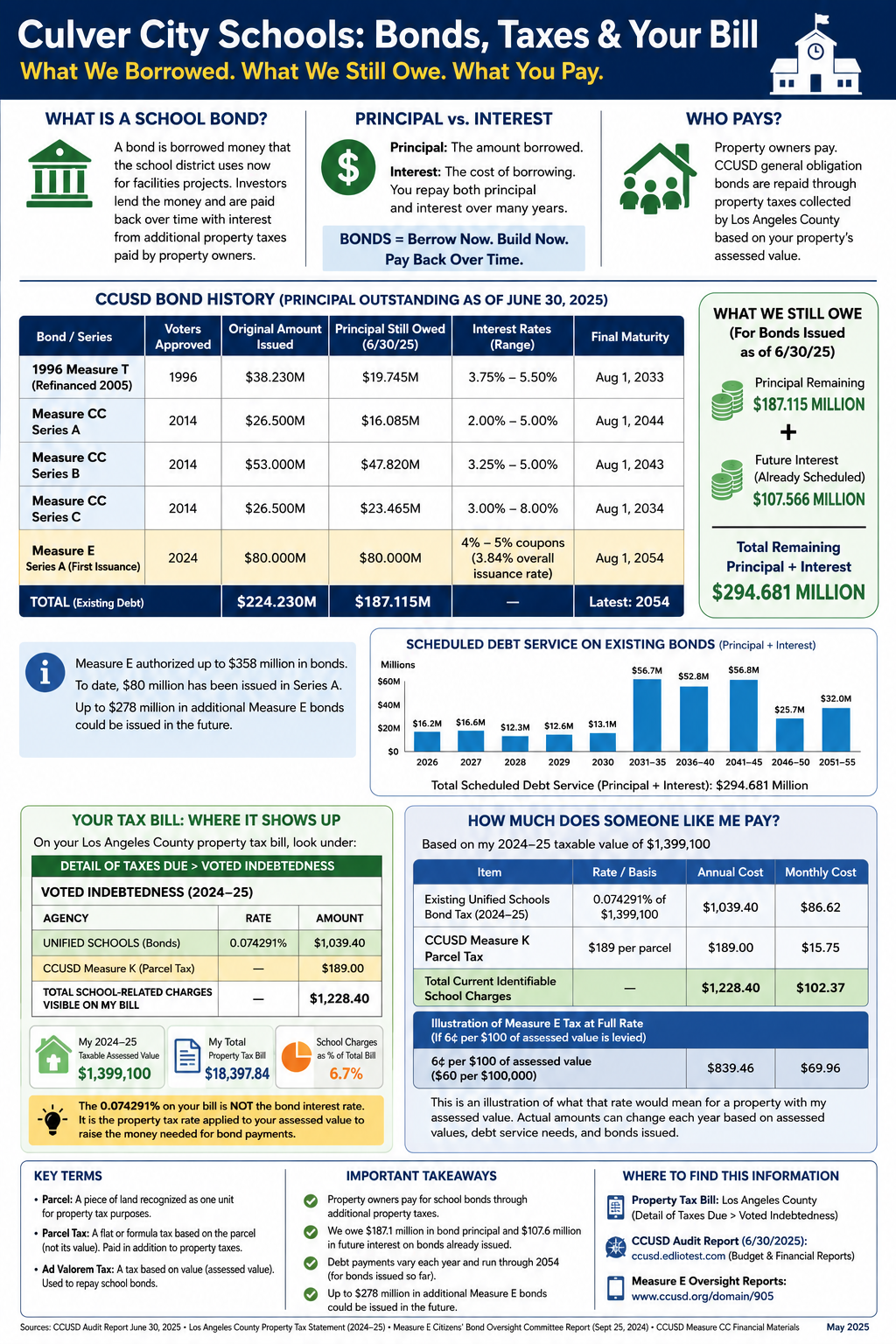
Outstanding CCUSD debtOriginal issuePrincipal still owed 6/30/25Interest rateFinal maturity2005 Financing Authority Bonds$38.230M$19.745M3.75%–5.50%2033Measure CC Series A$26.500M$16.085M2.00%–5.00%2044Measure CC Series B$53.000M$47.820M3.25%–5.00%2043Measure CC Series C$26.500M$23.465M3.00%–8.00%2034Measure E Series A$80.000M$80.000M4%–5% coupons; 3.84% reported issuance rate2054TOTAL$224.230M$187.115MVarious2054
These figures come directly from CCUSD's audited financial statements for June 30, 2025.
But $187 Million Isn't Everything That Still Has to Be Paid
This is where understanding principal and interest becomes important.
As of June 30, 2025, CCUSD reported:
Remaining principal
$187,115,000
But it also reported scheduled future interest of:
$107,565,952
Therefore, for the bonds already issued and reflected in that debt schedule:
Principal remaining: $187,115,000
Future interest: $107,565,952
Total scheduled remaining debt service:
$294,680,952
"Debt service" simply means:
Principal + interest payments on debt.
That $294.7 million does not mean CCUSD borrowed $294.7 million at that moment.
It means that, as of June 30, 2025, the existing bond schedule called for approximately $187.1 million of principal plus $107.6 million of future interest to be paid over time.
And this is before considering future Measure E bonds that had not yet been issued as of that date.
How Does the Debt Get Paid Over Time?
The payments aren't identical every year.
CCUSD's audit gives us the scheduled principal and interest for its existing bonds:
PeriodPrincipalInterestTotal debt service2026$8.640M$7.532M$16.172M2027$9.285M$7.341M$16.626M2028$5.280M$6.972M$12.252M2029$5.965M$6.683M$12.648M2030$6.710M$6.356M$13.066M2031–35$29.520M$27.140M$56.660M2036–40$31.565M$21.235M$52.800M2041–45$43.300M$13.486M$56.786M2046–50$17.950M$7.731M$25.681M2051–55$28.900M$3.090M$31.990MTOTAL$187.115M$107.566M$294.681M
This also demonstrates something important.
The debt payments don't simply increase every year.
They change.
For example, the scheduled total is about $16.2 million in 2026, $16.6 million in 2027 and $12.3 million in 2028.
Different bonds mature at different times.
Principal payments change.
Interest declines as debt is repaid.
And additional bonds can subsequently be issued.
How Do Property Owners Pay This?
This is where my own property-tax bill becomes useful.
My 2024–25 property-tax statement had a net taxable value of:
$1,399,100
Under the section:
VOTED INDEBTEDNESS
the bill shows:
UNIFIED SCHOOLS
Rate: 0.074291%
Amount: $1,039.40
That's the school voter-approved indebtedness line appearing on my actual bill.
The calculation is:
$1,399,100 × 0.074291% ≈ $1,039.40
So in fiscal year 2024–25, my property-tax bill charged:
$1,039.40
under the Unified Schools voter-approved indebtedness line.
Is 0.074291% the Bond Interest Rate?
No.
This is extremely important.
The:
0.074291%
on my property-tax bill is the property-tax rate applied to my assessed value.
It is NOT the interest rate CCUSD pays investors.
Those are two completely different rates.
For example:
My property-tax levy rate
0.074291%
determines how much tax I pay.
Meanwhile:
Measure E Series A
has individual stated bond interest rates of 4%–5%, with the oversight committee reporting a 3.84% overall issuance interest rate.
Those rates describe the cost of CCUSD's borrowing.
Where Do I Find the Bond Charge on My Property-Tax Bill?
Look under:
DETAIL OF TAXES DUE
Then:
VOTED INDEBTEDNESS
You'll see columns for:
AGENCY
RATE
AMOUNT
My statement says:
UNIFIED SCHOOLS | .074291 | $1,039.40
The bill doesn't say:
Measure CC Series A: $___
Measure CC Series B: $___
Measure E: $___
Principal: $___
Interest: $___
Instead, it provides the combined Unified Schools tax rate applicable in my tax-rate area.
That's why the property-tax bill alone doesn't tell the whole story.
To understand the underlying debt, you have to look at CCUSD's audited financial statements.
How Much Is Someone Like Me Paying?
Using my actual 2024–25 property-tax bill:
School-related charge visible on my billMy annual costUnified Schools — Voted Indebtedness$1,039.40CCUSD Measure K parcel tax$189.00Combined identifiable school bond/parcel-tax charges$1,228.40Average per month$102.37
My total property-tax bill was:
$18,397.84
So those two identifiable school-related lines represented about:
6.7% of my entire property-tax bill.
There is an important caveat: the tax statement labels the $1,039.40 line simply "UNIFIED SCHOOLS." It doesn't provide a bond-by-bond breakdown. Therefore, I can't truthfully say from the tax bill alone that a particular number of those dollars went to Measure CC versus Measure E.
What About Measure E Going Forward?
Measure E was presented with a levy limited to approximately:
6 cents per $100 of assessed value
which is another way of saying:
$60 per $100,000 of assessed value.
Using my 2024–25 taxable value of:
$1,399,100
a $60-per-$100,000 rate would work out to approximately:
$839.46 per year.
Or:
$69.96 per month.
But this is an illustration of what that rate would mean for a property with my assessed value.
It should not be added mechanically to my historical $1,039.40 bill and described as my actual current total. The Unified Schools rate can change, older bonds are being repaid, Measure E bonds are being introduced, assessed values change, and the County calculates the annual levy needed for the applicable debt.
Why Can My Bond Tax Change Every Year?
A bond's interest rate and a homeowner's property-tax rate are different things.
In simplified form, the annual property-tax rate depends on something like:
Required bond debt service
÷
Total taxable assessed value in the district
If CCUSD needs a certain amount for principal and interest, that amount must be raised across the taxable property base.
If Culver City's total assessed property value grows substantially, the cost can be spread across a larger tax base.
That's one reason a tax rate can decline.
CCUSD actually documented this with Measure CC.
The Measure CC tax rates were:
2014–15: $46.90 per $100,000 of assessed value
2015–16: $42.23
2016–17: $39.69
CCUSD explained that assessed values grew faster than originally projected.
So:
Bond taxes do not automatically increase every year.
They can increase or decrease depending on debt-service requirements, assessed valuation and additional bond issuance.
What Does a $358 Million Bond Really Mean?
This is perhaps the most important distinction.
Measure E authorized:
$358 million.
That is the amount of principal CCUSD is authorized to borrow, not the ultimate amount property owners necessarily repay.
The first issuance was:
$80 million.
Additional Measure E bonds can be issued later.
Each future series can have:
different interest rates,
different maturity dates,
different annual debt payments,
and different total interest costs.
Because those future bonds haven't all been issued yet, nobody can truthfully tell us today the exact final principal-and-interest cost of the entire $358 million authorization.
That will depend on the terms under which the remaining bonds are eventually sold.
The Complete Picture as of June 30, 2025
Here's the simplest summary I can make from CCUSD's audited financial statements:
Existing CCUSD bond principal outstanding
$187.115 million
Future interest scheduled on that existing debt
$107.566 million
Remaining principal + interest
$294.681 million
Latest final maturity among those issued bonds
2054
And:
Measure E authorization
$358 million
Measure E issued in Series A
$80 million
Remaining Measure E authorization not represented by Series A
$278 million
That does not mean CCUSD already owes another $278 million.
It means voters authorized additional borrowing that had not yet been issued in the Series A figures above.
Then There Is the Parcel Tax
And school bonds aren't the only school-related charge property owners pay.
My property-tax bill separately showed:
CCUSD Measure K — $189.
That was a parcel tax.
Measure O subsequently renewed the $189 annual school parcel tax.
A parcel tax and a bond tax work differently.
Parcel tax
Property owner pays tax → CCUSD receives annual revenue → money is spent for authorized educational purposes.
Bond
Investors lend money → CCUSD receives borrowed money → facilities are built or improved → property owners pay additional taxes over many years → investors receive principal and interest.
One is taxation providing current revenue.
The other involves borrowing followed by decades of repayment through taxation.
The Numbers in One Place
QuestionAnswerMy 2024–25 taxable assessed value$1,399,100My entire property-tax bill$18,397.84My "Unified Schools" voted-indebtedness charge$1,039.40My CCUSD Measure K parcel tax$189.00Combined identifiable school debt/parcel-tax lines$1,228.40/yearMonthly equivalent$102.37/monthCCUSD bond principal outstanding 6/30/25$187.115MFuture interest on issued debt schedule$107.566MRemaining principal + interest$294.681MMeasure E authorized$358MMeasure E Series A issued$80MMeasure E Series A reported overall interest rate3.84%Measure E Series A final maturity2054
Where Did I Get These Numbers?
I don't want readers to simply take my word for them.
The $1,039.40 Unified Schools charge, 0.074291% rate, $189 CCUSD Measure K charge, $1,399,100 taxable value and $18,397.84 total bill come directly from my Los Angeles County 2024–25 secured property-tax statement.
The outstanding principal, bond interest-rate ranges, issuance amounts, maturity dates and $107.566 million of scheduled future interest come from CCUSD's audited financial statements for the year ending June 30, 2025.
The 3.84% Measure E Series A overall interest rate comes from the Measure E Citizens' Bond Oversight Committee's semi-annual report.
The historical information on Measure CC's tax rates and repayment structure comes from CCUSD's own Measure CC financial materials.
What I Learned
A bond measure isn't simply:
"Should we spend $358 million on schools?"
Financially, the transaction is more accurately understood as:
Should we authorize CCUSD to borrow up to $358 million for the purposes specified in the measure and allow additional property taxes to be collected over many years to repay the resulting principal and interest?
That doesn't answer whether a particular bond is worthwhile.
Schools require buildings.
Buildings require repairs.
Roofs eventually fail.
Electrical systems become obsolete.
Classrooms need modernization.
Borrowing can allow a community to make major investments now rather than waiting decades to accumulate the cash.
But voters should understand both sides of the transaction.
There is the project side:
What are we getting?
And there is the financing side:
What are we borrowing?
What interest are we paying?
How much do we still owe?
How long will property owners be paying?
What taxes are property owners already paying for previous bonds?
Those aren't arguments for or against school improvements.
They're questions about understanding the bill.
And after going through my own property-tax statement, I think they're questions every property owner should be able to answer.
0 Comments