
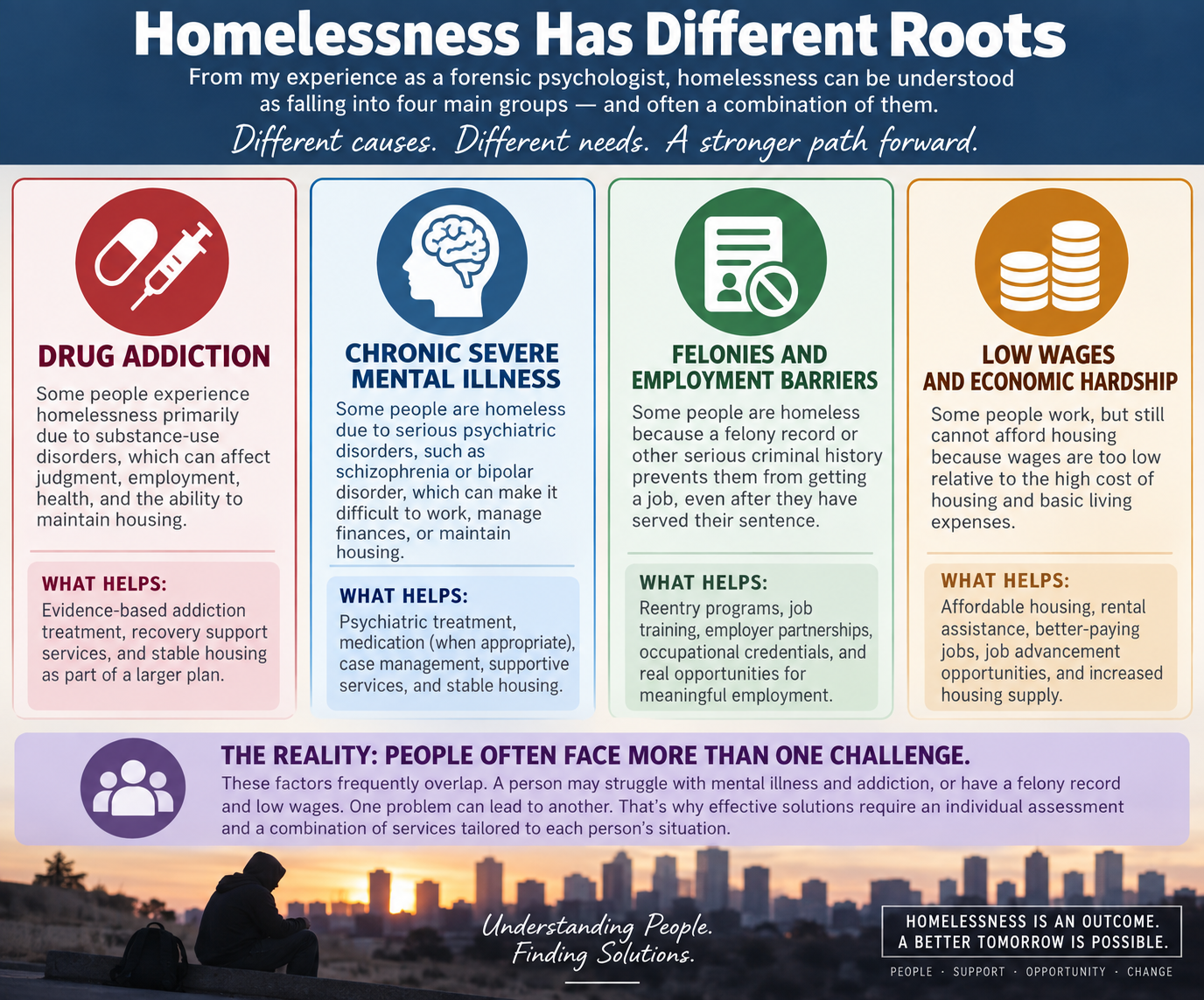
When politicians talk about homelessness, they often talk about “the homeless” as though everyone living on the street arrived there for the same reason.
My experience as a forensic psychologist has taught me something very different.
For more than a decade, I have worked with people involved in the criminal justice, correctional, medical, and mental-health systems. I have evaluated individuals with serious mental illness, substance-use disorders, criminal histories, trauma, and severe economic problems.
One lesson has stayed with me: homelessness is not a diagnosis. It is an outcome.
People can arrive at that outcome through very different paths.
In my experience, four major factors repeatedly appear, either individually or in combination:
Drug addiction and substance-use disorders
Chronic and severe mental illness
Felony records and other serious criminal histories that create barriers to employment
Low wages and economic hardship
The most important words are “and combinations.”
A person can have schizophrenia and a substance-use disorder. Another person may have a felony conviction, struggle to obtain employment, and eventually develop a drug problem. Someone else may work every day but simply not earn enough to afford housing.
They may all be homeless, but they do not have the same problem.
And therefore, they should not automatically receive the same solution.
Group 1: Drug Addiction
Some people experiencing homelessness have serious substance-use disorders.
For these individuals, simply providing an apartment may address where they sleep without adequately addressing the condition that is destabilizing their lives.
Addiction can affect judgment, employment, relationships, finances, physical health, and the ability to maintain housing.
That doesn't mean housing is unimportant. Stable housing can be an important part of recovery. But when addiction is a major driver of someone's homelessness, treatment has to be part of the conversation.
The goal should not simply be getting someone off one particular sidewalk.
The goal should be helping that person become sufficiently stable that they have a realistic chance of remaining housed.
Group 2: Chronic and Severe Mental Illness
This is the population I believe is especially important for the public to understand.
There is an enormous difference between experiencing ordinary emotional distress and living with a severe psychiatric disorder that substantially impairs a person's ability to function.
Some individuals suffering from serious mental illness may have difficulty maintaining employment, managing money, keeping appointments, taking medication consistently, maintaining relationships, or even recognizing that they are ill.
Housing alone cannot treat schizophrenia, bipolar disorder, severe psychosis, or another disabling psychiatric condition.
Again, housing may be part of the solution. But psychiatric treatment, medication when clinically appropriate, case management, benefits assistance, supportive services, and continuing supervision may also be necessary.
For some people, the appropriate intervention may need to be intensive and long-term.
Group 3: The Employment Barrier Created by a Felony Record
There is another population that receives considerably less attention.
Imagine someone who served a prison sentence and is released.
The sentence is supposedly over.
But then that person starts applying for jobs.
Application after application goes nowhere.
The individual may also have difficulty qualifying for housing. Without employment, savings disappear. Without a stable address, obtaining employment becomes even harder.
Eventually, the person may end up homeless.
Now we have created a vicious cycle:
Criminal record → difficulty finding work → insufficient income → housing instability → homelessness → even greater difficulty finding work.
If this is the primary problem, psychiatric treatment isn't necessarily the solution.
Neither is simply moving the person from one shelter to another.
The intervention needs to address employment.
That could mean job training, transitional employment, partnerships with employers willing to hire people with criminal histories, assistance obtaining occupational credentials, and programs that give people a genuine path back into the workforce.
If someone has completed their sentence and genuinely wants to work, society has an interest in making legitimate employment possible.
Group 4: Low Wages and Economic Homelessness
Then there is a very different person.
No psychosis.
No serious drug addiction.
No felony preventing employment.
The person works.
The problem is mathematics.
Rent is $2,000.
The person's income cannot support $2,000 rent plus food, transportation, utilities, healthcare, and every other basic expense.
That person may need an entirely different intervention: affordable housing, rental assistance, better-paying employment, job advancement, temporary financial assistance, or increased housing supply.
Sending this individual through intensive psychiatric or substance-abuse programs would make little sense if neither condition caused the homelessness.
Their primary problem is economic.
Most Real Cases Don't Fit Into Neat Boxes
This is where homelessness becomes considerably more complicated.
Human beings don't conveniently organize themselves according to government program categories.
Someone may have:
Mental illness + addiction.
Or:
Felony record + addiction + unemployment.
Or:
Low wages + mental illness.
Or:
Mental illness + criminal history + addiction + poverty.
And one problem can cause another.
A person with untreated mental illness may begin using drugs. Drug use may contribute to criminal behavior. A felony conviction may make employment difficult. Unemployment may lead to homelessness. Homelessness itself may then worsen both the psychiatric condition and substance use.
By the time government encounters that person on the street, we may be looking at the end of a chain that developed over many years.
Treating only the final symptom—homelessness—doesn't necessarily break that chain.
We Need Assessment Before Intervention
My clinical background strongly influences how I think government should approach this problem.
In psychology and medicine, we don't normally begin with treatment and figure out the diagnosis afterward.
We assess first.
Government should apply a similar principle.
When someone enters the homelessness system, we should be asking:
What caused this person's homelessness?
What is preventing this person from becoming housed today?
Is there a serious psychiatric disorder?
Is there a substance-use disorder?
Is there a criminal record interfering with employment?
Can the person work?
Is the person already working?
Is income simply too low relative to housing costs?
Are several of these problems occurring simultaneously?
Only then can we determine what combination of services is most likely to work.
Different Problems Require Different Solutions
That leads to a relatively simple framework.
If addiction is driving the homelessness: treatment and recovery services should be central.
If severe mental illness is driving it: psychiatric care and supportive services should be central.
If a criminal history is preventing employment: reentry and employment programs should be central.
If inadequate income is driving it: housing affordability and economic assistance should be central.
If several factors are present: the intervention needs to address several factors simultaneously.
Housing can be part of every one of those strategies.
But housing by itself should not become a substitute for understanding why someone became homeless and what is preventing that person from remaining housed.
Measure Outcomes, Not Good Intentions
There is one more lesson from my professional work that I would bring to government: measure whether the intervention actually worked.
It isn't enough to say how much money we spent.
If Culver City funds a homelessness program, residents should eventually be able to ask:
How many people entered the program?
What were their primary barriers?
How many were housed?
How many remained housed six months later?
How many remained housed one year later?
How many entered treatment?
How many obtained employment?
How many repeatedly returned to homelessness?
What did each successful outcome cost taxpayers?
Those questions are not attacks on homeless people or service providers.
They are how we determine whether our policies are actually helping people.
Compassion Requires Understanding the Individual
I don't believe compassion means pretending every homeless person has the same story.
I believe the opposite.
Real compassion requires taking someone's individual circumstances seriously enough to understand why that particular human being is homeless.
A person suffering from schizophrenia deserves appropriate psychiatric treatment.
A person struggling with addiction deserves a meaningful opportunity for recovery.
A person who completed a prison sentence and wants to rebuild his or her life deserves a realistic opportunity to work.
And someone working full time but unable to afford housing deserves an economic policy that recognizes that reality.
Those are different people.
They have different needs.
And sometimes they are the same person experiencing several problems at once.
That is what my experience as a forensic psychologist has taught me about homelessness.
We should stop treating homelessness as one problem requiring one ideological solution.
We should identify the causes, treat the causes, measure the results, and change course when the evidence tells us something isn't working.
That is how clinical decision-making should work.
And it is how I believe good local government should work.
0 Comments