
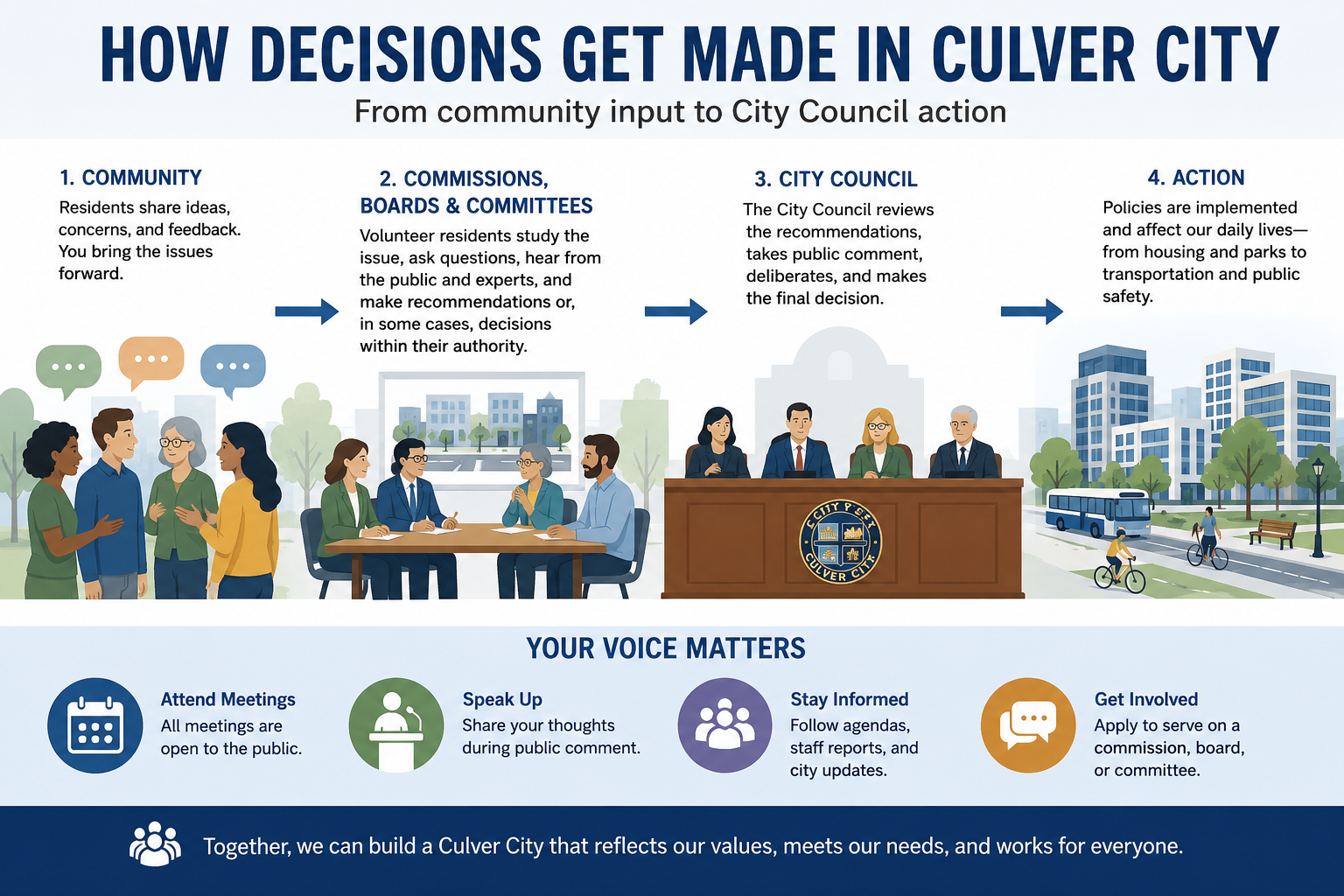
How Local Government Decisions Are Made
Many of the decisions that affect our daily lives don't start with the City Council. They often begin with volunteer residents serving on commissions, boards, and advisory committees.
These groups study issues, hear from the public, ask questions, and make recommendations before many important topics reach the City Council. In some cases, they also make certain decisions themselves.
Think of them as the City's research and public input teams.
The City Council still has the final say on most policy decisions, but these groups play an important role in shaping what reaches the Council.
What Do They Do?
Each group focuses on a different area of city government.
For example:
Planning Commission – Reviews housing, zoning, development projects, and land-use policies.
Finance Advisory Committee – Reviews budget and financial issues and makes recommendations.
Parks, Recreation & Community Services Commission – Advises on parks, recreation programs, and community services.
Their meetings are open to the public, and residents are encouraged to attend, speak, and participate.
Commissions, Boards, and Advisory Committees: What's the Difference?
You may hear terms like Commission, Board, or Advisory Committee at City Hall. While they each serve a different purpose, they all provide opportunities for residents to help shape the future of our city.
A Commission is a permanent body created by the City Council to focus on an important area of city government, such as planning, parks, or cultural affairs. Commissioners are volunteer residents appointed by the City Council after submitting an application and participating in a public appointment process. They typically serve fixed terms and are expected to attend meetings, review staff reports, listen to community members, and make informed recommendations. Depending on state law and the City's Municipal Code, some commissions also have authority to make certain decisions themselves. For example, the Planning Commission reviews development proposals, zoning changes, and land-use policies before many of those issues are considered by the City Council.
A Board is similar to a commission but usually has a more specialized responsibility. Some boards hear appeals, resolve disputes, or oversee a specific function of city government. Board members are also appointed through a public process, although some boards are made up of members already serving on another commission. For example, Culver City's Board of Zoning Adjustment is composed of Planning Commissioners selected to hear certain zoning matters.
An Advisory Committee studies a particular issue, gathers public input, and provides recommendations to the City Council. Unlike some commissions or boards, advisory committees generally do not make final decisions or establish City policy. Their role is to bring expertise, community perspectives, and thoughtful recommendations to elected officials. Examples include the Finance Advisory Committee, which reviews budget priorities, and the Bicycle and Pedestrian Advisory Committee, which recommends improvements to transportation safety and mobility.
Regardless of the title, these groups are made up of residents who volunteer their time because they care about Culver City. They bring different backgrounds, experiences, and perspectives to the table, helping ensure that community voices are heard before important decisions are made.
Serving on one of these bodies is one of the most direct ways residents can participate in local government. When vacancies occur, the City invites residents to apply. Applicants are interviewed, and the City Council appoints members during a public meeting after considering each person's experience, interests, and commitment to serving the community.
A Simple Example
Imagine someone wants to build a five-story apartment building near your neighborhood.
Before the City Council considers changing the zoning rules, the proposal might first go to the Planning Commission.
The Commission would:
Review the proposal.
Hear from city staff.
Listen to residents who support and oppose the project.
Ask questions about traffic, parking, environmental impacts, neighborhood compatibility, and housing needs.
Vote on whether to recommend approval, denial, or changes to the proposal.
The City Council would then review the Planning Commission's recommendation, hear additional public comments, discuss the issue, and make the final policy decision.
Some residents might support the project because it provides new housing, creates jobs, and brings more customers to local businesses.
Others may have concerns about increased traffic, parking availability, building height, or changes to the character of the neighborhood.
Both perspectives are valid, and part of good local government is carefully considering all viewpoints before making a decision.
Why This Matters
Whether the issue is housing, public safety, parks, transportation, climate action, or the city budget, these public meetings are where ideas are discussed, questions are asked, and recommendations are developed before many important decisions are made.
The people serving on these commissions, boards, and advisory committees are your neighbors. They volunteer their time to review information, listen to residents, consider expert staff recommendations, and weigh different perspectives before making recommendations—or, in some cases, decisions within their authority.
Every decision involves tradeoffs. A policy that benefits one group may create concerns for another. For example, approving new housing can help address affordability and support local businesses, while nearby residents may worry about traffic, parking, or neighborhood character. Expanding bike infrastructure may improve safety for cyclists and pedestrians, while some drivers may be concerned about changes to traffic flow or parking.
Good government isn't about making everyone happy—because that's rarely possible. It's about making thoughtful, transparent decisions after listening to the community, carefully considering the facts, and balancing competing public interests in a way that serves the long-term well-being of Culver City.
That is why public participation matters. Whether you support or oppose a proposal, attending meetings, speaking during public comment, submitting written comments, or simply staying informed helps ensure that decision-makers hear the full range of community perspectives before acting.
My Commitment
If elected to the Culver City Council, I will:
Listen first. Every resident deserves to be heard, even when we disagree.
Promote transparency. I will explain not only what decisions are made, but why they are made.
Respect the public process. I will value the work of our commissions, boards, and advisory committees while recognizing the City Council's responsibility to make the final decisions.
Encourage civic participation. Strong communities are built when residents stay informed, volunteer, and engage with their local government.
Focus on long-term solutions. Every decision should be guided by facts, fiscal responsibility, and what's best for the future of Culver City.
Local government works best when it works with the community. My goal is to ensure that every resident has the opportunity to participate, every voice is respected, and every decision is made openly, thoughtfully, and in the best interests of Culver City.
0 Comments