
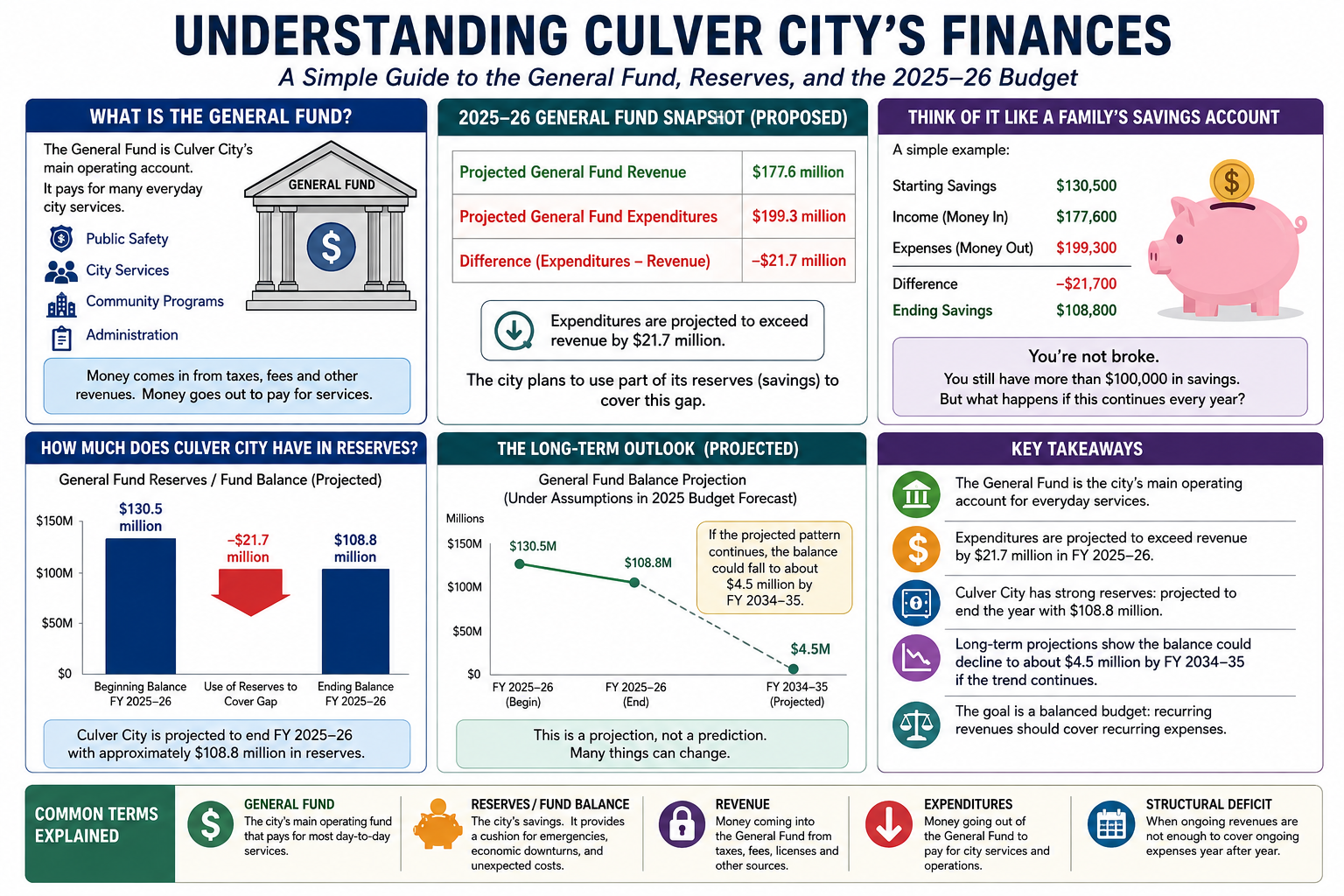
Culver City is facing an important financial question.
During its proposed 2025–26 budget discussions, the city projected that General Fund expenditures would exceed General Fund revenues. City financial officials also warned that the existing level of expenditures was not sustainable.
But what does that actually mean?
Terms such as General Fund, reserves, revenues, expenditures, fund balance, structural deficit, pension liabilities, and restricted funds can make a city budget almost impossible for the average person to understand.
So let's translate Culver City's finances into everyday language.
First: What Is the General Fund?
Think of the General Fund as the city's main operating checking account.
It is the primary pool of money Culver City uses to pay for many everyday government operations and services.
Money comes into the General Fund from sources such as taxes, fees, licenses, and other revenues.
Money then goes out to pay for city operations and services.
Culver City has many different funds, and this distinction matters because not all city money can simply be spent on whatever the City Council wants.
Some money is legally restricted or designated for particular purposes.
So when you hear:
"General Fund revenue"
think:
Money coming into the city's main operating fund.
When you hear:
"General Fund expenditures"
think:
Money being spent from that fund.
What Is Revenue?
Revenue is simply money coming in.
For an individual, revenue might be your salary.
For a business, it might be money received from customers.
For a city, revenue can come from sales taxes, property-related revenues, business taxes, fees, permits, licenses, charges for services, and other sources.
For the proposed 2025–26 budget, Culver City projected approximately:
$177.6 million in General Fund revenue.
That's the money the city expected to flow into its primary operating fund during the fiscal year.
What Are Expenditures?
Expenditures are the opposite.
They are money going out.
Employee compensation costs money.
Police and fire services cost money.
Government programs cost money.
City contracts cost money.
Maintaining facilities costs money.
Pension obligations cost money.
The basic equation is therefore remarkably simple:
Money In – Money Out = Surplus or Deficit
Government accounting becomes much more complicated, but this basic concept is useful for understanding the city's financial position.
Now Look at Culver City's Numbers
For the proposed 2025–26 budget, Culver City projected approximately:
General Fund revenue: $177.6 million
General Fund expenditures: $199.3 million
The difference is approximately:
$21.7 million.
In other words, proposed General Fund expenditures were approximately $21.7 million greater than projected General Fund revenue.
So how can the city spend $199.3 million when only $177.6 million is projected to come in?
That's where the city's reserves and fund balance become important.
What Are Reserves?
The easiest way to understand reserves is to think of them as the city's savings account.
Suppose you earn $100,000 this year but spend $110,000.
You're short $10,000.
If you have $50,000 in savings, you can withdraw $10,000 and pay all your bills.
You aren't broke.
You haven't defaulted on anything.
But your savings have dropped from:
$50,000 to $40,000.
That's roughly the concept behind using government reserves or accumulated fund balance to cover a budget shortfall.
How Much Does Culver City Have in Reserves?
This is an extremely important part of the story because Culver City entered this period with a substantial financial cushion.
For the proposed FY 2025–26 budget, the city's General Fund was projected to begin with approximately:
$130.5 million in fund balance/reserves.
The proposed budget projected:
$177.6 million coming in
and
$199.3 million going out.
That created the approximately:
$21.7 million gap.
If that difference were covered by the General Fund balance as projected, the city estimated that it would finish FY 2025–26 with approximately:
$108.8 million remaining.
So let's make one thing very clear:
Culver City was not broke.
In fact, a General Fund balance of more than $100 million represented a substantial financial cushion.
The concern was not simply how much money Culver City had.
The concern was the direction in which those numbers were moving.
Think of the City's Situation Like a Family's Savings Account
Imagine a family begins the year with:
$130,500 in savings.
The family earns:
$177,600.
But it spends:
$199,300.
The family therefore needs approximately:
$21,700 from savings.
At the end of the year, it still has:
$108,800.
Is that family broke?
Of course not.
It still has more than $100,000 in savings.
But there is another question that matters much more:
Will the family have to take another $21,700 out next year?
And another amount the following year?
That's where a manageable short-term deficit can become a serious long-term problem.
The $4.5 Million Number
This is why Culver City's longer-term forecast deserves attention.
During the 2025 budget discussion, the city's financial forecast showed that the General Fund balance could potentially decline to approximately:
$4.5 million by FY 2034–35
if the assumptions and projected financial trajectory continued without significant changes.
That does not mean Culver City will definitely have only $4.5 million in 2035.
A ten-year financial forecast is a projection, not a guarantee.
Many things can change.
Revenue can increase.
The economy can grow.
Expenses can be reduced.
Programs can change.
Taxes can change.
Development can generate additional revenue.
Labor and pension costs can change.
Or economic conditions could become worse.
The value of a long-term forecast is that it asks:
If we continue along the projected path, where might we end up?
The city's answer was concerning enough that its chief financial officer warned that the existing expenditure level was not sustainable.
But Does Culver City Really Have $108.8 Million Available to Spend?
Not necessarily.
This is another important distinction.
When someone hears:
"The city has $108.8 million remaining."
the natural reaction might be:
"Then what's the problem? We have $108.8 million to spend."
Government accounting doesn't work quite that way.
A fund balance can include money that is restricted, committed, assigned, or otherwise designated for particular purposes.
The city also needs reserves to protect itself from emergencies and economic downturns.
So readers should not automatically interpret a $108.8 million General Fund balance as:
"$108.8 million sitting around waiting for politicians to spend."
The more useful question is how much of that money is genuinely available for discretionary purposes while still maintaining prudent reserves and meeting existing obligations.
Why Does a City Need Savings?
Cities need reserves for many of the same reasons families and businesses maintain emergency funds.
Imagine a recession hits California.
Tax revenue could fall.
Or imagine Culver City experiences a major earthquake.
Or an expensive infrastructure failure.
Or an unexpected lawsuit.
Or another emergency.
Police officers still need to be paid.
Fire services still have to operate.
Infrastructure still has to function.
City government cannot simply close until revenue improves.
Reserves provide a financial cushion against those events.
Having substantial reserves is therefore generally a good thing.
The concern isn't that Culver City has reserves.
The question is why they are being used and whether the rate at which they are being used is sustainable.
Is Using Reserves Bad?
Not necessarily.
This distinction is critical.
Using reserves isn't automatically irresponsible.
Suppose Culver City has to spend $10 million rebuilding infrastructure after an earthquake.
Using reserves could make perfect sense.
Or suppose the city saves money for years to construct a major public facility.
Eventually spending those accumulated funds may be exactly what the money was intended for.
The concern becomes greater when reserves are repeatedly needed to pay for ongoing operating expenses.
Why?
Because those expenses come back next year.
And the following year.
And the year after that.
One-Time Expenses vs. Ongoing Expenses
This may be one of the most important concepts in government budgeting.
Imagine you earn $100,000 annually.
One year, your roof breaks and you spend $15,000 replacing it.
Your expenses that year become $115,000.
You take $15,000 from savings.
That's not necessarily alarming because you don't expect to replace the roof every year.
That's a one-time expense.
Now imagine instead that you permanently increase your normal lifestyle expenses to $115,000 while continuing to earn $100,000.
That's very different.
Every year you have to find another $15,000.
That's an ongoing expense.
Cities face exactly the same distinction.
A construction project may represent a one-time expense.
Hiring permanent employees, establishing continuing programs, signing recurring contracts, and assuming continuing obligations can create expenses that return year after year.
Those expenses eventually require recurring revenue.
What Is a Structural Deficit?
This brings us to another intimidating government term:
Structural deficit.
The concept is actually simple.
A structural deficit generally means that a government's ongoing revenues aren't sufficient to cover its ongoing expenditures.
Imagine earning $100,000 every year while your normal expenses are $110,000.
Your problem isn't an unexpected emergency.
The basic structure of your finances doesn't balance.
Savings can temporarily cover that difference.
They cannot permanently solve it.
Eventually, you have to:
earn more, spend less, or exhaust your savings.
Government faces essentially the same mathematical reality.
Culver City Isn't Broke — And That's an Important Distinction
Saying Culver City faces financial constraints does not mean Culver City is broke.
Those are completely different statements.
A family with $200,000 in savings isn't broke simply because it spends more than it earns during one particular year.
Likewise, a government can have significant reserves while simultaneously facing an unsustainable long-term financial trajectory.
The important question isn't simply:
"How much money does Culver City have today?"
It's:
"How quickly is money coming in compared with how quickly money is going out?"
And:
"What happens if that difference continues?"
Why Long-Term Projections Matter
Looking at a single year doesn't tell the entire story.
Imagine someone has $100,000 in the bank.
That sounds financially secure.
Now imagine discovering that person is withdrawing $20,000 every year to cover ordinary living expenses.
Suddenly the same $100,000 looks very different.
That's why Culver City's long-term forecast matters.
The proposed FY 2025–26 budget projected approximately $21.7 million in General Fund reserve/fund-balance usage.
At the same time, the longer-term forecast showed the General Fund balance potentially declining to approximately $4.5 million by FY 2034–35 under the assumptions presented at the time.
Again, that forecast is not destiny.
It is a warning system.
It tells policymakers and the public what could happen if the underlying financial trajectory isn't changed.
What Are Restricted Funds?
Here's another source of confusion.
Someone might look at Culver City's entire budget and ask:
"If the city has money elsewhere, why can't it simply move that money into the General Fund?"
Because government money frequently comes with restrictions.
Imagine someone gives you $10,000 but legally requires you to spend it repairing your roof.
Technically, you have another $10,000.
But you can't use it to buy groceries.
Government funds can operate similarly.
Certain revenues may be restricted or designated for transportation, housing, infrastructure, grants, capital projects, or other specific purposes.
That's why simply adding up all the money associated with city government can create a misleading picture of how much is actually available for everyday operations.
What Is a Pension Liability?
Another important concept readers will encounter is pension obligations.
City employees can earn retirement benefits.
Those benefits create financial obligations extending many years into the future.
California cities participate in retirement systems such as CalPERS.
The city therefore isn't simply paying today's employees.
It must also account for retirement obligations associated with employee service.
When pension costs increase, they can put significant pressure on future city budgets.
This is another reason municipal finances need to be examined over many years rather than simply looking at today's bank balance.
Why Can't the City Just Raise Taxes?
Increasing revenue is one possible response to a budget imbalance.
But additional revenue and expenditure control are two sides of the same equation.
Remember:
Revenue – Expenditures = Surplus or Deficit
There are fundamentally three ways to deal with an imbalance:
Increase revenue.
Reduce expenditures.
Use reserves.
A government can also use some combination of all three.
The difficult public-policy question is determining the appropriate balance.
Why Can't the City Just Cut Spending?
That's not as simple as it sounds either.
Government expenditures aren't one giant pile of optional spending.
The city has employees, contracts, public-safety responsibilities, infrastructure obligations, pension commitments, facilities, programs, and legal responsibilities.
Some expenditures can be changed relatively quickly.
Others cannot.
And spending reductions have consequences.
Eliminating a program saves money, but residents who use the program lose the service.
Reducing staffing saves money, but it can affect government operations.
Delaying infrastructure maintenance may save money today but potentially create larger expenses later.
Responsible budgeting therefore isn't simply about spending less.
It's about determining which expenditures provide sufficient public value to justify their cost.
The Most Dangerous Phrase in Government May Be: "It's Only $250,000"
A $100,000 program doesn't sound particularly significant when you're discussing a budget involving hundreds of millions of dollars.
Neither does $250,000.
Neither does $500,000.
But government spending accumulates.
Ten $250,000 commitments become:
$2.5 million.
And the bigger issue is whether those commitments happen once or repeat every year.
A $500,000 one-time project is fundamentally different from a $500,000 annual program.
Over ten years, that annual program could represent $5 million before accounting for inflation or increasing costs.
That's why every major new proposal should answer:
How much does this cost today?
How much will it cost every year?
Where will the money come from?
Is the funding temporary or permanent?
What measurable result are we getting?
What happens when the original funding disappears?
Measure Results, Not Intentions
This is particularly important when money is limited.
Government programs shouldn't be evaluated simply by how much money was allocated to them.
Suppose Culver City spends $10 million addressing a problem.
The important question isn't:
"Did we spend $10 million?"
It's:
"What did the public receive for that $10 million?"
If money is spent addressing homelessness, measure outcomes.
If money is spent on affordable housing, calculate the cost and number of units produced.
If money is spent on transportation, measure usage and results.
If a new program is created, establish measurable objectives.
Public money should produce measurable public benefits.
Five Questions Every Major Program Should Answer
City budgeting can become much easier to understand if every significant program is evaluated using the same questions:
1. How much does it cost?
2. Is the expense one-time or recurring?
3. Where does the money come from?
4. What measurable result does the program produce?
5. Can the city afford to continue paying for it?
Those questions should apply whether someone personally supports or opposes the program.
Give the Public a Simple Financial Dashboard
Culver City's financial information is publicly available, but government budget documents can be intimidating.
Imagine instead a simple online dashboard showing:
MONEY COMING IN
General Fund revenue
MONEY GOING OUT
General Fund expenditures
THE DIFFERENCE
Annual surplus or deficit
MONEY IN SAVINGS
General Fund reserves/fund balance
HOW MUCH OF THE SAVINGS IS AVAILABLE
Unrestricted versus restricted or committed funds
LONG-TERM OBLIGATIONS
Pensions and other major liabilities
FUTURE OUTLOOK
Projected General Fund balance in 1, 5 and 10 years
Then allow readers to click each number to see exactly where it came from.
Government finances shouldn't require an accounting degree to understand.
Here's the Entire Issue in One Example
Imagine a family beginning the year with:
$130,500 in savings.
The family earns:
$177,600.
The family spends:
$199,300.
That leaves a difference of:
–$21,700.
The family uses savings to cover it.
Its savings fall to:
$108,800.
There is no immediate crisis.
The family still has substantial savings.
But now imagine its financial adviser projects that, if the pattern continues, the savings account could eventually decline to only a few thousand dollars.
The question is no longer:
"Do we have enough money to pay our bills today?"
The question becomes:
"What do we need to change so we can continue paying our bills tomorrow?"
That is the fundamental financial issue Culver City faces.
Follow the Trend, Not Just the Bank Balance
The numbers from the proposed FY 2025–26 budget can be summarized very simply:
Projected General Fund revenue: approximately $177.6 million
Projected General Fund expenditures: approximately $199.3 million
Projected difference: approximately –$21.7 million
Projected beginning General Fund balance/reserves: approximately $130.5 million
Projected ending General Fund balance/reserves: approximately $108.8 million
Long-term projected General Fund balance by FY 2034–35 under the forecast presented at the time: approximately $4.5 million
None of these numbers, standing alone, tells the entire story.
Culver City wasn't broke.
It had substantial reserves.
Using reserves isn't inherently bad.
And a single year in which expenditures exceed revenues doesn't automatically mean a financial crisis.
The important questions are about the trend:
Are recurring revenues keeping pace with recurring expenses?
Are reserves increasing or decreasing?
Why are reserves being used?
How much of the fund balance is actually available?
Are today's spending decisions creating continuing obligations?
What does the five- or ten-year forecast show?
Culver City has significant resources and a substantial economic base.
But those advantages don't eliminate the basic mathematics of municipal finance.
A city can use savings to deal with temporary problems.
It cannot indefinitely use savings to pay for a permanent gap between recurring revenue and recurring spending.
Understanding that distinction is the first step toward having an informed conversation about Culver City's financial future.
0 Comments