
When people hear politicians discussing housing laws such as SB 79, the conversation usually involves phrases like “transit-oriented development,” “density,” “FAR,” and “upzoning.”
Most people don't talk that way.
So I decided to ask a much simpler question:
What does SB 79 actually mean for a real residential property in Culver City?
I used a property on Wesley Street as an example.
The answer surprised me.
First, I Asked the City
I contacted Culver City's Planning & Development Department to determine whether the property was affected by SB 79.
The City confirmed:
“The address is within the ¼ mile boundary for SB 79.”
The City also directed me to Culver City's new Section 17.400.116 — Transit-Oriented Housing Development Projects, along with the City's RMD multifamily standards, supplemental multifamily standards, Objective Design Standards, and SB 79 implementation ordinance.
Rather than stopping there, I read the ordinance.
Here is what I found.
An R2 Property Can Be Treated Very Differently Under SB 79
This particular property is in an R2 residential zone.
Ordinarily, when most people hear “R2,” they think of relatively small-scale residential development.
But Culver City's SB 79 implementation ordinance specifically makes a qualifying Transit-Oriented Housing Development Project a permitted use in R2 zones within the designated transit areas.
And the development standards can be dramatically different from what residents might associate with an R2 neighborhood.
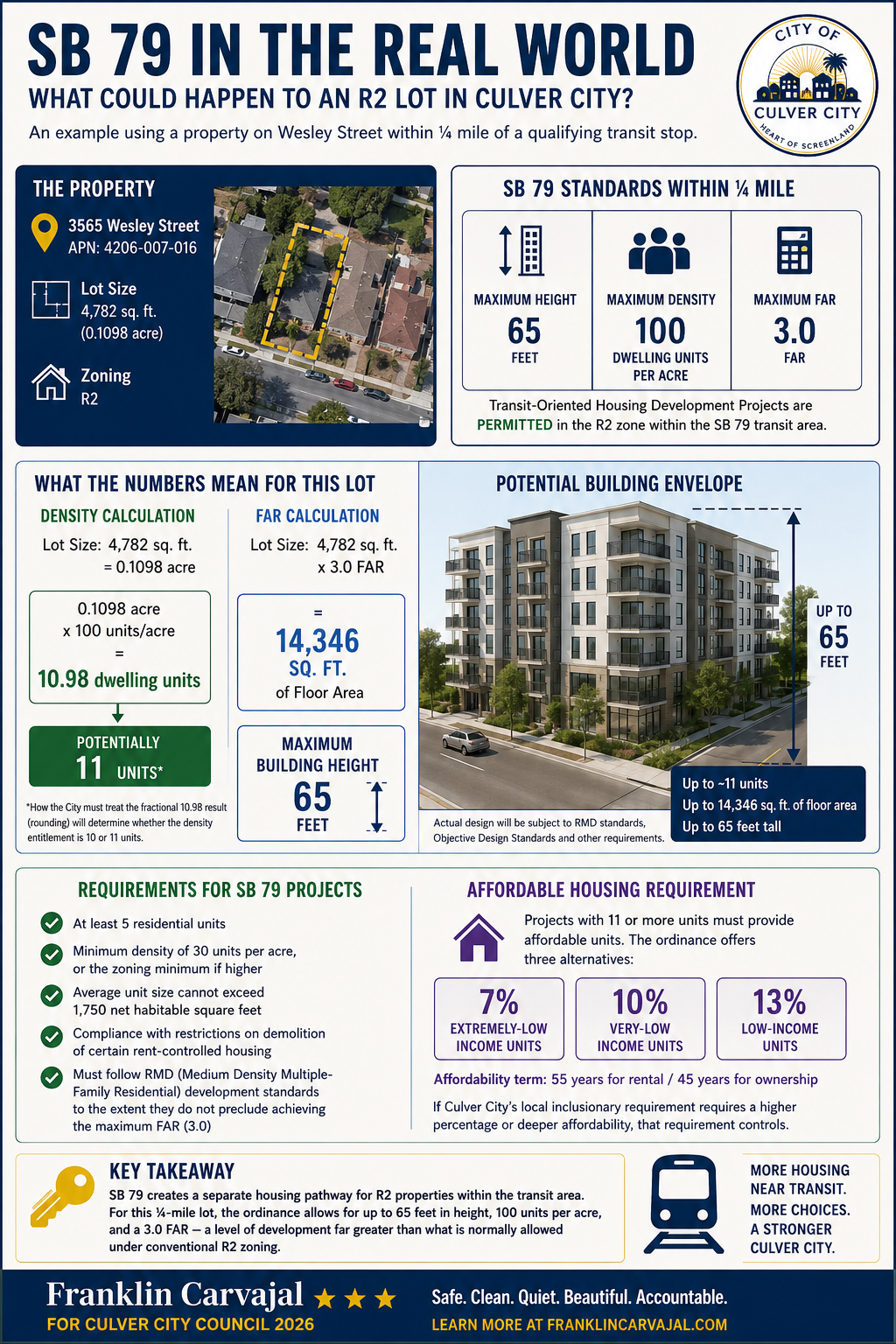
Within ¼ Mile: 65 Feet, 100 Units Per Acre and 3.0 FAR
Culver City's ordinance contains a table showing what can be permitted depending upon the property's distance from a qualifying transit stop.
For a property within ¼ mile, the ordinance establishes:
Maximum building height: 65 feet
Maximum residential density: 100 dwelling units per acre
Maximum residential FAR: 3.0
The ordinance goes even further for properties within 200 feet of a qualifying stop: up to 85 feet, 140 units per acre and a 4.0 FAR.
Those are substantial numbers.
What Does That Mean on an Actual Lot?
Let's use an approximately 4,782-square-foot lot as an example.
There are 43,560 square feet in an acre.
So:
4,782 ÷ 43,560 = approximately 0.1098 acre
SB 79 allows a maximum density of 100 dwelling units per acre within this ¼-mile area.
That produces:
0.1098 × 100 = 10.98 dwelling units
In other words, the density calculation comes extremely close to 11 units on a lot of less than 5,000 square feet.
There is an important caveat: I have not yet established how the applicable law requires Culver City to treat the fractional 10.98 result. Therefore, I am not claiming that the property has an automatic entitlement to exactly 11 units.
But the calculation itself illustrates the magnitude of the change.
Then There Is FAR
“FAR” means Floor Area Ratio.
It's one of those planning terms that sounds complicated but is fairly simple.
A 3.0 FAR means that the amount of qualifying building floor area can generally equal three times the lot area, subject to how the applicable code defines and calculates floor area and the other development standards.
For this approximately 4,782-square-foot lot:
4,782 × 3.0 = 14,346 square feet
So the SB 79 maximum FAR corresponds to approximately 14,346 square feet of floor area.
And the maximum building height established by the ordinance for the ¼-mile category is 65 feet.
Think about that for a moment.
We're talking about an R2 lot of less than 5,000 square feet.
There Are Important Restrictions
This does not mean somebody can simply walk into City Hall tomorrow and say:
“I want an 11-unit, 65-foot building.”
SB 79 projects have requirements.
Under Culver City's ordinance, a qualifying Transit-Oriented Housing Development Project must contain at least five residential units.
It must generally have a minimum density of 30 dwelling units per acre, or the applicable zoning minimum if higher.
The average residential unit cannot exceed 1,750 net habitable square feet.
There are also restrictions involving the demolition of certain rent-controlled housing.
And because this example involves an R2 property, Culver City's ordinance says the project generally follows development standards from the City's RMD — Medium Density Multiple-Family Residential — zone.
That can involve things such as setbacks, upper-floor stepbacks, open space and other multifamily development requirements.
The City's Objective Design Standards may also apply.
So the theoretical SB 79 maximum and the building that could actually be designed and approved are not necessarily the same thing.
What Happens at 11 Units?
There is another interesting threshold.
Culver City's ordinance states that SB 79 projects containing 11 or more units must provide affordable units.
The ordinance lists three alternatives:
7% of the units affordable to extremely-low-income households;
10% affordable to very-low-income households; or
13% affordable to low-income households.
The ordinance also says that if Culver City's local inclusionary requirement demands a higher percentage or deeper affordability, the local requirement controls.
Affordable rental units provided under this provision generally must remain affordable for at least 55 years, while affordable ownership units are subject to a 45-year affordability period.
Why This Matters Beyond One Property
I'm using one small Culver City property because it turns an abstract state housing law into something residents can actually visualize.
Take an ordinary R2 lot.
Put it inside the SB 79 transit boundary.
Suddenly we're discussing a state-created housing framework involving potentially 65-foot buildings, 100 units per acre and a 3.0 FAR.
Whether a developer could actually achieve every one of those maximums on a particular parcel is a different question.
But residents deserve to understand that these are the standards now written into the City's SB 79 implementation ordinance.
This Is Why Residents Need Plain-English Information
One of the recurring themes of my campaign for Culver City Council is accountability.
Government information shouldn't be understandable only to planners, attorneys, developers and people who have the time and money to hire consultants.
Residents should be able to ask:
Does this law affect my street?
How tall could a building become?
How many apartments could potentially be built?
What happens to an R2 property?
What protections remain for neighboring properties?
And they should be able to get understandable answers.
I was told that obtaining a more detailed analysis from the City could cost approximately $700.
That experience illustrates a larger problem.
A resident should not have to become a land-use expert—or spend hundreds of dollars—just to understand what a major new housing law could mean for a property in their neighborhood.
So I read the ordinance.
And this is what it says.
Whatever your position on SB 79—whether you strongly support more housing near transit, strongly oppose this level of density, or fall somewhere in between—we should at least understand what the law actually does.
That's what I want my campaign website to do:
Take complicated government decisions and translate them into information ordinary Culver City residents can understand.
Because before residents can decide whether they support a policy, they first need to know what it means in the real world.
Safe. Clean. Quiet. Beautiful. Accountable.
Franklin Carvajal
Candidate for Culver City Council, 2026
0 Comments