
When I decided to run for Culver City City Council, I thought a campaign would mostly be about talking to residents.
What problems do you see in your neighborhood? Is traffic getting worse? Are we spending money wisely? Do you feel safe walking down your street? Can you afford to live here? What should we do about housing?
Then I discovered another part of campaigning.
The questionnaires.
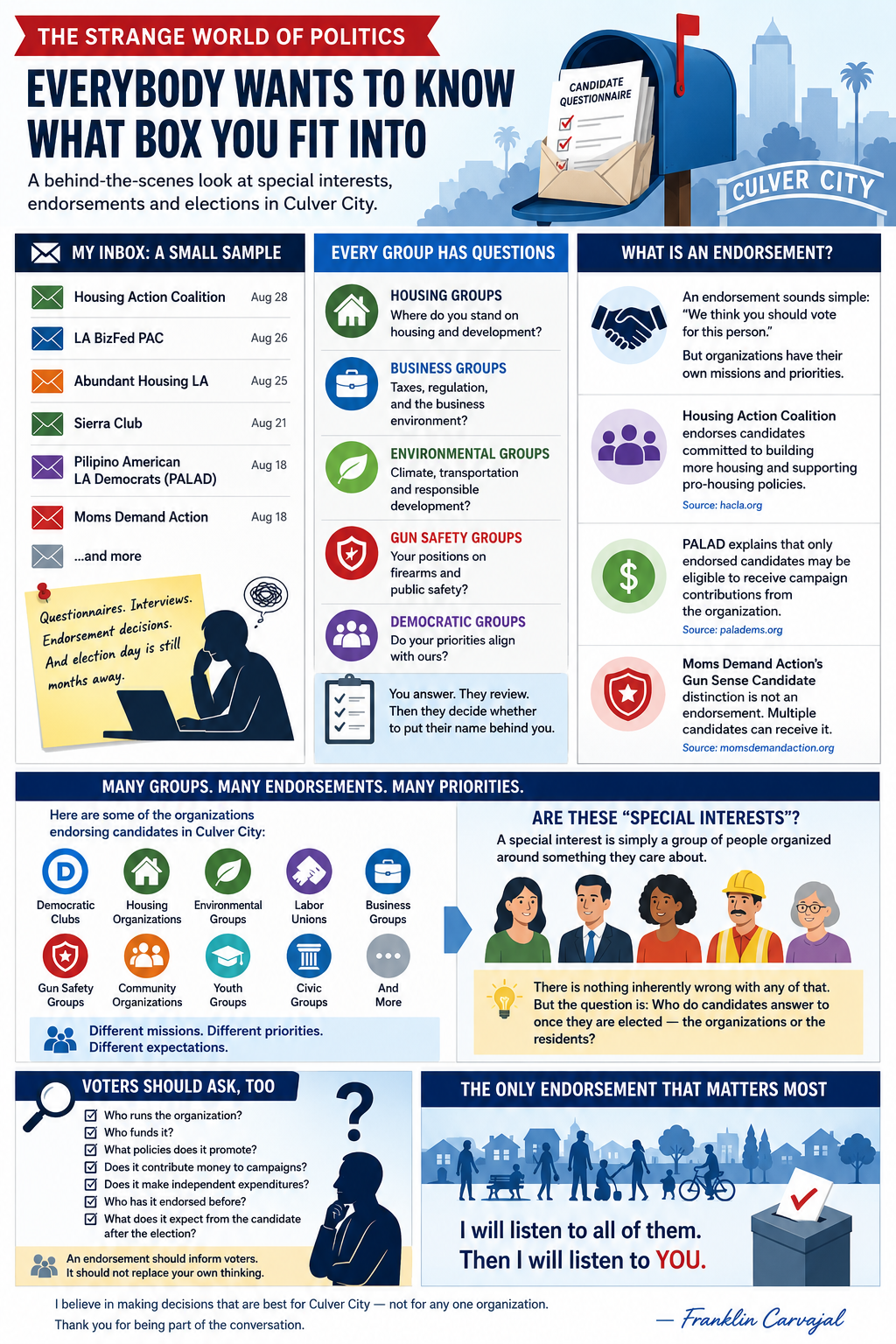
Take a look at my inbox.
In just a short period of time, I have received requests from organizations including:
Housing Action Coalition
LA BizFed PAC
Abundant Housing LA
Sierra Club
Pilipino American Los Angeles Democrats (PALAD)
Moms Demand Action
And those are only some of them.
Welcome to another episode of The Strange World of Politics.
Everyone Has Questions for the Candidate
The process usually starts innocently enough.
An organization sends you an email:
Congratulations on your candidacy. Please complete our candidate questionnaire.
Then come the questions.
A housing organization wants to know where you stand on housing and development.
A business organization wants to know where you stand on taxes, regulation and businesses.
An environmental organization wants to know about climate, transportation and development.
A gun-safety organization wants to know your positions on firearms.
A Democratic organization wants to know whether your positions align with its priorities.
You answer the questions. Sometimes you are interviewed. Sometimes a committee reviews your answers. Eventually, the organization decides whether it wants to put its name behind you.
And that endorsement can become part of the campaign.
I Started Wondering: What Exactly Is an Endorsement?
An endorsement sounds simple:
“We think you should vote for this person.”
But organizations have their own missions and priorities.
Housing Action Coalition, for example, describes its endorsed candidates as leaders committed to building more housing and supporting pro-housing policies. It has already endorsed Culver City Councilmember Freddy Puza in the 2026 election.
PALAD has its own endorsement process and explains that only candidates it endorses may be eligible to receive campaign contributions from the organization.
Moms Demand Action is an interesting variation. Its Gun Sense Candidate distinction is specifically not an endorsement. Instead, the organization says the designation tells its supporters that a candidate has demonstrated support for gun-safety policies. Multiple candidates in the same race can receive it.
So even the word “endorsement” doesn't always mean the same thing.
Then I Noticed Something Else
The same organizations appear again and again in candidate politics.
Look at Culver City races and you can see candidates displaying long lists of organizational endorsements.
For example, Freddy Puza's current endorsement page lists the Culver City Democratic Club, Westside Young Democrats, several labor unions, Housing Action Coalition, Abundant Housing Los Angeles, Sierra Club, Moms Demand Action, Our Culver and many others.
Westside Young Democrats has already endorsed Freddy Puza and Thomas Small for the two Culver City Council seats in November.
Meanwhile, Culver City Democrats United recently endorsed Jeannine Wisnosky Stehlin and Kimberley Griffin for City Council.
This is where politics starts getting interesting.
Are These “Special Interests”?
People often hear the phrase special interest and assume it means something sinister.
I don't think that is necessarily fair.
A special interest is fundamentally a group of people organized around something they care about.
Environmentalists care about environmental policy.
Businesses care about the business environment.
Housing advocates care about housing.
Labor unions care about workers.
Gun-safety organizations care about gun policy.
Democratic clubs care about electing candidates who reflect their political values.
There is nothing inherently wrong with any of that.
In fact, this is part of democracy.
But there is another question worth asking:
What happens when candidates become so focused on collecting endorsements that they begin answering to organizations instead of residents?
That is the part that interests me.
The Candidate Is Being Interviewed — But Voters Should Interview the Organizations Too
When I receive one of these questionnaires, the organization is evaluating me.
But as I go through this process, I've realized that I should also be evaluating them.
Who runs the organization?
Who funds it?
What policies does it promote?
Does it contribute money to campaigns?
Does it make independent expenditures?
Who has it endorsed before?
And, most importantly:
What does the organization expect from the candidate after the election?
Those are perfectly reasonable questions.
An endorsement should provide information to voters. It shouldn't substitute for voters doing their own thinking.
There Is Also Something Strange About Local Politics
Culver City Council is officially a nonpartisan office.
Yet candidates can spend an enormous amount of time seeking endorsements from Democratic clubs, advocacy organizations, labor groups, business groups, environmental organizations, housing organizations and political action committees.
The City itself lists the candidates for the November 3, 2026 municipal election and provides their candidate statements.
But nowhere on the ballot questionnaire is there a box saying:
“Which collection of organizations do you promise to agree with?”
Ultimately, we are supposed to represent Culver City.
And This Is Where I May Be a Difficult Candidate
I don't expect every organization to endorse me.
Why?
Because sometimes my answer is going to be:
I agree with you on this issue.
Sometimes:
I disagree with you.
And sometimes:
I need more information before I make that decision.
That probably isn't the best strategy for winning every endorsement.
But it may be a better strategy for governing.
I don't want housing policy dictated entirely by housing organizations.
I don't want transportation policy dictated entirely by bicycle advocates or automobile advocates.
I don't want economic policy dictated entirely by businesses or labor organizations.
And I don't want City Council decisions dictated by a political club simply because it helped someone get elected.
I want to hear from all of them.
Then I want to hear from you.
My Inbox Has Become a Political Education
Before becoming a candidate, most residents probably never see this side of elections.
I certainly didn't appreciate how extensive it was.
Questionnaire.
Questionnaire.
Interview.
Questionnaire.
Endorsement meeting.
Another questionnaire.
And election day is still months away.
So I am going to keep writing about this process because I think voters deserve to see how the machinery works behind the campaign signs and glossy mailers.
When an organization asks me for an endorsement questionnaire, I'll ask myself something very simple:
Am I answering this because it is what I actually believe is best for Culver City—or because it is the answer they want to hear?
If the answer is the second one, I probably shouldn't write it.
Because ultimately there is one endorsement that matters more than all the others:
Yours.
Welcome to the strange world of politics.
0 Comments