
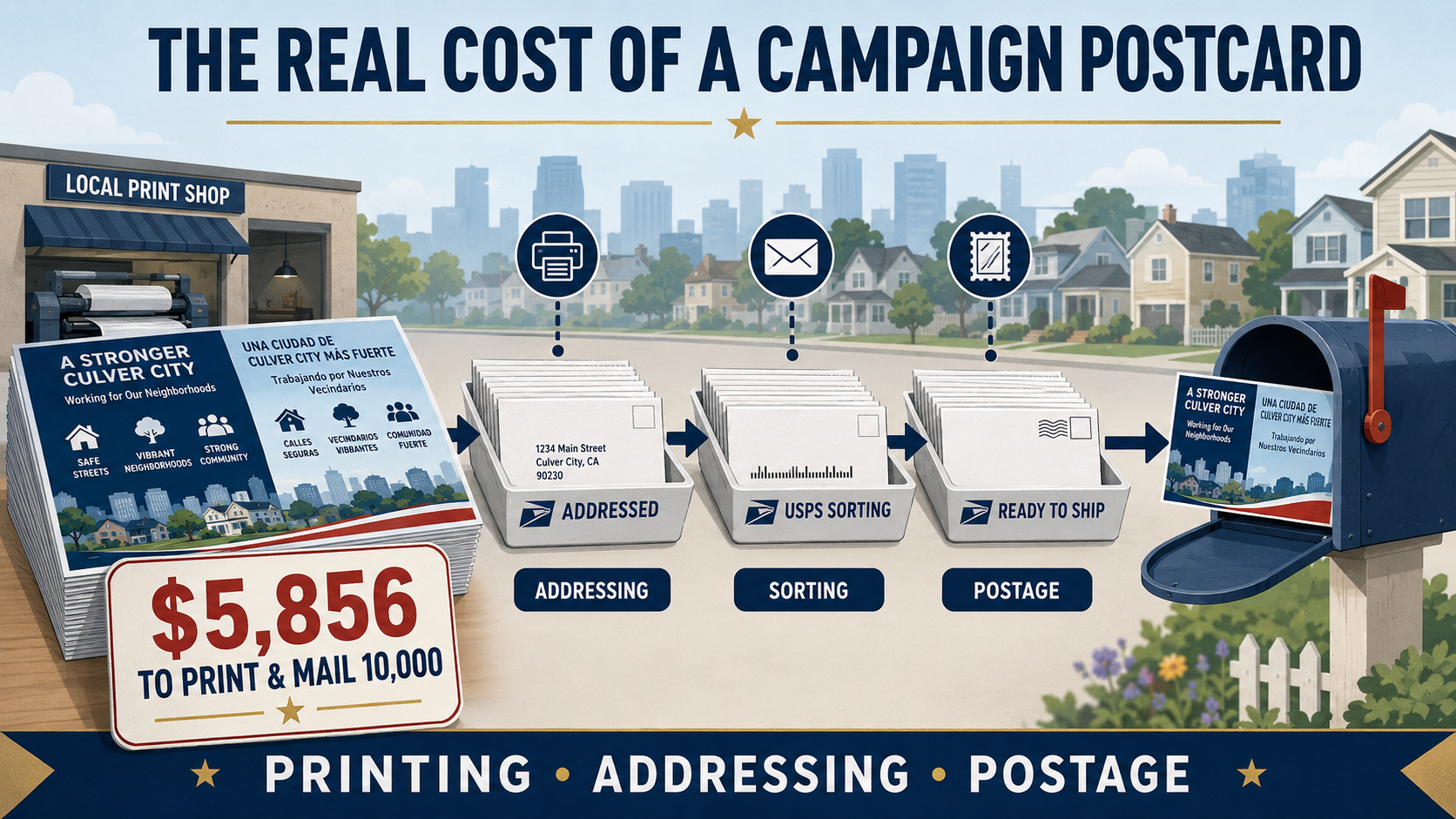
Most voters receive political postcards without thinking about how much work—or money—it takes to place one in their mailbox. I recently learned that even a simple campaign postcard involves printing, voter data, postal regulations, artwork, language decisions, and thousands of dollars.
On August 19, I contacted Fox Hills Printing, a local Culver City business, for prices on 6-by-11-inch, full-color campaign postcards. I requested estimates for 2,500, 5,000, 7,500, and 10,000 postcards.
I wanted the company to handle the entire process:
Print both sides in full color
Add addresses from a voter list
Sort the postcards
Prepare them for bulk mailing
Calculate the postage
Deliver them to the United States Postal Service
Fox Hills Printing responded the same day with the following estimates.
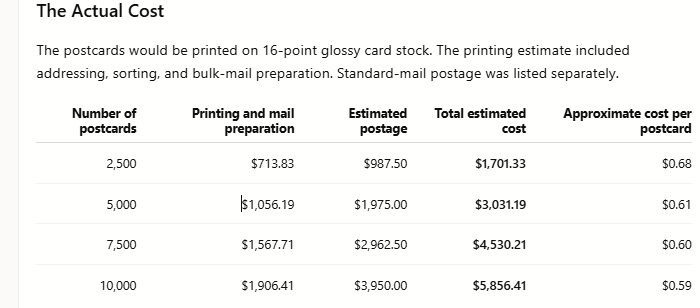
The larger the order, the lower the average cost of each postcard. However, the total expense still rises significantly. Mailing 10,000 postcards would cost approximately $5,856—and that is for only one mailing.
If a campaign sent two similar mailings to 10,000 voters, the estimated cost could approach $12,000.
Postage Costs More Than Printing
One of the most interesting things I learned is that postage is the largest part of the expense.
For 10,000 postcards:
Printing, addressing, sorting, and preparation: $1,906.41
Estimated postage: $3,950
Total: $5,856.41
In other words, more than two-thirds of the estimated total is postage.
The printer also explained that the final postage price could change depending on where the postcards are going and how many addresses remain after the mailing list is checked with the post office. Some addresses may be invalid, duplicated, or otherwise removed during processing.
English, Spanish, or Both?
I also had to consider whether the postcard should be in English, Spanish, or both languages.
Fox Hills Printing explained that placing English and Spanish on the same postcard should not create a problem. However, printing one English postcard and a separate Spanish postcard would require:
Two different designs
Two mailing lists
Two separate print jobs
A revised and more expensive quote
This creates another campaign decision. A bilingual postcard can communicate with more voters, but fitting two languages onto one card reduces the amount of space available for each message. Separate cards provide more space, but they cost more and require the campaign to decide which voters receive which version.
Even language access becomes a question of design, voter data, and money.
Other Possible Expenses
The quote assumes that the campaign provides “press-ready” artwork. That means the design must already be correctly prepared for professional printing.
If the artwork needs to be created or corrected, Fox Hills Printing charges $65 per hour. Rush service may also cost more or may not be available. The quote was valid for 30 days and stated that shipping fees or sales tax might apply where appropriate.
The estimate also did not answer every political-compliance question. A campaign still has to make sure the postcard includes the legally required “paid for by” disclosure and any other applicable campaign information.
Is Direct Mail Worth It?
A postcard can introduce a candidate to thousands of voters. It can include a photograph, qualifications, priorities, endorsements, a website, and voting information. It also allows a campaign to communicate directly with voters who may never attend a candidate forum or follow local politics online.
But direct mail is expensive.
A campaign must decide:
Which voters should receive the postcard?
Should the campaign contact 2,500 carefully selected voters or 10,000 broader households?
Is one mailing enough?
Should the card be bilingual?
Would door-to-door outreach be more effective?
How much of the campaign budget should be spent on postage?
A postcard that costs approximately 59 cents to produce and mail may receive only a few seconds of attention before it is discarded. On the other hand, it may be the only time a voter sees the candidate’s name before receiving a ballot.
That is the gamble.
Why I Am Sharing This
I want my campaign to help residents understand how local politics actually works. Candidates do not simply give speeches and attend public events. They spend a great deal of time requesting quotes, studying voter lists, checking disclosure rules, reviewing artwork, comparing mailing options, and making difficult budget decisions.
Campaign spending also affects who can realistically run for office. A well-funded campaign can send multiple pieces of mail to thousands of voters. A candidate with fewer financial resources must rely more heavily on door-to-door conversations, volunteers, social media, community events, and earned media.
So, the next time a political postcard arrives in your mailbox, remember that it may represent months of planning and several thousand dollars in campaign funds.
That is another lesson from the strange world of politics: a postcard may look simple, but almost nothing about getting it into your mailbox is simple.
0 Comments