
Today I learned something about Culver City government that immediately caught my attention.
The City may have ways, if legally and properly structured, to use City resources to help our public schools.
That led me to a simple question:
If Culver City has substantial financial reserves while the Culver City Unified School District has a reserve of only about 3%, why aren't we having a serious conversation about whether the City can help?
I think we should.
My proposal is simple:
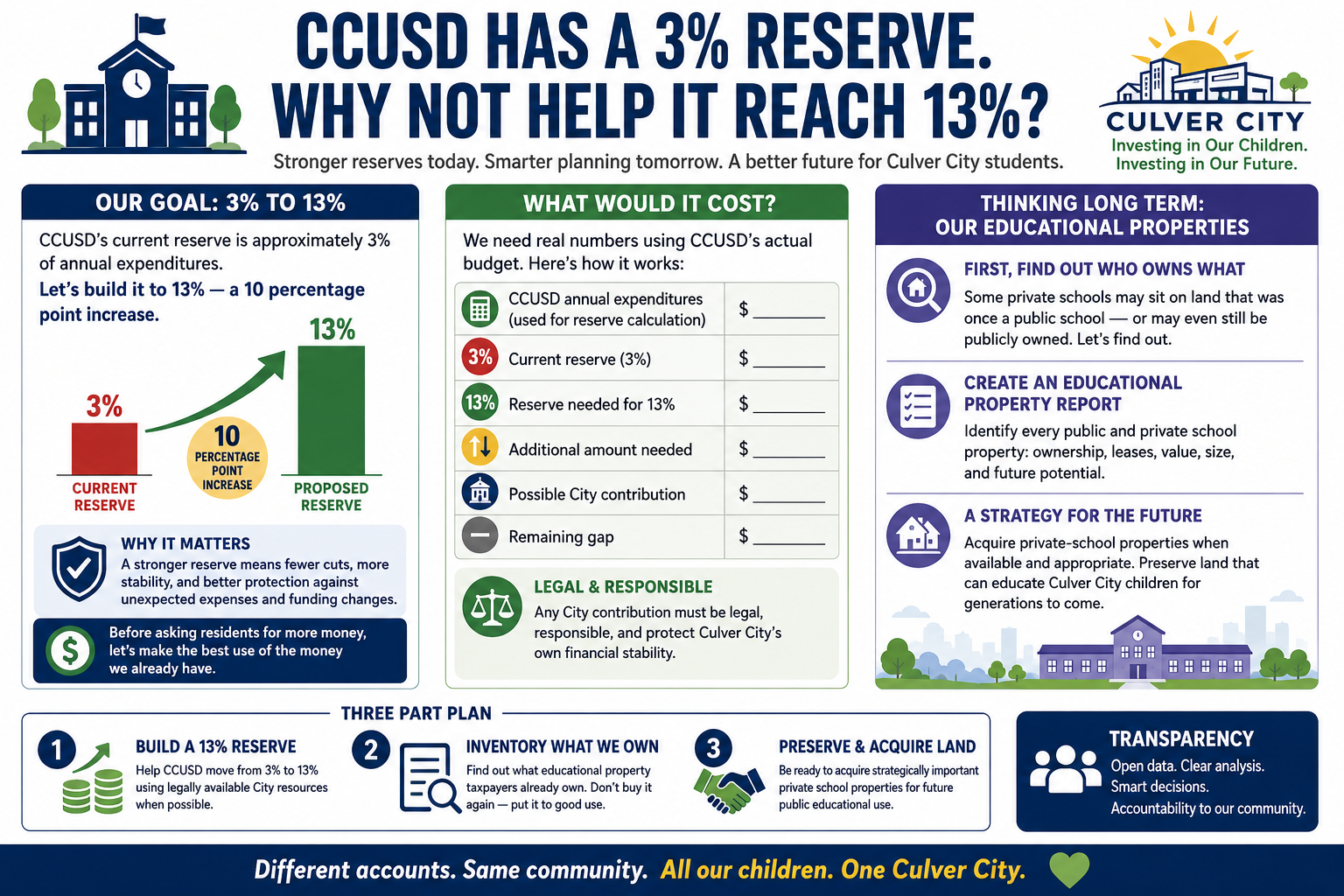
Let's explore whether Culver City can help CCUSD increase its reserve from 3% to 13%.
And while we're talking about the long-term financial health of our schools, I want to go further.
I also want Culver City and CCUSD to develop a long-term strategy to acquire private-school properties and preserve educational land for future generations.
Before buying anything, however, we need to find out something surprisingly basic:
Who actually owns all of these school properties?
Some properties being used for private education may have historical connections to CCUSD or may even sit on publicly owned land.
Let's find out.
From a 3% Reserve to a 13% Reserve
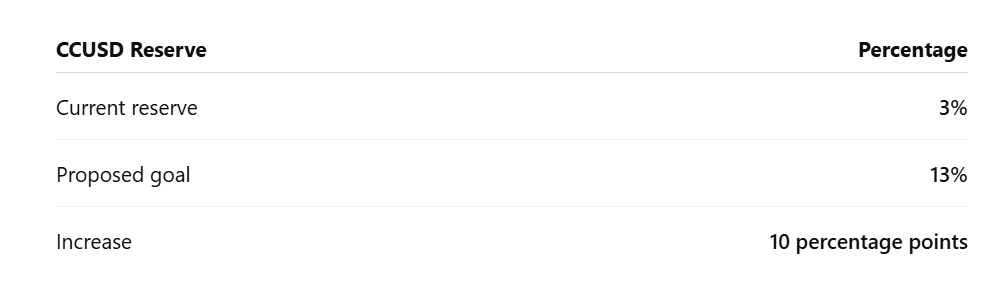
CCUSD's current reserve is approximately 3% of annual expenditures.
I want to explore increasing that reserve to 13%.
That means building an additional financial cushion equal to approximately 10% of annual expenditures.
Why does that matter?
Because a reserve is essentially a savings account.
When state funding changes, enrollment declines, unexpected expenses occur, facilities need emergency repairs, or another financial problem develops, the District needs somewhere to turn.
With a very small reserve, financial problems can quickly become discussions about:
Cutting teachers and staff
Eliminating programs
Increasing class sizes
Delaying maintenance
Asking property owners for additional taxes
Asking voters to approve additional bonds
A 13% reserve would give CCUSD considerably more breathing room.
How Much Would 13% Actually Cost?
This is where I want numbers rather than political promises.
The City and CCUSD should publicly calculate exactly how much money would be necessary to move the District from approximately 3% to 13%.
For example, if the relevant annual expenditures were $100 million, the calculation would look like this:
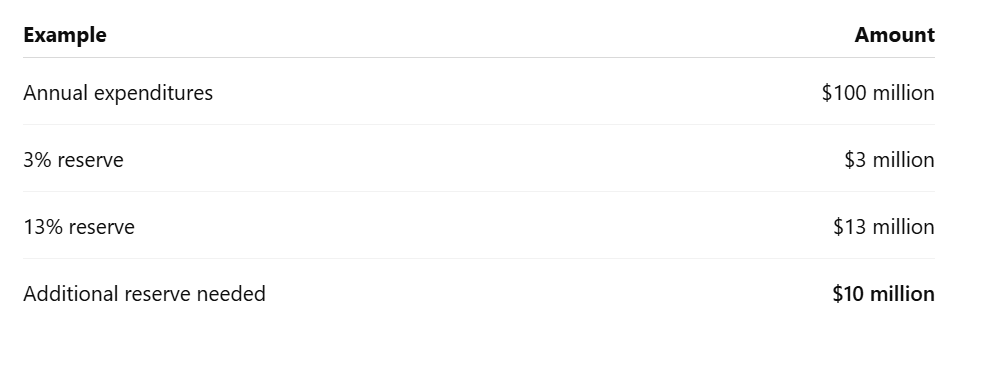
That is only an illustration.
I want the calculation made using CCUSD's actual current budget numbers.
Then residents should be shown something like this:
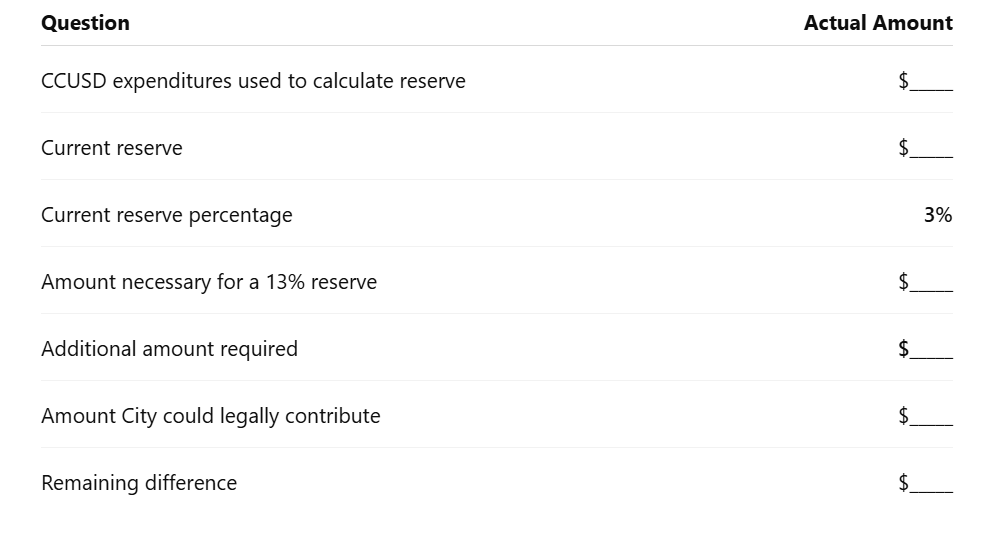
Once we have those numbers, we can have an informed discussion.
Where Would the Money Come From?
My first question would be Culver City's own reserves.
I am not suggesting that Culver City empty its savings account and give the money to CCUSD.
The City needs reserves too.
We need money available for emergencies, recessions, unexpected expenses and other legitimate City obligations.
But I want residents to know exactly how much money Culver City is holding.
Then I want that money divided into understandable categories:
How much is restricted and legally cannot be used for something else?
How much is unrestricted?
How much does City policy require us to maintain?
How much is necessary to maintain the City's financial stability?
And how much, if anything, exists above those requirements?
If there is money available beyond what Culver City reasonably needs to protect itself, then I want to know:
Could some of that money legally and responsibly be used to help CCUSD move from a 3% reserve toward 13%?
Maybe the answer is no.
Maybe the City could contribute $1 million.
Maybe $5 million.
Maybe $10 million.
Maybe more.
I don't know yet.
That's why I want the analysis.
I don't think candidates should manufacture numbers because they sound good.
Get the numbers.
Show them to residents.
Then make the decision.
But the City and CCUSD Are Separate
There is an important complication.
The City of Culver City and CCUSD are separate governmental entities.
The City Council does not run our schools.
CCUSD has its own elected Board of Education, administration, budget and legal responsibilities.
That means the City Council cannot simply decide that it wants to take over the School District's finances.
But separate governments can cooperate.
They serve many of the same residents.
Before transferring money, I would want the City Attorney, City Manager, CCUSD and appropriate financial professionals to publicly answer several questions.
Is such a contribution legal?
Which City funds could legally be used?
Could the City require the money to remain in reserve?
Would the contribution be one-time or recurring?
Could it affect Culver City's credit rating?
Would it weaken the City's ability to respond to an emergency?
Would CCUSD be required to maintain a particular reserve level afterward?
And perhaps most importantly:
Would transferring the money actually solve a long-term problem, or would CCUSD simply spend down the reserve again?
That last question matters.
I don't want to move money from one government account to another simply to watch it disappear.
If Culver City helps CCUSD reach 13%, there should be a serious plan for maintaining a financially healthy reserve.
Before Asking Residents for More Money, Look at the Money We Already Have
Culver City property owners already support public education through property taxes, school bonds, parcel taxes and other public revenues.
Sometimes additional taxes may be necessary.
Sometimes bonds may be necessary.
But before government asks residents for more money, I think government has an obligation to ask:
Are we using the public resources we already have as effectively as possible?
The City may have one bank account.
CCUSD may have another.
But taxpayers don't have separate wallets.
Ultimately, it is all public money.
That doesn't eliminate the legal separation between the City and CCUSD.
It does mean we should be looking for responsible ways for the two governments to work together.
Then I Started Thinking About Something Even Bigger
If we're going to think about the long-term financial health of CCUSD, why stop with the reserve?
There is another resource that may become even more valuable over the next several decades:
Land.
Culver City is small.
It is largely built out.
And land is extraordinarily expensive.
That is why I want Culver City and CCUSD to begin thinking strategically about the private-school properties that already exist within our city.
My long-term goal would be:
Preserve educational land and, when appropriate and financially reasonable, acquire privately owned school properties for future public educational use.
First, Find Out Who Actually Owns the Schools
Before we talk about purchasing anything, we need to answer a surprisingly complicated question:
Who owns the land underneath Culver City's private schools?
Historical City planning documents indicate that some former CCUSD elementary-school sites were placed under long-term leases and used by private schools or other organizations.
That creates an important possibility.
Some properties residents currently think of as "private schools" may have originally been public-school properties.
And in some situations, the underlying property could potentially still be publicly owned.
Before spending taxpayer money purchasing anything, let's find out.
Create a Culver City Educational Property Report
I would ask Culver City and CCUSD to jointly create a Culver City Educational Property Report identifying every public and private educational property in the city.
For each property, residents should be able to see:
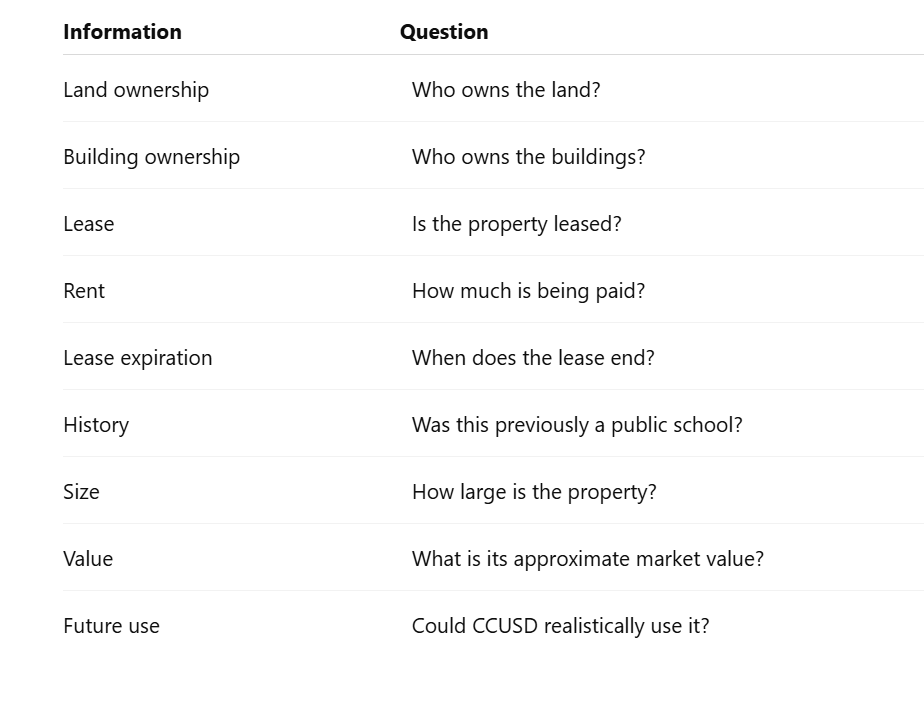
Put the report online.
Update it periodically.
Let residents see what we actually own.
If We Already Own It, Don't Buy It Again
This is particularly important.
If CCUSD already owns a property being used by a private school, then obviously:
Don't buy it. We already own it.
Instead, examine the lease.
How long does it last?
How much rent does CCUSD receive?
When does the lease expire?
Does the private school have renewal rights?
Can CCUSD decline to renew it?
What happens to the buildings when the lease ends?
Could that property eventually return to public-school use?
And how much would returning an existing property to public use cost compared with purchasing completely new land?
These are important public-policy questions.
What About Schools That Really Are Privately Owned?
For genuinely privately owned school properties, I want a different strategy.
I want Culver City and CCUSD to be prepared to buy them when appropriate.
I am not talking about simply confiscating private schools.
Private property rights matter.
I am talking primarily about voluntary purchases from willing sellers.
Suppose a private school closes 10 years from now.
The owners decide to sell the campus.
A developer sees an opportunity.
That's understandable.
But I want Culver City and CCUSD looking at the same property and asking:
Could our community need this school 20, 30 or 50 years from now?
If the answer is yes, government should at least have the ability to consider purchasing it.
Once Educational Land Is Gone, It May Be Gone Forever
Imagine that an existing private-school campus is sold.
The buildings are demolished.
The property is redeveloped.
Twenty years later, Culver City needs another public elementary school.
Where do we put it?
We may need to purchase dozens of individual properties.
We may have to demolish buildings.
We may have to relocate residents or businesses.
And the price of the land could be dramatically higher.
Or we may discover that assembling enough land for a school is practically impossible.
That is why existing school properties are different from ordinary real estate.
They are already educational sites.
That has enormous long-term value.
Public Education Is Infrastructure
When politicians talk about infrastructure, they usually mean:
Roads.
Sidewalks.
Sewers.
Parks.
Bridges.
Public buildings.
But I would add another category.
Schools.
An educational property purchased today could serve Culver City children for generations.
A purchase may look expensive when measured against one year's budget.
It can look completely different when the property is considered over 50 or 75 years.
That is the kind of long-term thinking I want from local government.
Divide Our Educational Properties Into Three Categories
Once the Educational Property Report is completed, I would divide properties into three broad categories.
1. Already Publicly Owned
Determine whether these properties could eventually return to public educational use.
If they are leased, understand the lease and the long-term options.
2. Privately Owned and Potentially Available
When an owner is interested in selling, evaluate whether voluntary acquisition makes financial and educational sense.
3. Privately Owned and Not Available
Don't interfere with them.
But maintain an inventory so that if circumstances change decades from now, the City and CCUSD aren't starting their research from zero.
Consider an Educational Property Acquisition Fund
There is another possibility worth exploring.
Culver City and CCUSD could consider establishing a long-term Educational Property Acquisition Fund.
Money could accumulate over time rather than requiring taxpayers to suddenly produce tens of millions of dollars when an important property comes onto the market.
Then, if an educational property becomes available, the community would already have resources available to consider acquiring it.
Again, I am not saying we should buy every property at any price.
Quite the opposite.
Do the analysis.
What is the property worth?
What would it cost to renovate?
What would a comparable new school cost?
Does CCUSD actually need the additional capacity?
Could the property serve another public educational or community purpose?
Does buying it make sense?
If the numbers don't work, don't buy it.
My Proposal Has Three Parts
This is ultimately a three-part proposal.
1. Increase CCUSD's Reserve From 3% Toward 13%
Determine exactly how much money is necessary and whether Culver City has legally available reserves that could responsibly help CCUSD get there.
Protect Culver City's own financial stability in the process.
2. Find Out What Educational Property Taxpayers Already Own
Create a complete inventory of public and private school properties, including ownership, leases, values and historical public-school sites.
If taxpayers already own it, don't buy it again.
Determine whether it could eventually return to public educational use.
3. Preserve and Acquire Educational Land for the Future
When genuinely privately owned school properties become available for voluntary sale, Culver City and CCUSD should have a long-term strategy for determining whether acquiring them would benefit future generations.
And Put Everything in Public
There is one condition I would attach to all of this:
Transparency.
If Culver City is considering transferring millions of dollars to CCUSD, show residents the financial analysis.
If CCUSD owns property being leased to a private school, make the basic publicly available information about that arrangement easy to find.
If government wants to purchase a multimillion-dollar school property, explain why.
Show the appraisal.
Show the anticipated costs.
Show the intended use.
And show residents the alternatives.
A new idea isn't automatically a good idea simply because it involves schools.
My approach would be:
Investigate it.
Put numbers on it.
Explain it.
Measure the benefits and risks.
Then decide.
Think Beyond the Next Election
Local politics encourages politicians to think in four-year increments.
I don't want to do that.
I want us asking:
What will Culver City's schools need in 2040?
What will they need in 2050?
What about 2075?
Will future Culver City residents look back and wonder why we allowed valuable educational land to disappear when we had an opportunity to preserve it?
Or will they say:
Those people planned ahead.
That is the kind of government I want.
Protect Culver City's financial stability.
Help CCUSD move from a 3% reserve toward 13% if the numbers and law allow it.
Before asking taxpayers for more money, examine the public resources we already have.
Find out what educational land taxpayers already own.
Preserve it where appropriate.
And when strategically important private-school properties become available for sale, seriously consider acquiring them for future generations.
The City of Culver City and CCUSD may be separate governments.
But the children sitting in our classrooms don't care which government account the money came from.
They are all Culver City children.
And sometimes the best investment government can make isn't something that produces results before the next election.
Sometimes it is an investment that people won't fully appreciate for another 25 or 50 years.
Let's start planning for them now.
0 Comments