
As I continue running for Culver City Council, I keep discovering parts of our local government that most residents probably never hear about.
Today I learned about another one.
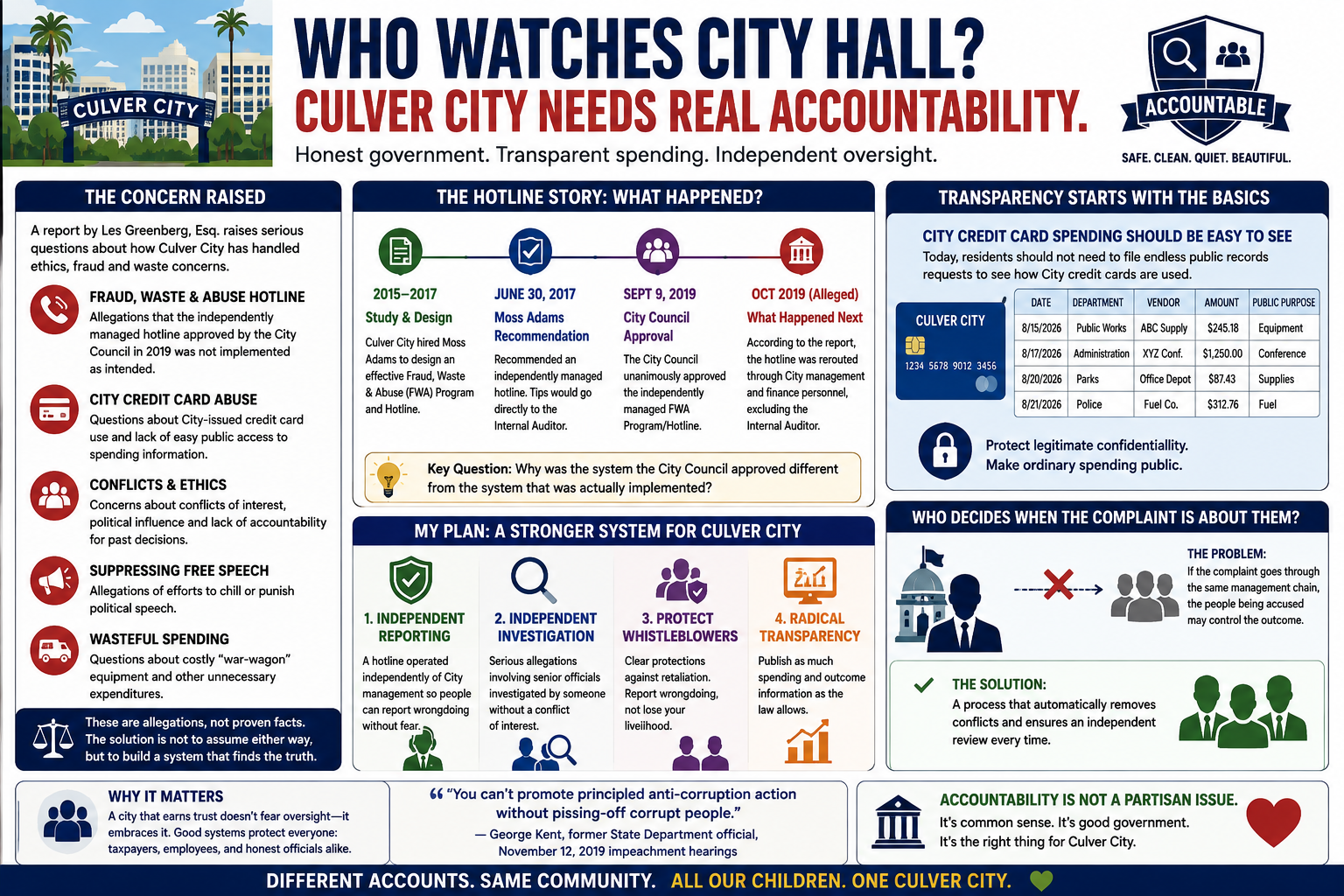
Years ago, Culver City spent considerable time developing a Fraud, Waste and Abuse Program and Hotline—a way for City employees and others to report suspected wrongdoing.
That sounds like exactly what a city should have.
But then I read a lengthy report by Culver City resident and attorney Les Greenberg titled “Culver City Is An Ethical Desert.”
That is his characterization, not mine.
The report contains numerous allegations about former City officials, City-issued credit cards, conflicts of interest, the City's fraud and waste program and other controversies. I am not in a position to independently establish that all of those allegations are true.
But one issue in the report particularly caught my attention because it raises a much larger question:
Who investigates City government when the complaint is about City government itself?
That is a question Culver City should be able to answer.
Culver City Already Studied This Problem
According to the report, Culver City hired Moss Adams as its Internal Auditor and, by June 2017, Moss had recommended an independently managed Fraud, Waste and Abuse Program and Hotline.
The basic idea was straightforward:
Someone who sees possible fraud, waste or abuse should have somewhere safe to report it.
And importantly, the report says the answering service receiving those complaints was supposed to report them directly to the Internal Auditor.
That independence matters.
Imagine that an employee believes a supervisor, department director or senior City official is doing something improper.
Now imagine telling that employee:
Report your complaint to the same management structure you are complaining about.
Would you feel comfortable doing that?
I wouldn't.
City Employees Apparently Had the Same Concern
One of the most troubling statements in the report involves an earlier assessment by Culver City's Internal Auditor.
According to Greenberg's report, a significant portion of supervisors, managers and director-level employees did not feel protected against retaliation for reporting wrongdoing. The report also says a substantial number believed Culver City faced a meaningful risk of fraud, waste and abuse.
That should concern everyone.
This isn't about assuming City employees are corrupt.
Quite the opposite.
An effective reporting system protects honest employees.
If someone sees something wrong, that person should be able to report it without worrying about losing a promotion, damaging a career or becoming a target inside City Hall.
In 2019, the City Council Unanimously Approved a Program
Here's where the history becomes particularly interesting.
According to the report, Culver City's Finance Advisory Committee reviewed the proposed Fraud, Waste and Abuse Program in June 2019 and unanimously forwarded it to the City Council.
Then, on September 9, 2019, the City Council unanimously voted to accept the program recommended by Moss Adams.
So far, so good.
But Greenberg alleges something changed afterward.
According to his account, within approximately a month, the Internal Auditor was excluded from receiving the hotline reports and the reports were instead directed through City management and finance personnel.
That is a serious allegation.
I am not going to declare from one person's report that anyone acted corruptly.
But I do think residents deserve a very simple explanation:
What exactly did the City Council approve in 2019, what was ultimately implemented, and why were they different if they were different?
That should not be difficult to answer.
The Bigger Issue Is Independence
For me, this is not primarily about relitigating what happened in 2019.
It is about designing a better system today.
Suppose tomorrow someone submits a complaint alleging misconduct by:
The City Manager
A department head
A senior Finance Department employee
The City Attorney
A City Councilmember
Another high-ranking official
Who receives the complaint?
Who decides whether it deserves investigation?
Who selects the investigator?
Who receives the investigator's findings?
Who decides whether the findings become public?
And what happens when the person making those decisions is also the subject of the complaint?
Those questions need clear answers.
My Proposal: An Independent Culver City Ethics and Accountability System
If elected, I would ask the City Council to review the current Fraud, Waste and Abuse Program and determine whether it provides genuine independence.
My starting principle would be simple:
No City official should control the investigation of a serious complaint against himself or herself.
That shouldn't be controversial.
I would propose several safeguards.
1. An Independently Operated Hotline
Employees and residents should be able to report suspected:
Fraud.
Waste.
Abuse.
Misuse of public money.
Serious ethical violations.
Conflicts of interest.
Retaliation.
And other significant misconduct.
The reporting system should be operated independently enough that someone making a complaint against senior City management does not have to send that complaint directly through the people being accused.
2. Protect Whistleblowers
People need to know that reporting suspected wrongdoing will not destroy their careers.
The system should clearly explain:
Who can see the complaint?
When can someone's identity be disclosed?
What protections exist against retaliation?
How can retaliation itself be reported?
If employees don't trust the system, the hotline may exist on paper while accomplishing very little.
3. Establish Rules Before the Complaint Arrives
We should not invent investigative procedures after somebody important gets accused.
The rules should already exist.
For example:
If the complaint concerns an ordinary employee, there should be one procedure.
If it concerns a department head, another level of independent review may be necessary.
If it concerns the City Manager, City Attorney or a Councilmember, the process should automatically prevent that person from controlling the investigation.
The rules should apply regardless of who is in office.
4. Independent Investigation of Serious Allegations
Not every complaint requires an expensive outside investigation.
Some will be misunderstandings.
Some may have no evidence.
Some may involve routine personnel matters.
But serious and credible allegations involving senior officials should have a path to an independent investigator who does not report to the person being investigated.
That protects everyone.
It protects the whistleblower.
It protects taxpayers.
And it also protects an innocent official who has been falsely accused.
An independent investigation can clear someone's name just as easily as it can substantiate wrongdoing.
Then There Is the Question of City Credit Cards
Greenberg's report raises another issue that caught my attention: City-issued purchasing cards.
The report says Culver City had issued approximately 85 credit cards to approximately 650 employees and cites City Council Policy No. 4209, which described the cards as intended generally for relatively low-value purchases.
The report then makes a number of specific allegations concerning purchases and expenses.
Again, I am not independently adopting those accusations as fact.
But the underlying policy question is legitimate:
How easy is it for residents to see how City credit cards are being used today?
This is 2026.
Residents shouldn't need to become amateur investigators and submit endless public-record requests just to understand how government credit cards are being used.
Put City Credit-Card Spending Online
I would like Culver City to explore publishing City purchasing-card expenditures in a searchable online database.
Something simple:
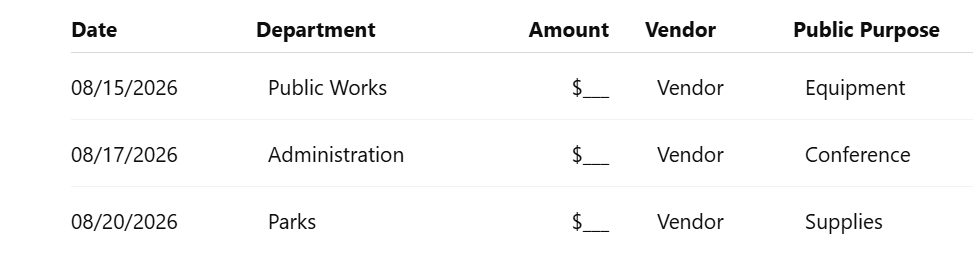
Obviously, legitimate confidential information should be protected.
But ordinary government spending should not be mysterious.
If taxpayers paid for it, taxpayers should generally be able to see it.
Accountability Shouldn't Depend on Who Controls City Hall
This is the part of the issue that matters most to me.
Today you may trust the City Council.
Tomorrow you may not.
Today you may trust the City Manager.
Ten years from now someone completely different will occupy that office.
Good government cannot depend entirely on good people.
It needs good systems.
A genuinely independent fraud and ethics process isn't an attack on City employees.
It protects City employees.
It isn't anti-government.
It makes government stronger.
And it shouldn't matter whether the person being investigated is progressive, conservative, Democrat, Republican, independent or anything else.
The same rules should apply.
My Proposal
If elected, I would ask for a public review of Culver City's current ethics and Fraud, Waste and Abuse system.
I would want answers to several questions:
What did the City Council approve in 2019?
What was actually implemented?
What system exists today?
Who currently receives complaints?
Who decides whether a complaint is investigated?
What happens when a complaint concerns the City Manager, City Attorney or a Councilmember?
How are whistleblowers protected?
How many complaints have been received?
How many resulted in investigations?
How many were substantiated?
What information can legally be reported publicly?
Then I would look at establishing four basic principles:
1. Independent reporting
A whistleblower should have somewhere to go outside the management chain being accused.
2. Independent investigation
Serious allegations involving senior officials should be investigated by someone without a conflict of interest.
3. Protection against retaliation
Employees should not have to choose between reporting suspected wrongdoing and protecting their careers.
4. Radical transparency about public spending
Routine City spending—including purchasing-card expenditures—should be much easier for residents to examine.
Don't Assume Corruption. Build a System That Can Find It.
There is an important distinction here.
Reading an allegation does not make the allegation true.
Someone being accused of misconduct does not make that person guilty.
And political disagreement is not corruption.
Those principles matter to me.
But the opposite is also true:
We shouldn't assume government is functioning perfectly simply because nobody has proven otherwise.
The solution isn't to automatically believe every accusation.
The solution is to create a credible process capable of determining what actually happened.
That is what an independent accountability system provides.
Trust Requires Verification
I am running for Culver City Council talking repeatedly about five things:
Safe. Clean. Quiet. Beautiful. Accountable.
That last word matters.
Accountable.
Government officials—including me, if I am elected—should operate under systems that do not require residents simply to trust us.
Show the spending.
Show the rules.
Create an independent place to report wrongdoing.
Protect the people who come forward.
Investigate credible allegations fairly.
Publish as much of the outcome as the law allows.
And make sure nobody inside City Hall gets to decide whether a serious complaint against themselves deserves investigation.
I don't know whether every allegation contained in Les Greenberg's report is correct.
I don't have to know that to recognize the larger problem it raises.
A government that is confident in its integrity should welcome independent oversight.
And a resident shouldn't have to spend years fighting City Hall just to find out whether City Hall followed its own rules.
That's the system I want to examine and, if necessary, change.
Because accountability shouldn't depend on who happens to be sitting behind the desk.
It should be built into the desk itself.
0 Comments