
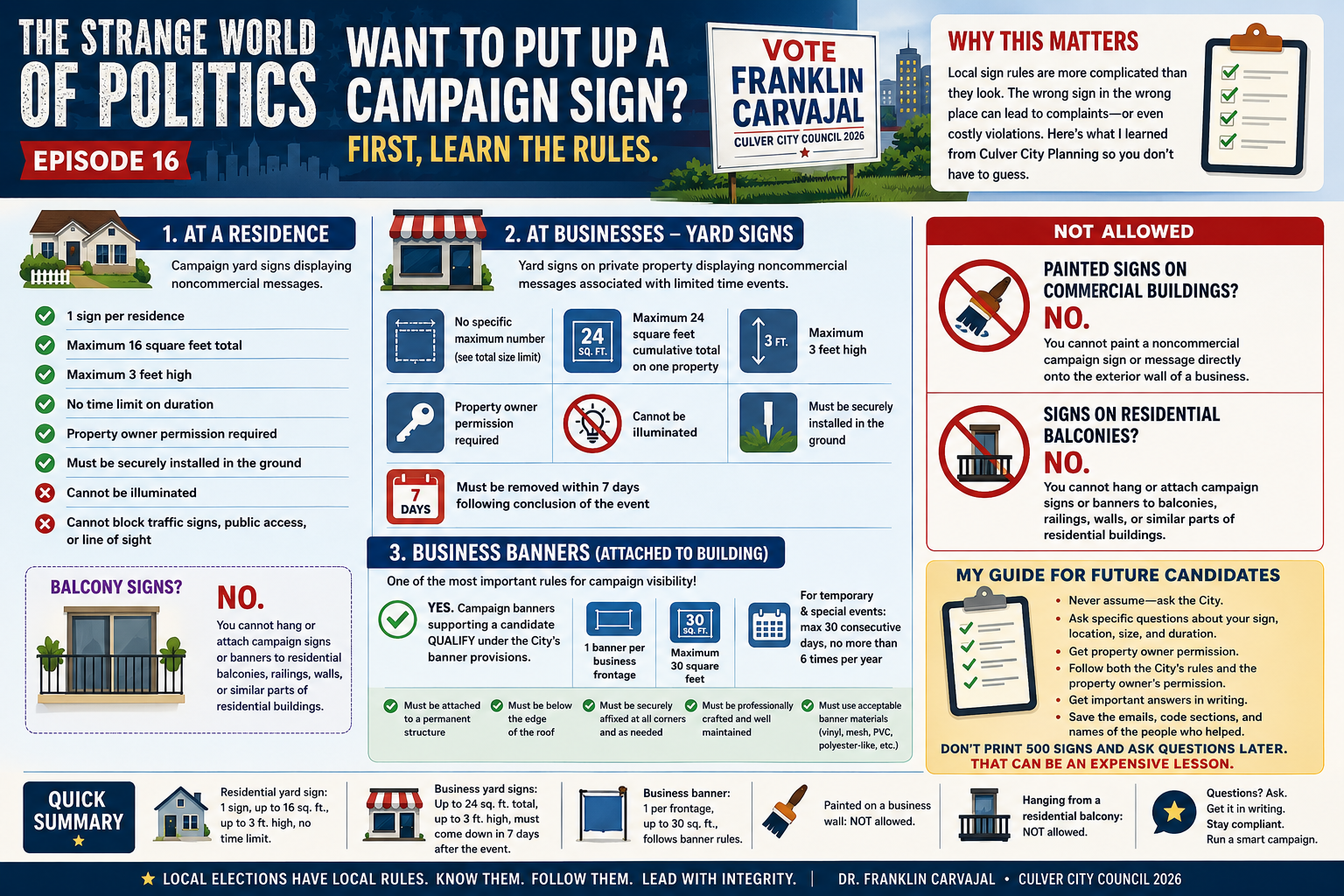
One thing I continue to learn while running for Culver City Council is that even the simplest part of a political campaign can turn into a lesson in local government.
Take campaign signs.
You might think the process is simple: print a sign, ask a homeowner or business owner for permission, and put it up.
Not necessarily.
As part of my campaign, I wanted to know exactly what Culver City allows. I wasn't interested in guessing or doing something simply because I had seen other campaigns do it. I wanted to follow the City's rules.
That led me to contact the Culver City Planning Department.
And that experience became another chapter in The Strange World of Politics.
Lesson #1: Don't Assume You Know the Rules
My first questions were straightforward.
How many campaign signs can someone put on a property?
Can a business owner allow a candidate to put a sign on the exterior wall of a restaurant or liquor store?
Can the campaign message actually be painted onto a wall?
Can someone hang a campaign sign from a residential balcony?
These sound like questions that should have simple yes-or-no answers.
But local sign regulations are much more complicated.
There are different rules depending on whether the property is residential or commercial, whether the sign is in the ground or attached to a building, whether it is considered a banner, and how large it is.
After corresponding with the Planning Department, I received much clearer guidance.
Here is what I learned.
Residential Campaign Yard Signs
For residentially zoned property being used as a residence, the City provided the following rules for yard signs displaying noncommercial messages:
The sign also cannot obscure a traffic sign, interfere with public access, or interfere with a driver's line of sight.
That last part is important.
A homeowner saying, "Sure, put your sign here," does not automatically mean that every location on the property is acceptable.
What About Balconies?
This was one of my specific questions.
Could someone hang my campaign sign from a balcony, railing, wall, or similar part of a residential building?
According to the response I received from Culver City Planning:
No.
That is exactly why candidates should ask questions rather than assume something is legal because they have seen signs displayed that way somewhere else.
What About Businesses?
This gets more interesting.
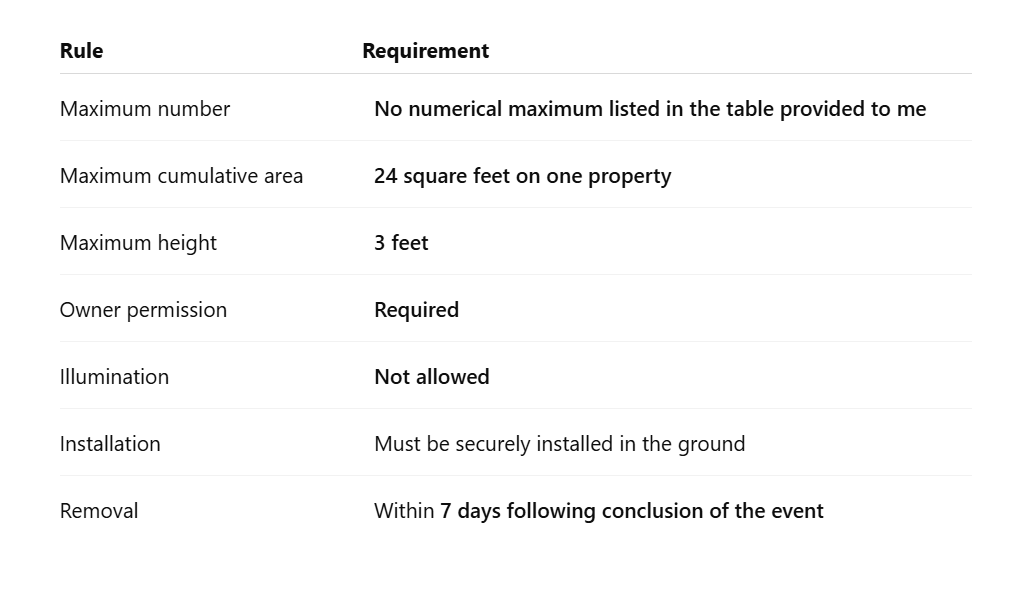
The City provided information concerning yard signs on qualifying mixed-use property developed with a commercial, nonresidential use.
For the provision identified by the City, the rules include:
Notice something important.
Instead of simply limiting the number of signs, this provision limits their combined area.
If you are running for office, details like this matter.
The 30-Square-Foot Business Banner
Then I learned about another option: banner signs.
The City's regulations provided to me allow a banner of up to 30 square feet, with a maximum of one per business frontage, subject to the applicable requirements.
But I noticed a potential problem.
The language discussed businesses displaying banners advertising activities or events.
Would a political campaign banner actually qualify?
I did not want to assume that it would.
So I wrote back to Planning and asked directly:
Can a business display a noncommercial campaign banner supporting a candidate under this provision?
The answer I received was:
Yes.
That clarification is important for anyone running a future campaign in Culver City.
Under the provisions the City identified for me, a campaign banner can qualify, provided all the other requirements are followed.
The banner must also be properly attached to a permanent structure, remain below the roof edge, be securely affixed, and be professionally crafted and maintained using acceptable banner materials.
For temporary and special events, the provision provided to me also contains a maximum display period of 30 consecutive days and no more than six times per calendar year.
Future candidates should confirm with the City how those timing provisions apply to their particular campaign and proposed display.
Can You Paint "Vote for Franklin" on a Business Wall?
I specifically asked whether, with the owner's permission, a campaign message could simply be painted directly onto the exterior wall of a business.
The City's answer was:
No.
That distinction is worth remembering.
A qualifying banner attached to the business may be permissible.
A campaign message painted directly onto the building is not, according to the guidance I received.
My Guide for Future Culver City Candidates
If you decide to run for office someday, here is my advice based on this experience.
1. Never assume that something is permitted because another candidate is doing it.
Seeing ten political signs somewhere does not establish that ten signs are legal.
The other campaign may be wrong.
2. Ask very specific questions.
Don't just email the City and ask:
"What are the campaign sign rules?"
Give examples.
Ask:
"Can a homeowner hang my sign from a second-floor balcony?"
Or:
"Can a restaurant owner attach a 30-square-foot campaign banner to the exterior of the restaurant?"
Specific questions are more likely to produce useful answers.
3. Read the response carefully.
My initial response contained a great deal of useful information, but it did not directly answer every question I had asked.
That happens.
Instead of assuming what the unanswered portions meant, I followed up.
4. Follow up when the answer is incomplete.
I specifically asked again about:
painting campaign messages on commercial buildings;
signs hanging from residential balconies; and
whether the 30-square-foot business-banner provision actually applied to political campaign banners.
That produced three very important answers:
Painted campaign wall signs: No.
Residential balcony signs: No.
Qualifying campaign banners on businesses: Yes.
5. Get important answers in writing.
This may be the most important lesson.
When I am spending campaign money printing signs and asking residents and businesses to display them, I don't want to rely on:
"Someone told me at City Hall that it was okay."
I want the applicable rules and the City's interpretation in writing.
Save the emails.
Save the code sections.
Save the name of the person who provided the guidance.
Rules and interpretations can change, so future candidates should obtain current guidance rather than relying solely on what the City told my campaign in 2026.
6. Ask permission before putting signs on private property.
A political campaign does not give you the right to use someone else's property.
Get permission.
And remember that the City's rules may specifically require the property owner's permission.
7. Don't confuse homeowner permission with City permission.
This is an important distinction.
A homeowner or business owner can say:
"Yes, Franklin, you can put your sign here."
That gives you permission from the property owner.
It does not eliminate the City's zoning and sign regulations.
You need both.
Why Am I Writing About Something as Boring as Sign Regulations?
Because this series isn't just about my campaign.
One of the reasons I started The Strange World of Politics was to show residents what actually happens when an ordinary person decides to run for local office.
There are forms.
There are deadlines.
There are campaign-finance rules.
There are nomination signatures.
There are organizations seeking endorsements.
There are voter lists.
There are banking requirements.
And, apparently, there are detailed rules governing whether your campaign sign can be in someone's yard, attached to a restaurant, hanging from a balcony, or painted on a wall.
Most voters will never have a reason to learn any of this.
Candidates do.
And I think future candidates should have an easier time than I did.
A Final Checklist for Future Candidates
Before ordering hundreds of campaign signs:
✓ Contact the Planning Department.
✓ Get the current sign ordinance.
✓ Explain exactly what type of sign you intend to use.
✓ Identify whether it will be at a residence or business.
✓ Ask about number, size, height, location, materials and duration.
✓ Ask whether wall-mounted signs and banners are treated differently.
✓ Ask whether the rule applies specifically to political/noncommercial messages.
✓ Get property-owner permission.
✓ Get important City interpretations in writing.
✓ Save the correspondence for your campaign records.
And perhaps most importantly:
Don't print 500 signs first and ask the City what the rules are afterward.
That could become a very expensive lesson in the strange world of politics.
The Strange World of Politics is my continuing account of what I am learning as a candidate for Culver City Council. My goal is not only to tell voters what I believe, but also to explain how local government and local elections actually work. If someone decides to run for office five or ten years from now and these articles make the process a little easier to understand, then writing them was worthwhile.
0 Comments