
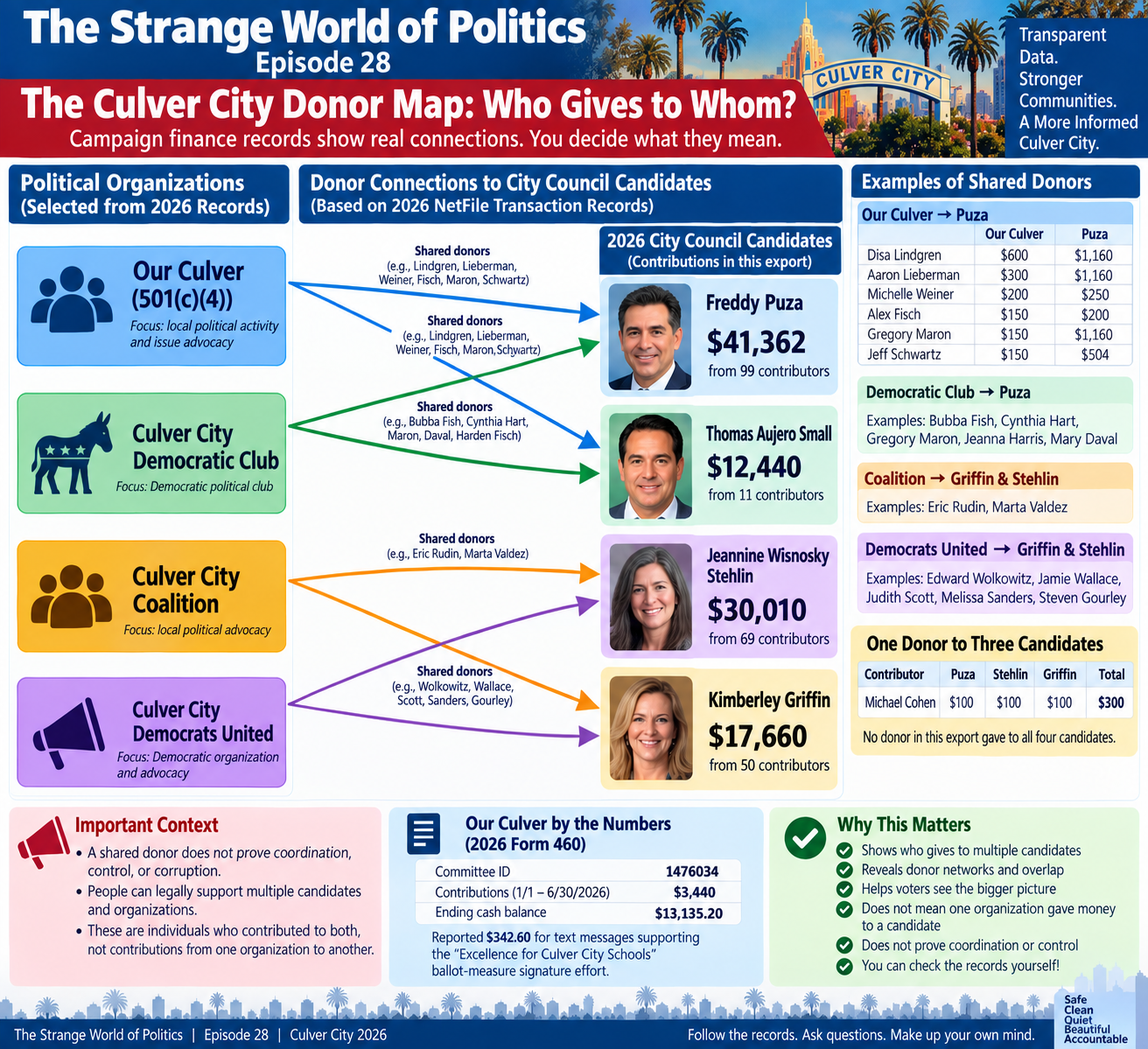
One of the most revealing things about local politics is that campaign-finance records do more than tell us how much money a candidate has raised.
They can also show us where political networks overlap.
After downloading Culver City's 2026 campaign transaction data from NetFile, I compared the contributors reported by the four other City Council candidates whose campaigns appeared in the export:
Freddy Puza
Thomas Aujero Small
Jeannine Wisnosky Stehlin
Kimberley Griffin
I also compared those contributors with political organizations operating in Culver City, including Our Culver, the Culver City Democratic Club, Culver City Democrats United, and the Culver City Coalition.
The results are interesting.
But before getting into them, there is an important rule for reading this information:
A shared donor does not prove coordination, control, corruption, or an agreement between candidates or organizations.
It means exactly what it says:
the same person or organization contributed to more than one political entity.
What voters make of that information is up to them.
First: How much money appears in the candidate records?
In the 2026 electronic transaction data I reviewed, the four candidate committees showed approximately:
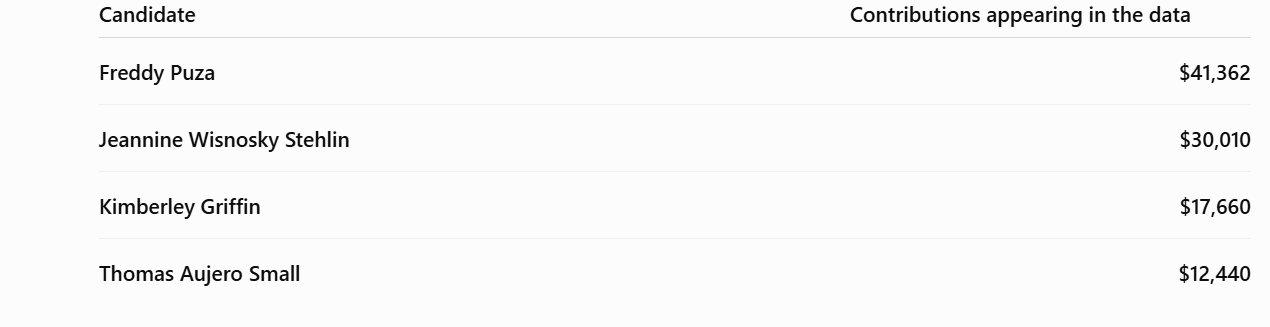
These numbers should be understood carefully.
They reflect the transactions contained in the electronic NetFile export I downloaded, not necessarily the final amount each candidate will raise during the entire 2026 election.
The election is still underway.
More contributions can arrive.
More reports can be filed.
And NetFile itself warns that its transaction search contains electronic filings only.
So consider this a snapshot—not the final financial history of the election.
But the total raised isn't the most interesting part
What interested me more was this question:
Are the same people giving money to several candidates?
The answer is yes.
I found approximately 25 contributors appearing in at least two of the four candidate campaigns.
But the money isn't distributed evenly across the field.
Instead, distinct clusters appear.
And one cluster is particularly noticeable.
Stehlin and Griffin share many contributors
The strongest donor overlap I found was between:
Jeannine Wisnosky Stehlin
and
Kimberley Griffin.
Several contributors gave substantial amounts to both campaigns.
Examples from the records include:
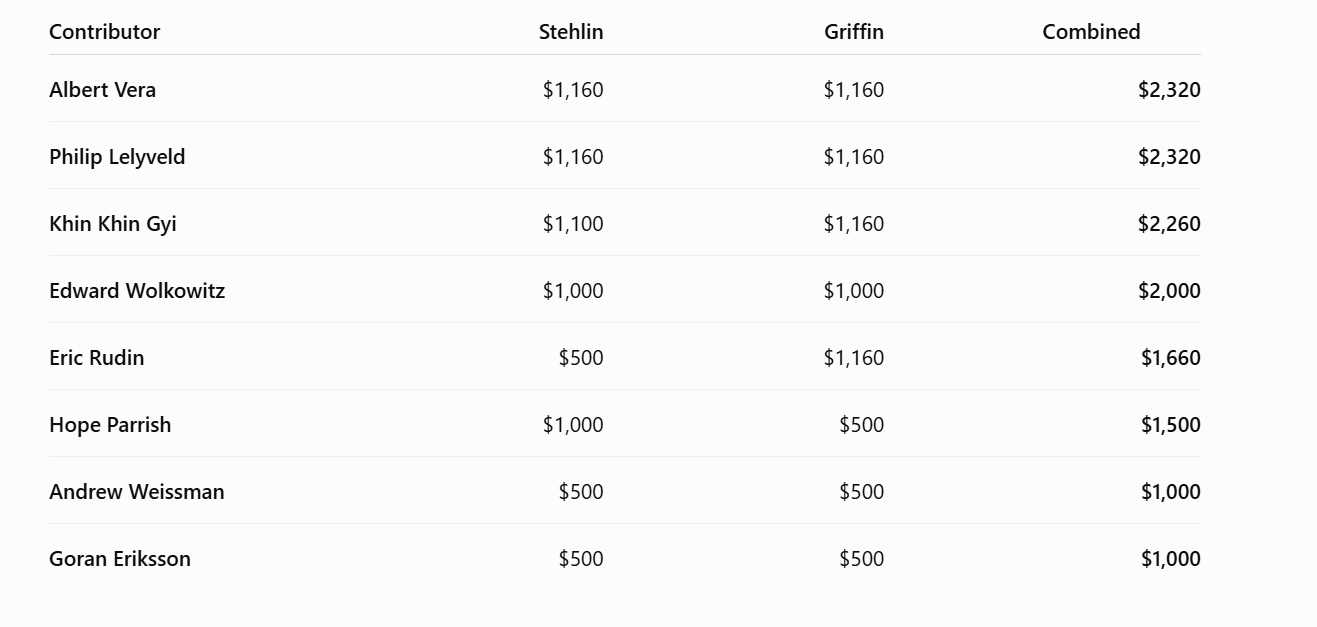
There were additional contributors appearing in both campaigns at smaller amounts.
Again:
This does not establish that Stehlin and Griffin are coordinating their campaigns.
It establishes that they have significant overlap among some of their contributors.
That is an important distinction.
One donor appears across three campaigns
I found one contributor in the dataset who appeared in three of the four candidate campaigns:
Michael Cohen
The transactions showed:
Puza — $100
Stehlin — $100
Griffin — $100
Total:
$300
I did not identify anyone in this dataset who contributed to all four candidate campaigns.
Puza and Small have much less overlap
Compared with the Stehlin-Griffin donor network, the overlap between Freddy Puza and Thomas Small was much smaller.
One example is:
Haifaa Moammar
Puza — $100
Small — $1,160
That is interesting because it illustrates why simply labeling donors as belonging to one political “side” can be misleading.
People can—and do—support more than one candidate.
Then I looked at Our Culver
This is where things become even more interesting.
Our Culver is a Culver City political organization organized as a 501(c)(4).
Its 2026 Form 460 identifies it as committee ID 1476034. The filing covering January 1 through June 30, 2026 reports $3,440 in contributions during that period and an ending cash balance of $13,135.20.
Then I compared Our Culver's contributors with the Council candidate donor lists.
I found several people who contributed to both Our Culver and Freddy Puza during the period examined.
Examples include:
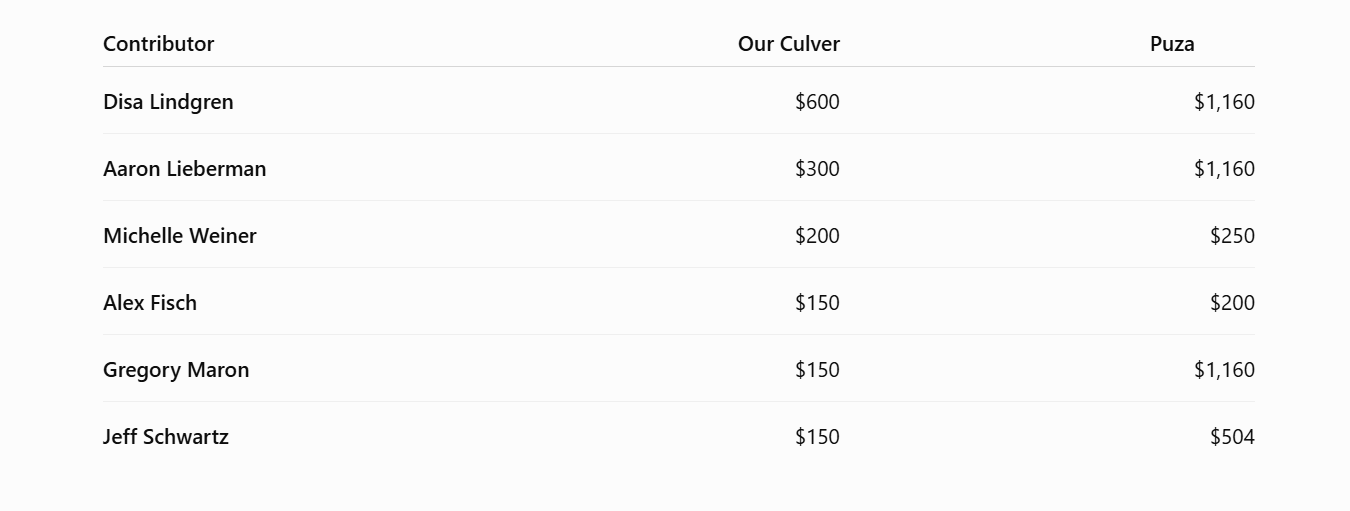
Our Culver's own Form 460 confirms recurring contributions from several of these individuals.
That gives us a visible donor overlap between:
Some Our Culver contributors → Freddy Puza
But this is where I want voters to be very precise.
This does not mean Our Culver gave Puza this money.
These are individuals who contributed to both.
That distinction matters.
Our Culver also spends money politically
Our Culver is not merely receiving contributions.
Its 2026 Form 460 reports a $342.60 independent expenditure for text messages supporting the “Excellence for Culver City Schools” ballot-measure signature effort.
That demonstrates why looking only at candidate campaign accounts can give voters an incomplete picture.
Political organizations can raise money.
Candidates can raise money.
PACs can raise money.
And organizations can independently spend money on political activity.
All of those deserve scrutiny.
The Democratic Club connection
I also compared contributors associated with the Culver City Democratic Club with contributors to the candidates.
Several names appearing in that donor network also contributed to Puza.
They included people such as:
Bubba Fish
Cynthia Hart
Gregory Maron
Jeanna Harris
Mary Daval
Another donor, Harden Fisch, appeared in Small's contributor records.
Once again, this doesn't establish that the Democratic Club directed these contributions.
It shows that individuals involved in or contributing to one political organization also appear in candidate fundraising records.
Culver City Democrats United
Another cluster appears around Culver City Democrats United.
Contributors associated with that organization who also appeared among Stehlin contributors included:
Edward Wolkowitz
Jamie Wallace
Judith Scott
Melissa Sanders
Steven Gourley
Several also appeared among Griffin's contributors.
That creates another visible network:
Culver City Democrats United contributors → Stehlin → Griffin
Not exclusively.
Not universally.
But enough overlap to be visible in the records.
The Culver City Coalition
The Culver City Coalition produces another smaller connection.
Two names in particular appeared both in Coalition-related records and among donors to Stehlin and Griffin:
Eric Rudin
and
Marta Valdez
Again, that doesn't mean the Coalition controls either campaign.
It tells us that some of the same people participate financially in both political organizations and candidate campaigns.
So what does the donor map actually look like?
If I reduce hundreds of transactions into a very simple map, I see something like this:
One cluster
Our Culver contributors
↓
Freddy Puza
with additional overlap involving some individuals associated with the Democratic Club.
Another cluster
Culver City Democrats United contributors
↓
Jeannine Wisnosky Stehlin
↕
Kimberley Griffin
with additional shared contributors appearing around the Culver City Coalition.
Another candidate
Thomas Small
appears to have a comparatively more distinct contributor base in this particular dataset.
That doesn't mean Small is politically isolated.
It means the donor overlap visible in this particular dataset is considerably smaller.
Why should voters care?
Because endorsements tell you one thing.
Candidate websites tell you another.
Campaign mail tells you another.
But money can reveal connections that are otherwise difficult to see.
For example, imagine you repeatedly see the same names contributing to:
a political organization,
a political club,
a PAC,
and two City Council candidates.
That doesn't tell you what those people discussed.
It doesn't tell you what they expect.
It doesn't tell you whether the candidates agree with everything those donors believe.
But it does tell you:
these people are financially participating in the same part of the local political ecosystem.
That is useful information.
And there is nothing inherently wrong with this
This point deserves emphasis.
People have the right to participate in politics.
If someone believes two candidates would make good councilmembers, that person can support both.
If someone supports a political organization and a candidate, that is also legitimate.
Businesses organize.
Labor organizes.
Renters organize.
Homeowners organize.
Environmental groups organize.
Political clubs organize.
And individuals write checks.
The existence of a network doesn't establish wrongdoing.
But hiding the network from voters would defeat the purpose of campaign-finance disclosure.
California requires disclosure precisely so the public can see where political money comes from and where it goes.
Be careful with words like “machine”
I have previously written about what I call Culver City's political machinery.
The donor records help explain what political machinery can look like.
But I think there is an important distinction.
A political network consists of:
people,
organizations,
endorsements,
contributors,
volunteers,
consultants,
PACs,
clubs,
and relationships.
A political machine, historically, implies something stronger—a coordinated organization capable of exercising sustained political influence.
The campaign-finance data alone cannot prove that.
What it can demonstrate is the network underneath local politics.
And voters can decide for themselves whether that network has too much influence, too little influence, or exactly the influence political participation is supposed to provide.
There is another important limitation
My campaign does not appear as a filer in the particular 2026 transaction export I analyzed.
So this should not be presented as a five-candidate comparison yet.
It is currently a comparison of the four other candidate committees appearing in that export.
When my campaign transactions become available in the same dataset, I intend to apply exactly the same analysis to myself.
That's important.
Transparency cannot mean:
investigate everybody except me.
If we're going to follow the money, we should follow all of it.
Try this yourself
This is the part I hope residents take away from Episodes 27 and 28.
Don't rely on my interpretation.
Go to Culver City's campaign-finance portal.
Select:
Filings & Research → Search Transactions
Set the dates.
Download the CSV.
Put contributors into a spreadsheet.
Compare them.
Then go to:
Search Independent Expenditures by Date
Look there too.
You may be surprised by what you find.
The bigger lesson
One of the reasons I started The Strange World of Politics was because I realized how much local politics happens in a world most residents never see.
Before running for office, most people probably don't spend their evenings reading Form 460s.
They probably don't know what a Form 497 is.
They don't know what Schedule A or Schedule D means.
They don't search committee identification numbers.
They don't download hundreds of campaign transactions into spreadsheets.
I certainly didn't spend my life doing that.
But once you start looking, the political structure becomes much easier to see.
Candidates don't operate alone.
Organizations don't operate alone.
Donors don't necessarily support only one candidate.
The lines cross.
The circles overlap.
And that is why campaign-finance disclosure matters.
The money doesn't necessarily tell you what to think.
But it tells you where to look.
And in the strange world of politics, sometimes drawing the lines between the names tells you more than looking at any one name by itself.
0 Comments