
Most of us think we understand voting.
We vote for candidates.
We vote on ballot measures.
Sometimes we vote directly on taxes or other questions placed before us.
But here is something I have been learning during my campaign for Culver City City Council:
Voting for a representative can give that person the legal authority to make some very significant decisions on your behalf without asking you to vote again on each one.
That sounds obvious when you say it.
But the consequences may not be.
A Lesson From Culver City's New Bonds
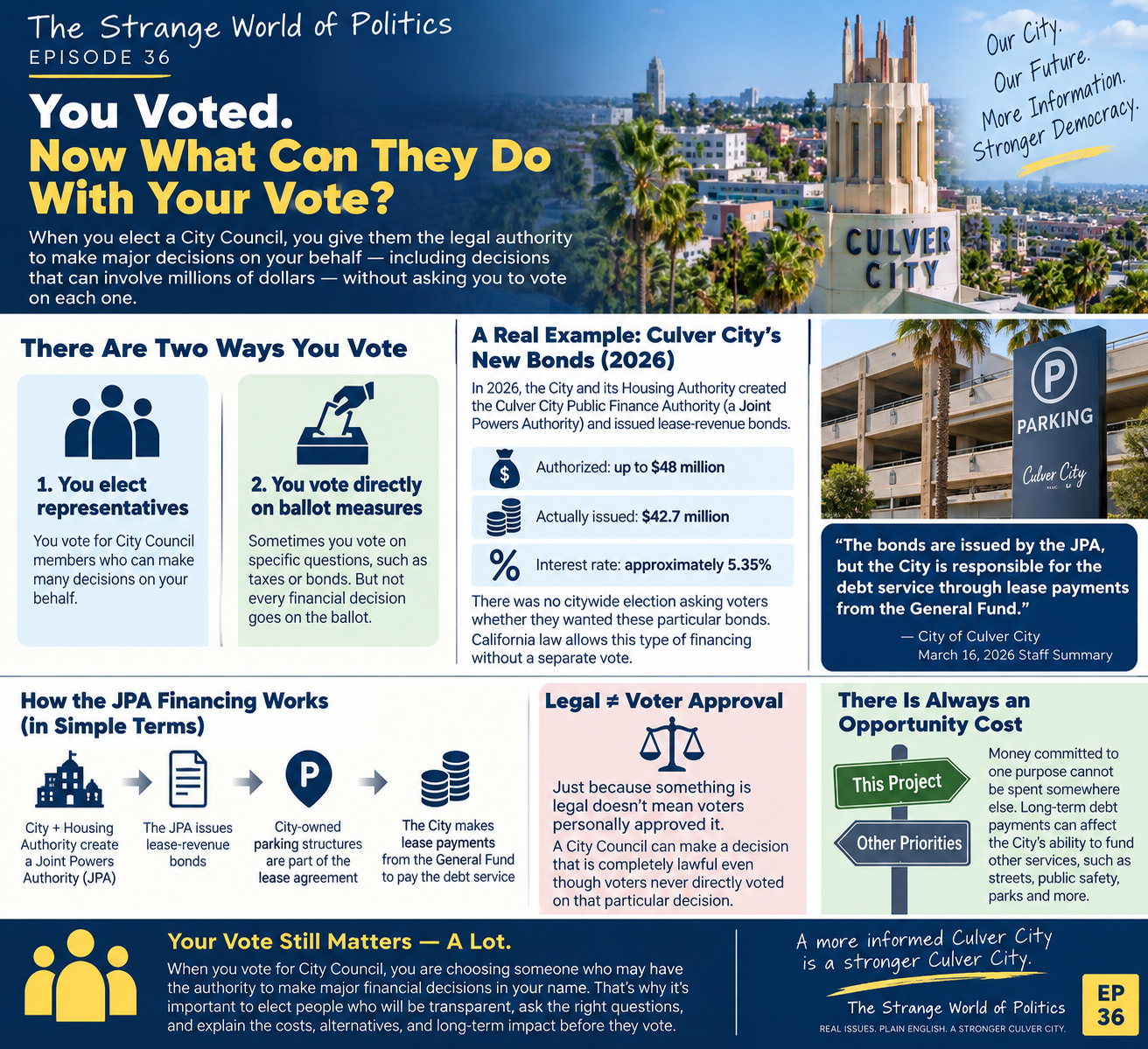
In 2026, Culver City created something called the Culver City Public Finance Authority.
This is a Joint Powers Authority, commonly called a JPA.
Don't let the terminology scare you.
In simple language, the City and its Housing Authority created a separate public entity that can be used as a financing vehicle.
The City then used that structure to issue lease-revenue bonds.
The City Council authorized up to $48 million in bonds. The final issuance was approximately $42.7 million, at an interest rate of approximately 5.35%.
And here is the part voters should understand:
There was no citywide election asking Culver City voters whether they wanted these particular bonds issued.
That does not by itself make what happened improper.
The City described the financing as a way to fund priorities including affordable housing, infrastructure, sidewalks, streets, alleys, parks and recreation improvements, and other capital projects.
And California law provides mechanisms through which local governments can undertake certain financing without holding an election on every transaction.
That distinction is the point of this episode.
"But I Didn't Vote for That"
This is where representative democracy becomes very important.
When you vote for a City Council member, you aren't simply voting for someone to attend meetings and fix potholes.
You are choosing someone who may have the legal authority to make decisions involving millions of dollars of public resources and financial commitments extending years into the future.
The City's own explanation of the 2026 financing makes this particularly interesting.
Although the bonds are issued through the Public Finance Authority, the City explained that Culver City is responsible for the debt service through lease payments.
Those payments come from the City's General Fund.
The General Fund is the City's main operating pot of money—the same broad fund used to support many City services.
So voters should understand an important distinction:
You may not vote directly on every financial decision, but the people you elect may vote on those decisions for you.
Legal Does Not Mean Voters Personally Approved It
This distinction gets lost in political arguments.
There are really two separate questions:
Question 1: Is the government legally allowed to do something?
Question 2: Do residents think it is a good use of their government's resources?
Those aren't the same question.
A City Council can make a decision that is completely lawful even though voters never directly voted on that particular decision.
That is not necessarily a loophole.
That is, in many circumstances, how representative government is designed to work.
We elect representatives precisely because it would be impractical to hold a citywide election every time the City signs a contract, adopts a budget, purchases property, borrows money or undertakes a capital project.
But that creates an enormous responsibility for voters.
Your Vote Doesn't End on Election Day
This may be the most important lesson.
When you vote for someone for City Council, you aren't only choosing between personalities or campaign slogans.
You are delegating governmental power.
The person you elect may eventually be asked to decide questions you never heard about during the campaign.
Should the City borrow money?
Should it purchase property?
Should it sell property?
Should it subsidize a project?
Should it spend money on affordable housing?
Sidewalks?
Police?
Parks?
Bicycle infrastructure?
Trees?
Schools?
Should it enter into a financial arrangement lasting many years?
You probably won't receive another ballot asking you to approve every one of those decisions.
Your elected representatives may make them for you.
The JPA Makes This Especially Interesting
Culver City's experience demonstrates how complicated municipal finance can become.
The City Council first authorized pursuit of a JPA financing structure in March 2026.
In April, the Council approved creation of the Culver City Public Finance Authority through an agreement between the City and the Housing Authority.
City-owned parking structures became part of the lease structure.
The Public Finance Authority could issue bonds.
The City would make lease payments from the General Fund.
Then, in June, the Council authorized up to $48 million of lease-revenue bonds.
The final issuance was approximately $42.7 million.
All of this could lawfully occur through actions of elected officials and the public entities involved without a separate citywide vote on those particular bonds.
Whether you support or oppose how the money was used is a separate question.
The important thing is understanding who had the authority to make the decision.
"But Haven't Cities Done This Before?"
Yes.
Culver City has historical experience with public financing authorities, and JPAs are widely used by California governments.
That history matters because I don't want to suggest that Culver City suddenly invented some unusual financial device in 2026.
It didn't.
But historical precedent doesn't eliminate the underlying democratic question:
How much authority are we comfortable delegating to the people we elect, and how transparent should they be when exercising it?
My answer on transparency is simple.
As much as legally possible, tell us what you are doing.
Tell us what it costs.
Tell us how long we will be paying for it.
Tell us where the money comes from.
Tell us what alternatives were considered.
And tell us what else we might not be able to fund because of that decision.
There Is Always an Opportunity Cost
This is another concept voters should understand.
Government money is finite.
Suppose a future City Council commits General Fund money to debt payments for many years.
That doesn't automatically mean the decision was bad.
The project financed by that debt may provide substantial benefits.
But those future payments become part of the City's financial obligations.
Money committed to one purpose is money that cannot simultaneously be spent somewhere else.
That is why the City's own April discussion of the financing included balancing long-term debt obligations against infrastructure, street safety, affordable housing, reserves and other community priorities.
Those are legitimate choices elected officials have to make.
But voters should know those choices are being made.
The Real Power of Your Vote
We sometimes treat local elections as though we are hiring someone to represent our general political philosophy.
I increasingly think that is incomplete.
You are hiring someone to exercise governmental authority in your name.
And some of the most important votes that person will cast may involve issues that didn't even exist when you elected them.
That means voters should ask candidates more than:
"Do I agree with this person?"
Ask:
Will this person explain complicated decisions to me?
Will this person tell me what something actually costs?
Will this person discuss the alternatives?
Will this person distinguish what is legally permissible from what they believe is good policy?
Will this person tell the public about the financial consequences before voting rather than explaining them afterward?
Those questions matter because once an election is over, voters have transferred substantial decision-making authority to five people sitting on the Culver City City Council.
Welcome to the Strange World of Politics
This episode started with a disagreement I had about Culver City's financing structure.
I learned something from that disagreement.
The better question wasn't simply:
"Can they legally do this without putting it on the ballot?"
In this instance, the answer is that the City used a financing mechanism that did not require a separate citywide vote on these particular lease-revenue bonds.
The more interesting question is:
"If our elected representatives have the legal authority to make decisions like this for us, what do we expect from them before they exercise that authority?"
For me, that brings us back to transparency.
Representative democracy cannot mean:
You elected us, so trust us.
It works better when it means:
You elected us to make decisions. Now we owe you an explanation of what we are doing, what it costs, what the alternatives are, and why we believe it is the right decision.
Because Election Day isn't the end of your involvement in government.
It is the day you decide who gets to exercise some of that power on your behalf.
And that may be one of the most important things to remember before you vote.
— Franklin Carvajal
Candidate for Culver City City Council
0 Comments
Comments are reviewed before they appear.