
Once you decide to run for office, you quickly discover something about politics that nobody puts on a campaign sign:
There are forms. Lots and lots of forms.
In the previous episodes of The Strange World of Politics, I talked about going to the Culver City clerk's office, receiving the candidate packet, collecting signatures, getting sworn in, and beginning the actual work of becoming a candidate.
Then comes another adventure: California campaign-finance paperwork.
And this is where things can get confusing very quickly.
First, it's Form 410, not Form 401
Let's get one confusing detail out of the way.
The form I'm talking about is California FPPC Form 410 — Statement of Organization.
Form 401 is something entirely different.
This may sound like a minor distinction, but when dealing with government paperwork, getting one number wrong can send you searching for a completely different document.
What exactly is Form 410?
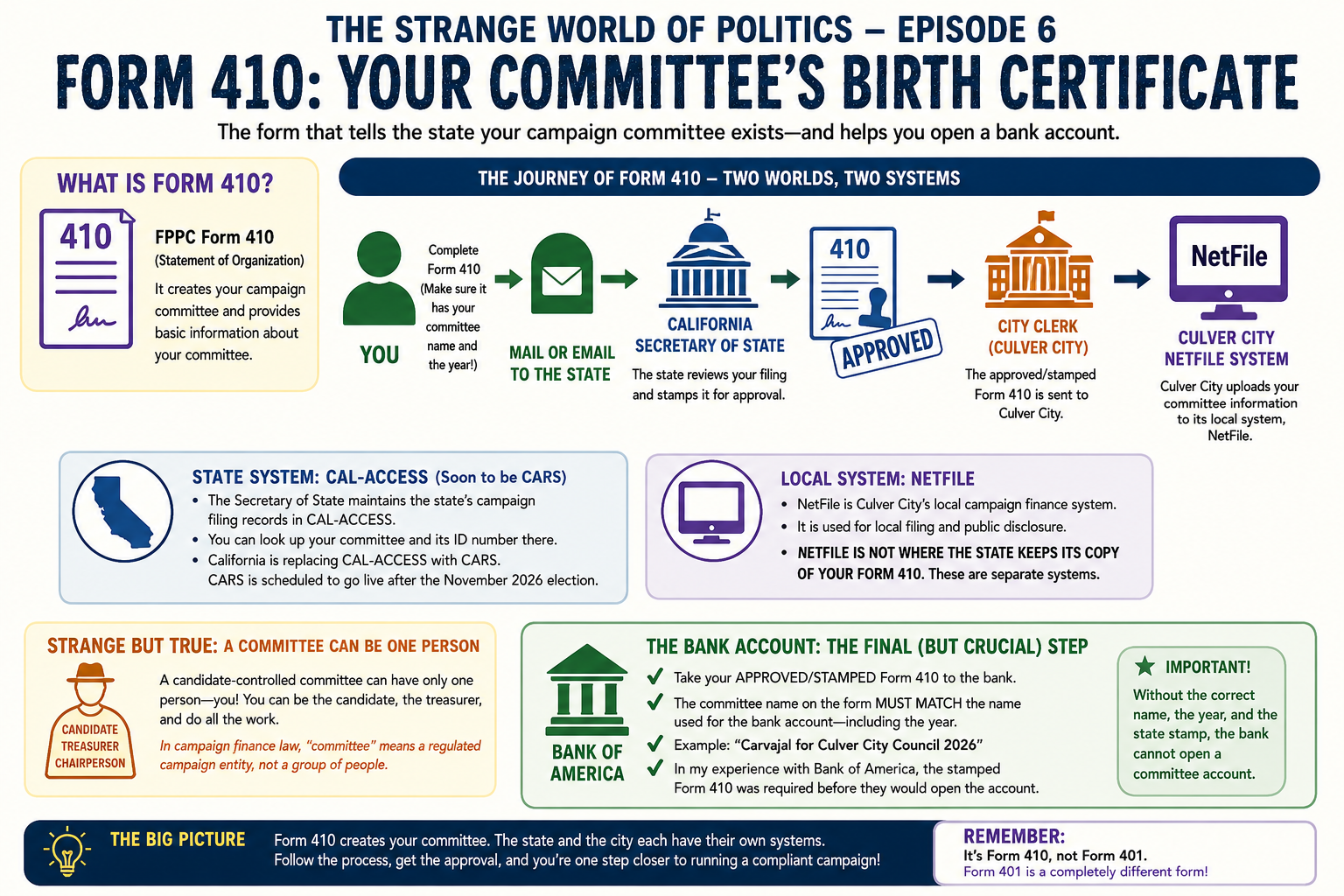
In very simple terms, Form 410 tells the State of California that your campaign committee exists.
Think of it almost like a birth certificate for the campaign committee.
California wants information identifying the committee, including the candidate, the office being sought, the committee's treasurer, and the committee's official name.
For a local candidate, that name might look something like:
Carvajal for Culver City Council 2026
Remember that name. It becomes surprisingly important when you eventually walk into the bank.
Here's the strange part: a "committee" can essentially be one person
When most people hear the word committee, they imagine a group.
Five people around a conference table sounds like a committee.
Ten people sounds even more like a committee.
One person?
Apparently, welcome to campaign finance.
A candidate can serve as the treasurer of their own candidate-controlled committee. So, particularly at the beginning of a campaign, one person can potentially wear several hats.
You can therefore have a conversation that sounds something like this:
"I formed a campaign committee."
"Great. Who's on the committee?"
"Well...me."
The terminology makes more sense once you understand what California means by "committee." In campaign-finance law, the term describes a regulated campaign-finance entity. It does not necessarily mean a traditional committee consisting of a room full of people.
Where does Form 410 actually go?
Now we enter another part of the strange world.
For a city council candidate, the original Form 410 is filed with the California Secretary of State, and a copy is filed with the city clerk.
The Secretary of State processes the committee information and assigns the committee an identification number.
California also maintains its own campaign-finance records through a state system called CAL-ACCESS.
That means the state side of the process is separate from the system you may encounter at Culver City.
And this distinction is important.
CAL-ACCESS and NetFile are NOT the same thing
This was one of the things I initially found confusing.
California has its state campaign-finance system, CAL-ACCESS. A candidate can search the Secretary of State's CAL-ACCESS records for a committee and its assigned identification number.
Culver City, meanwhile, uses NetFile for its local campaign-finance filing and disclosure system.
So a simplified way to picture the process is:
STATE LEVEL
Candidate → Form 410 → California Secretary of State → Committee ID → CAL-ACCESS
LOCAL LEVEL
Candidate/committee → Culver City clerk → Culver City's local campaign records → NetFile
Those systems should not be confused with each other.
NetFile is not where the State of California simply keeps its own copy of your Form 410.
It is a system Culver City uses for local campaign-finance administration and disclosure.
The Secretary of State maintains the state's campaign-finance records separately through CAL-ACCESS.
And, because government paperwork apparently needs an occasional sequel, California is now replacing CAL-ACCESS with a newer system called the CAL-ACCESS Replacement System, or CARS. As of August 2026, the Secretary of State says the new system is scheduled to go live after the November 2026 election.
So eventually even the state system itself is changing.
How do you send Form 410 to the state?
The Secretary of State provides filing procedures for Form 410.
Traditionally, candidates may think of this as something that has to be physically mailed to Sacramento. But California also has procedures allowing qualifying campaign filings to be submitted electronically by email when they contain the required verified digital signature.
The important lesson for a first-time candidate is:
Don't assume that submitting something to Culver City's NetFile means you have automatically completed your filing obligation with the California Secretary of State.
They are separate systems with separate purposes.
Always follow the current FPPC and Secretary of State filing instructions because campaign-finance requirements and electronic filing procedures can change.
Then comes the bank account
Now we arrive at another surprisingly complicated part of becoming a candidate.
The campaign needs a campaign bank account.
Campaign money isn't supposed to simply disappear into your regular personal checking account. The campaign's financial activity needs to be identifiable and traceable.
So off I went to Bank of America to open an account for the committee.
You might imagine the conversation going like this:
"I'm running for Culver City Council and need a campaign account."
"Wonderful. Here's your account."
Not quite.
The bank needs documentation identifying the committee.
And that brings you right back to Form 410.
The committee name matters—a lot
Based on my experience opening the committee account at Bank of America, the bank required the processed/stamped committee documentation before it could establish the campaign committee account.
There was also another seemingly small detail that became extremely important:
The committee name on the documentation needs to match the committee name being used to open the bank account.
And that includes the election year when the year is part of the official committee name.
So if the official committee is:
Carvajal for Culver City Council 2026
you don't want to walk into the bank with documentation identifying it differently.
To a normal person, the difference may seem trivial.
To the bank, these are legal and financial records identifying the entity for which the account is being opened.
And, based on my Bank of America experience, the documentation also needed to show that it had been processed/stamped before the bank would open the committee account.
That is an important practical lesson for another first-time candidate: before going to the bank, ask exactly what version of the Form 410 or other committee documentation that particular bank requires.
Why does California make candidates do all of this?
Underneath all of the bureaucracy is actually a reasonable idea.
Campaigns receive and spend money to influence elections.
If someone gives a candidate $100, $500, or some other amount to help that person get elected, the public has an interest in eventually being able to answer basic questions:
Who contributed to the campaign?
How much money did the campaign receive?
Where did the campaign money go?
Who controls the money?
How much did the campaign spend?
Creating a committee and a separate campaign bank account establishes a financial trail.
That makes it possible for campaign money to be reported and disclosed rather than simply mixed together with someone's personal finances.
The beginner's version
If all of this has made your head spin, here is the simple version I wish someone had given me at the beginning:
Form 410 identifies and organizes your campaign committee.
Your "committee" does not necessarily mean a group of people. A candidate can serve as their own treasurer, so the operation can essentially begin with one person wearing multiple hats.
For a city council candidate, the original Form 410 goes to the California Secretary of State, and a copy goes to the city clerk.
The Secretary of State maintains state campaign-finance records through CAL-ACCESS, which is being replaced by CARS.
Culver City uses NetFile for its local campaign-finance system.
CAL-ACCESS and NetFile are not the same database.
And then there is the bank.
If you are opening a campaign committee account, make sure the committee documentation meets your bank's requirements and that the committee name matches exactly—including the election year if the year is part of the official committee name.
In my experience with Bank of America, that processed/stamped documentation was essential to getting the account opened.
Once you understand the pieces, it starts to make sense:
Form 410 → State committee registration → Local filing requirements → Campaign bank account → Campaign financial reporting
Simple, right?
Well, simple after somebody explains it.
Before that, it's just another episode in The Strange World of Politics.
0 Comments