
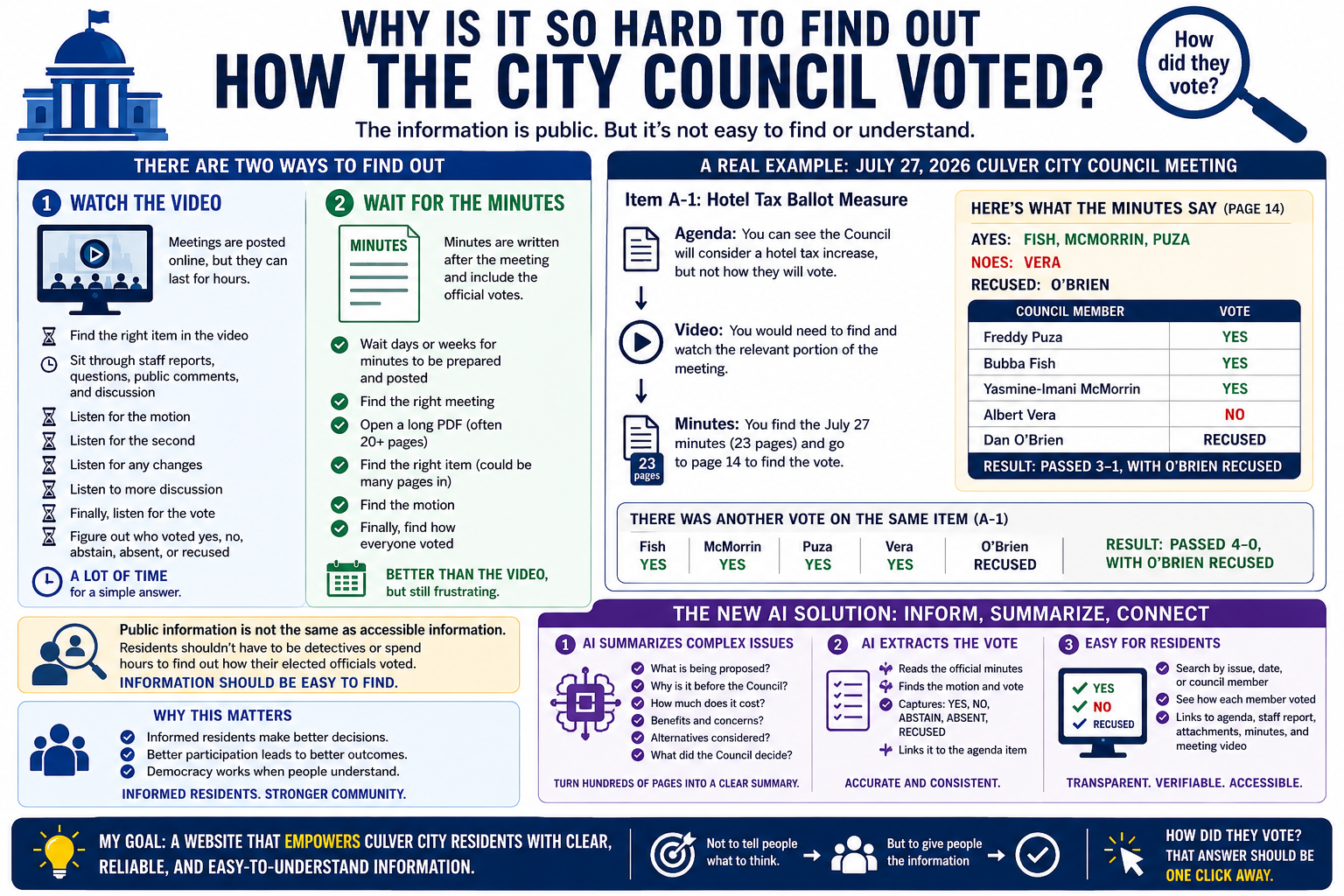
As I continue my journey into the strange world of local politics, I keep discovering things that make me ask the same question:
Why does this have to be so complicated?
For Episode 7, I ran into another example.
Suppose you're a Culver City resident and want to know something incredibly basic:
How did each City Council member vote on an issue?
You would think you could go to the City's website, find the issue and immediately see five names with YES, NO, ABSTAIN, ABSENT or RECUSED next to them.
Not exactly.
Welcome to another episode of The Strange World of Politics.
First Stop: The Agenda
Before a City Council meeting, the City publishes an agenda.
The agenda is useful. It tells residents what the Council plans to discuss and usually provides staff reports, recommendations and supporting documents.
But there's an obvious problem.
The agenda is prepared before the meeting.
It tells you what the Council is going to consider. It can't tell you what the Council ultimately decided or how each council member voted.
So you can read an entire agenda—and potentially hundreds of pages of supporting material—and still not know whether your council member voted YES or NO.
Where do you go next?
Option #1: Watch the Video
One way to find out is to watch the City Council meeting.
The meetings are recorded and made available online.
Problem solved?
Not quite.
Council meetings can last for hours.
First, you have to locate the issue you're interested in. Then you may have to sit through a staff presentation, questions from council members, public comments and council discussion.
Eventually, someone makes a motion.
Someone seconds it.
The motion might be changed.
There may be more discussion.
Eventually, the Council votes.
Now you have to listen carefully enough to determine who voted yes, who voted no, whether someone abstained, whether someone was absent or whether someone recused themselves.
And if there is no easily accessible transcript, you may have to move around a several-hour recording trying to find a vote that may take less than a minute.
All of this to answer one simple question:
How did they vote?
Option #2: Wait for the Official Minutes
There is another way.
You can wait for the official minutes.
Minutes are different from agendas.
The agenda tells you what the Council plans to consider.
The minutes tell you what actually happened.
They can contain the motions, decisions and voting results.
That's much better if all you want to know is how the Council voted.
But there's a catch:
You have to wait for the minutes to be prepared and published.
So if you want to know what happened shortly after a meeting, you may have to watch the video.
If you're willing to wait, you can eventually find the official minutes and search through those instead.
Neither option is particularly convenient for an ordinary resident who simply wants to know what their elected representatives did.
A Real Example: July 27, 2026
I recently looked at the official minutes from the July 27, 2026 Culver City Council meeting.
The document is 23 pages long.
One of the major issues that evening was Item A-1, concerning a proposal to put an increase in Culver City's Transient Occupancy Tax—the hotel tax—before voters.
The proposal involved increasing the hotel tax to 15% until March 1, 2028 and up to 16% thereafter.
If you looked at the agenda before the meeting, you could learn that the Council was considering the proposal.
But you couldn't know how anyone ultimately voted.
To learn that immediately, you would have needed to find and watch the relevant portion of the meeting video.
Or you could wait for the official minutes.
Then you would need to locate the correct meeting, open the 23-page document, find Item A-1 and make your way to page 14.
Finally, you get your answer:
AYES: Fish, McMorrin, Puza
NOES: Vera
RECUSED: O'Brien
In ordinary language:
Council memberVoteFreddy PuzaYESBubba FishYESYasmine-Imani McMorrinYESAlbert VeraNODan O'BrienRECUSED
The motion passed 3-1, with O'Brien recused.
There it is.
That's exactly the information a resident might want.
But why did I have to find page 14 of a 23-page document to get it?
Wait—There Was Another Vote on the Same Item
It gets more complicated.
The Council wasn't finished with Item A-1.
There was another motion concerning authorization of ballot arguments and creation of an ad hoc subcommittee.
That vote was:
Fish — YES
McMorrin — YES
Puza — YES
Vera — YES
O'Brien — RECUSED
That motion passed 4-0, with O'Brien recused.
Think about that.
Even asking:
"How did the Council vote on Item A-1?"
may not be specific enough.
There can be multiple votes on the same agenda item.
Welcome again to the strange world of politics.
And There Were Plenty of Other Decisions
The July 27 meeting also included a consent calendar covering Items C-1 through C-9.
Those items included decisions involving cash disbursements, sidewalk work, parking services, tax reports, parking equipment, illegal dumping and encampment abatement, a special-events grant and an additional $500,000 for citywide tree maintenance.
The minutes state that Vice Mayor Fish moved approval of C-1 through C-9, Council Member McMorrin seconded the motion, and the consent calendar was "unanimously carried."
There were other votes too.
For Item A-3, involving the civil penalty schedule for parking violations, Fish made the motion, Puza seconded it, and the motion was unanimously carried.
For Item A-4, the Council created a Standing Affordability Subcommittee, appointed Puza and McMorrin and dissolved the Minimum Wage Ad Hoc Subcommittee. That motion was also unanimously carried.
These are real government decisions involving taxes, contracts, fines, public spending and public policy.
Residents should be able to see them easily.
Even "Absent" and "Recused" Can Get Confusing
The July 27 minutes contain another interesting example.
Earlier in the meeting, the Council voted to receive and file correspondence.
The recorded result showed:
Fish — YES
O'Brien — YES
Puza — YES
Vera — YES
McMorrin — ABSENT
The minutes then contain an important clarification. McMorrin had initially been marked recused, but she was actually absent from the dais.
Those aren't the same thing.
A useful voting record should distinguish clearly between:
YES — NO — ABSTAIN — ABSENT — RECUSED
Residents shouldn't have to become experts in municipal minutes to figure this out.
Public Information Is Not Necessarily Accessible Information
I want to make an important distinction.
I'm not suggesting that Culver City is hiding Council votes.
The information is public.
The agenda is public.
The meeting is public.
The video is public.
The minutes are public.
The problem is that public information isn't necessarily accessible information.
There's a big difference between:
"The information is somewhere on our website."
and:
"Here is the information you're looking for."
A resident shouldn't have to understand agendas, staff reports, meeting videos, municipal minutes and parliamentary procedure just to determine whether their elected representative voted YES or NO.
And Finding the Vote Is Only Half the Problem
There's an even bigger issue.
Suppose I make it easy for you to discover that a council member voted YES.
Your next question might reasonably be:
YES to what?
That can be much harder to answer.
City Council agenda items can involve lengthy staff reports, financial documents, contracts, ordinances, resolutions, environmental studies, consultant reports and numerous attachments.
Sometimes a resident may need to read dozens—or even hundreds—of pages to understand what five council members are being asked to decide.
This is where I believe artificial intelligence can become an extremely useful tool for public information.
Using AI to Explain Complicated City Issues
Imagine clicking on an agenda item and seeing a short, plain-language explanation before diving into all of the City's original documents.
AI could help answer basic questions such as:
WHAT IS BEING PROPOSED?
What exactly is the Council being asked to approve?
WHY IS THIS BEFORE THE COUNCIL?
What problem is the proposal intended to address?
WHAT DOES IT COST?
How much money is involved?
WHERE DOES THE MONEY COME FROM?
The General Fund? A grant? A special fund? Bonds? Fees?
WHAT ARE THE POTENTIAL BENEFITS?
What arguments or expected benefits are presented in support of the proposal?
WHAT ARE THE POTENTIAL DRAWBACKS OR CONCERNS?
What costs, tradeoffs, risks or objections are identified in the public materials?
WHAT DID THE COUNCIL DECIDE?
And finally:
HOW DID EACH COUNCIL MEMBER VOTE?
Suddenly, a complicated City Council item becomes something an ordinary resident can begin to understand in a few minutes.
AI Should Explain the Sources—Not Replace Them
There is an important distinction here.
I don't want AI telling residents what they should think about an issue.
I want AI helping residents understand the information so they can decide what they think.
That's very different.
Every AI-generated summary should point residents back to the original City documents.
A resident should be able to read the simple explanation and then click:
Agenda | Staff Report | Attachments | Meeting Video | Official Minutes
If you want the summary, it's there.
If you want to investigate further, the original evidence is one click away.
AI should not become the source of truth.
The City's official documents should remain the source of truth.
AI should be a tool for making those documents easier to navigate and understand.
Imagine What This Could Look Like
Instead of searching through documents, imagine seeing:
Item A-1 — Hotel Tax Ballot Measure
WHAT IS IT?
A proposal concerning an increase in Culver City's hotel tax.
WHAT HAPPENED?
The Council voted to place the measure before voters.
RESULT: PASSED 3-1
Council memberVoteFreddy PuzaYESBubba FishYESYasmine-Imani McMorrinYESAlbert VeraNODan O'BrienRECUSED
Want to know more?
Read the Staff Report | Read the Minutes | Watch the Meeting
That's information people can actually use.
Why Not Create a Searchable Council Voting Database?
We already have most of the information necessary to do this.
The agenda tells us what was proposed.
The staff report explains the City's analysis and recommendation.
The video records what happened during the meeting.
The minutes provide the official written record of the decision.
Technology could connect all of these sources.
Residents could search by:
Council member
Housing
Traffic
Bike lanes
Taxes
Homelessness
Development
Public safety
City spending
Click on an issue and see what was proposed, a plain-language summary, what the Council decided and how everyone voted.
Click on a council member and see that person's voting history.
And every entry could link back to the City's original records.
This Is Why Informing the Public Is Central to My Campaign Website
This experience explains something important about my campaign.
A major focus of my campaign is informing the public.
That's why I don't want my campaign website to simply contain photographs, campaign slogans and statements about why people should vote for me.
I want it to be useful.
As I go through the process of running for City Council, I'm learning where these documents are, how the process works, what the terminology means, where public money comes from and where Council decisions are actually recorded.
And I keep thinking:
Why shouldn't everyone have easy access to this information?
That's what I'm trying to do with my website.
If there's an important housing proposal, I want residents to be able to understand it.
If the City is spending millions of dollars, I want residents to be able to understand what the money is being spent on and where it comes from.
If the Council is considering a tax, residents should be able to understand what the tax does.
If an issue has legitimate arguments on both sides, residents should be able to understand those arguments.
And when the Council finally votes, residents should be able to see who voted YES and who voted NO.
From Government Documents to Useful Information
This is where I think technology—and particularly AI—can fundamentally improve public access to local government.
Imagine taking a complicated 100-page City report and turning it into a five-minute explanation.
Not by eliminating the 100-page report.
Not by replacing it.
And certainly not by telling residents what conclusion they should reach.
Instead:
Here is the complicated information.
Here is what it means in ordinary language.
Here are the potential benefits.
Here are the potential drawbacks.
Here is what it costs.
Here is what the Council decided.
Here is how everyone voted.
And here are the original documents so you can check everything yourself.
That's the model I want my website to pursue.
Residents Have Better Things to Do
Most Culver City residents aren't going to spend their evenings watching four-hour Council meetings.
They aren't going to read every 100-page staff report.
They aren't going to search through 23 pages of minutes looking for three lines containing AYES and NOES.
They have jobs.
They have families.
They have businesses.
They walk their dogs, take their children to activities, pay their bills and live their lives.
That doesn't mean they don't care about their city.
It means government needs to communicate with people in a way that respects their time.
A resident interested in one particular issue should be able to answer:
What is this?
Why does it matter?
How much does it cost?
What are the arguments for and against it?
What did the Council decide?
How did each council member vote?
And if that resident wants to investigate further, all the original material should be right there.
Another Lesson From the Strange World of Politics
Every episode of this journey teaches me something new about how government actually operates.
Episode 7 taught me something particularly important:
There's a difference between making government information public and making government information understandable.
Culver City already produces enormous amounts of information.
The agenda tells us what's coming.
The staff reports provide the details.
The video shows us what happened.
The minutes eventually provide the official result.
Now technology gives us the opportunity to connect those pieces and explain them in a way ordinary people can actually use.
That's one of the purposes of my campaign website.
I want to take information that is technically public but often complicated, scattered or time-consuming to find and make it easier for Culver City residents to understand.
AI can help summarize the complicated issues.
Technology can organize the information.
The City's original records can provide the evidence.
And residents can make up their own minds.
Because the goal shouldn't be to use technology to tell people what to think.
The goal should be to give people the information they need to think for themselves.
And when it comes to the people representing us, one of the most fundamental questions should have one of the easiest answers:
How did you vote?
In 2026, that answer—and an understandable explanation of what they were voting on—should be one click away.
0 Comments