
Running for office introduces you to organizations you probably never thought much about before becoming a candidate.
You fill out questionnaires. You send in your answers. Then sometimes you get invited to an interview because an organization is considering endorsing you.
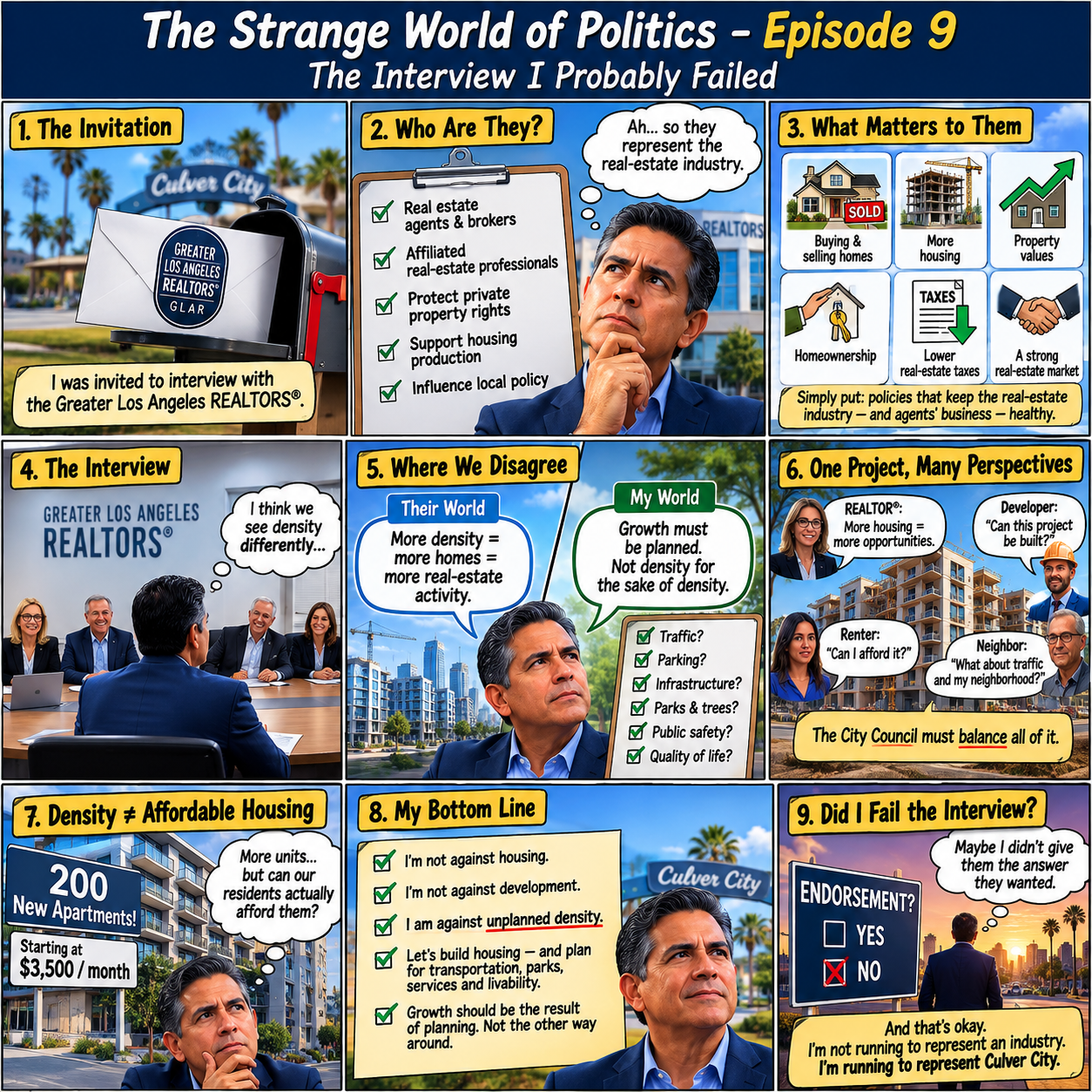
That brings me to my latest adventure in The Strange World of Politics: my interview with the Greater Los Angeles REALTORS® (GLAR).
I don't think I did very well.
And strangely enough, I am perfectly comfortable with that.
First, I Had to Understand Who Was Interviewing Me
Before this process, I didn't completely understand what an organization like GLAR was looking for from a candidate.
The name can make it sound like a broad housing organization. But GLAR is a professional association representing REALTORS® and affiliated real-estate professionals.
That distinction matters.
Their candidate questionnaire says that candidates' answers are distributed to the organization's PAC trustees and committee members.
In other words, this isn't simply a civics quiz.
They are evaluating candidates for political support.
And naturally, an organization representing people who work in real estate is going to be interested in government policies that affect real estate.
Then Came the Interview
During my interview, it became apparent that we didn't necessarily see development in the same way.
I am not against development.
I am not against apartments.
I am not against building housing.
And I certainly understand that Culver City needs housing.
What I don't support is density simply for the sake of density.
My position is that development has to be planned around the community that must actually live with it.
If we add hundreds or thousands of new residents to an area, I want to know:
Where will the cars go?
Can the intersections handle the additional traffic?
Do we have enough parks?
Are there enough trees and open spaces?
What happens to parking?
Can our water, sewer and other infrastructure accommodate the growth?
Can police, fire and emergency services keep up?
Are pedestrians and cyclists going to be safer or less safe?
And what does all of this do to the people who already live there?
Those aren't arguments against housing.
They are arguments for planning.
Why a REALTOR® Organization Might See Things Differently
This is where politics gets interesting.
More housing and more development can mean more real-estate activity.
Imagine that Culver City approves a development containing 500 new condominiums.
Those are 500 new homes that can potentially be bought and sold.
Now imagine several projects producing thousands of additional housing units over time.
That creates considerably more real-estate activity.
Real-estate professionals make their living in a functioning property market, so it is perfectly understandable that an organization representing them would care about policies affecting housing construction, homeownership, property rights, taxes and real-estate transactions.
That doesn't mean REALTORS® want bad planning.
And it doesn't mean every REALTOR® supports every development.
But it does mean that more housing production and fewer obstacles to real-estate development can align with the economic interests of the industry they represent.
That's an important distinction.
A REALTOR®, a Renter and a Neighbor Can Look at the Same Building Differently
Suppose someone proposes a large apartment or condominium development.
A REALTOR® might ask:
"Will this create more housing and opportunities for people to buy and sell homes?"
A renter might ask:
"How much will the apartments cost, and will I actually be able to afford one?"
A nearby homeowner might ask:
"What will this do to traffic, parking and my neighborhood?"
A developer might ask:
"Can this project be built economically?"
And I believe the City Council needs to ask:
"How do we balance all of those interests?"
That's the job.
Density Isn't the Same Thing as Affordable Housing
This is another distinction I think gets lost.
Building more housing and building affordable housing aren't necessarily the same thing.
A new apartment building can add 200 units to Culver City's housing supply while still charging rents that many existing Culver City residents cannot afford.
So when someone tells me that we need more density, my next questions are:
What are we building?
Who can afford it?
Where are we putting it?
What infrastructure accompanies it?
And what problem are we actually trying to solve?
Those questions may make development conversations more complicated.
That's okay.
City government is supposed to deal with complicated questions.
I Don't Want Culver City Frozen in Time Either
There is another extreme that I don't support.
We cannot simply say:
"Nothing can ever change."
Cities evolve.
People need places to live. Young people should have opportunities to remain in the communities where they grew up. Older residents may want smaller homes. Workers should have opportunities to live closer to their jobs. Businesses need customers and employees.
Culver City will grow.
The question isn't whether Culver City changes.
The question is how it changes.
I favor planned density.
That means looking at housing together with transportation, infrastructure, schools, parks, trees, pedestrian safety, bicycles, emergency services, parking and neighborhood character.
Don't approve the building first and figure everything else out later.
Plan them together.
Maybe That Isn't the Answer They Wanted
During the interview, I had the distinct impression that my position wasn't necessarily the position that would make me the ideal candidate for this particular endorsement.
Perhaps I'm wrong.
We'll see.
But I wasn't going to change my position simply because I was sitting in front of an organization capable of endorsing candidates.
That's another strange thing you discover when you run for office.
Organizations aren't interviewing candidates randomly.
They have constituencies.
They have priorities.
They have interests.
A labor organization will understandably examine candidates through the interests of workers.
A business organization will examine candidates through the interests of businesses.
A tenants' organization will examine candidates through the interests of renters.
And a REALTOR® organization will naturally examine candidates through issues important to REALTORS® and the real-estate industry.
There's nothing inherently wrong with that.
The important thing is for voters to understand it.
The Person I Ultimately Have to Answer To
I would certainly appreciate GLAR's endorsement.
But I am not running for the Culver City Council to represent a real-estate association.
I'm not running to represent developers.
I'm not running to represent landlords.
I'm not running to represent renters alone.
I'm not running to represent homeowners alone.
I'm running to represent Culver City.
Sometimes those interests will align.
Sometimes they won't.
My responsibility is to look at the entire city and ask what makes sense over the next 10, 20 and 30 years.
If we need more housing, let's build housing.
If we need greater density in appropriate locations, let's consider greater density.
But let's also build the transportation, infrastructure, parks, trees, pedestrian protections and public services necessary to support the people we're adding.
Growth should be the result of planning. Planning shouldn't be the result of growth.
And So, I Probably Failed the Interview
Maybe I'll get the endorsement.
Maybe I won't.
But if getting an endorsement requires me to support density without adequately considering infrastructure and its effects on existing neighborhoods, then I am probably not going to be very good at that interview.
And I'm okay with that.
Because one of the most interesting things I'm discovering while running for office is that candidate interviews aren't only opportunities for organizations to decide whether they support you.
They're also opportunities for candidates to discover whose interests those organizations represent—and whether those interests align with their own vision for the city.
Welcome once again to The Strange World of Politics.
0 Comments