
California needs more housing. Culver City needs more housing.
One solution we hear about constantly is the Accessory Dwelling Unit, or ADU—a small additional home built on a property that already has a house or another residential building.
On paper, the idea makes enormous sense.
Instead of tearing down neighborhoods or relying exclusively on large apartment developments, homeowners can add housing to properties that already exist. A garage can become an apartment. A backyard can accommodate a small home. In some cases, several small units can be added to a property.
So there is an obvious question:
If ADUs are such a good way to create housing, why aren't more homeowners building them?
The answer is surprisingly simple.
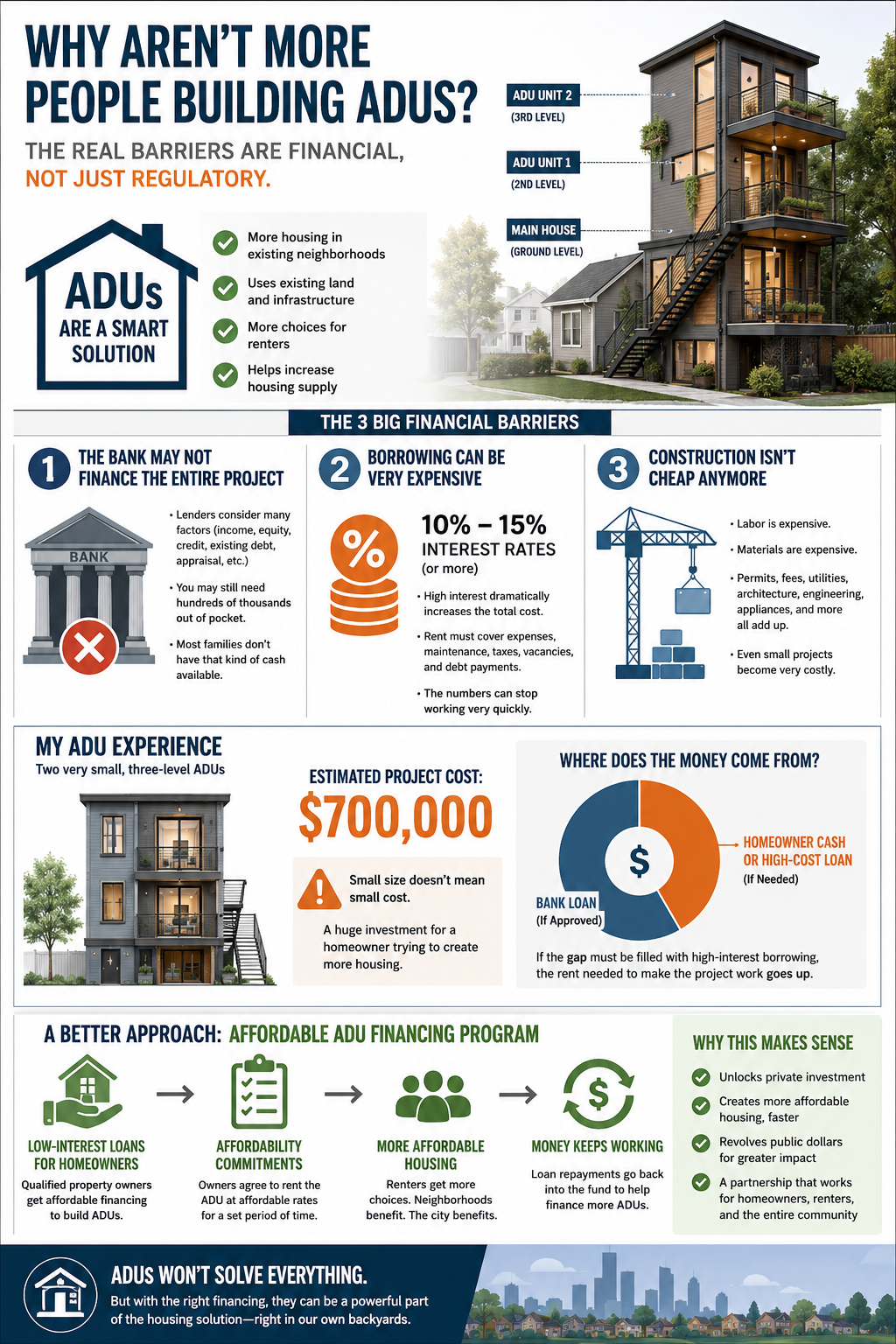
Building an ADU is expensive, and financing one can be extremely difficult.
The First Problem: The Bank May Not Finance the Entire Project
Suppose a homeowner wants to build an ADU that costs $300,000.
The homeowner might reasonably think:
"I'll get a construction loan, build the ADU, rent it out, and use some of the rental income to repay the loan."
Unfortunately, it isn't necessarily that simple.
Traditional lenders may not finance the entire cost of an ADU project. Loan availability depends on the homeowner's income, equity, credit, existing mortgage, appraisal, projected property value, and the particular lending product.
That can leave homeowners with a substantial financing gap.
And most families don't have hundreds of thousands of dollars sitting in a bank account waiting to be spent on construction.
The Second Problem: Borrowing Can Be Very Expensive
Even when financing is available, the cost of borrowing can make a project difficult to justify.
Depending on the type of financing, a homeowner may encounter interest rates around 10% to 15%, particularly with certain construction, private, bridge, or other higher-cost financing products.
That changes the economics dramatically.
Borrowing $300,000 at a high interest rate isn't just a $300,000 project anymore. Interest and financing costs can add enormously to the amount that ultimately has to be repaid.
And the rent from an affordable ADU still has to cover operating expenses, maintenance, insurance, taxes where applicable, vacancies, and debt payments.
The numbers can stop working very quickly.
The Third Problem: Construction Isn't Cheap Anymore
Then there is the actual cost of building.
Labor is expensive.
Materials are expensive.
Electrical work is expensive.
Plumbing is expensive.
Concrete, lumber, windows, roofing, appliances, engineering, architecture, permitting, site preparation, utility connections, and dozens of other expenses add up.
Even a physically small project can become remarkably expensive.
I know this because I have looked at doing it myself.
My Own ADU Experience
In my case, I have considered building two very small, three-level ADUs on my property.
You might assume that because the units are small, they would be relatively inexpensive.
They're not.
The estimated project cost is approximately $700,000.
Think about that for a moment.
Here is a homeowner willing to create additional housing on an existing property. No land needs to be purchased. The property already exists. The neighborhood already exists.
Yet creating two relatively small additional homes could require approximately $700,000 in investment.
Then comes the financing question.
If a bank won't finance the entire project, where does the rest of the money come from?
And if the remaining money has to be borrowed at very high interest rates, how much rent would have to be charged simply to make the project financially possible?
That leads us directly to one of the contradictions in our affordable-housing discussion.
We Want Affordable Rent—but the Housing Is Expensive to Build
Government can tell homeowners:
Build more housing.
It can also tell them:
Make that housing affordable.
But there is a missing question:
How are they supposed to pay for it?
If we want private property owners to create affordable housing, we have to make it financially possible for them to do so.
Otherwise, we are asking homeowners to solve a public housing problem using hundreds of thousands of dollars of their own money.
Some wealthy property owners might be able to do that.
Most cannot.
A Different Approach: Make ADU Financing Part of the Housing Solution
This is where I think Culver City should start thinking differently.
Instead of focusing only on regulations, mandates, density, and large affordable-housing developments, we should examine whether public affordable-housing resources can help reduce the financing cost of privately built ADUs in exchange for real affordability commitments.
Imagine a voluntary program in which qualified Culver City property owners could receive low-interest financing to build ADUs.
In exchange, participating owners would agree to rent those units at specified affordable rates for an agreed period.
This shouldn't simply be a giveaway to property owners.
It should be an investment with conditions.
The city or a housing partner could establish eligibility requirements, affordability restrictions, repayment terms, safeguards against abuse, and mechanisms to ensure the units actually remain occupied as housing.
The homeowner gets access to financing that makes construction feasible.
The city gets additional housing without having to purchase every property and build every unit itself.
And a renter gets another place to live.
The Money Can Keep Working
There is another important distinction between a loan and a subsidy.
If government spends $200,000 as a grant, that money is generally spent once.
If government lends $200,000 and the borrower repays it over time, the principal can potentially be recycled into another housing project, subject to defaults, administrative costs, inflation, and the program's financing structure.
That creates the possibility of a revolving housing fund.
One homeowner builds an ADU.
The loan is gradually repaid.
Those repayments help finance another ADU.
Then another.
Instead of asking only, "How many affordable units can the city build?" we should also ask:
"How many private dollars can each public dollar responsibly unlock?"
ADUs Won't Solve the Entire Housing Problem
ADUs aren't a magic solution.
Not every property can accommodate one. Not every homeowner wants to become a landlord. Construction costs still matter. Financing programs carry risk. Neighborhood infrastructure and parking need to be considered. And large affordable-housing developments will still have an important role.
But ADUs offer something valuable:
They allow us to distribute new housing throughout existing neighborhoods instead of treating housing production as something that can happen only through enormous developments.
They can also allow homeowners to build wealth while creating rental housing.
That isn't necessarily a conflict.
Good public policy can create situations where homeowners, renters, neighborhoods, and the broader city all benefit.
We Need to Address the Real Barrier
If Culver City wants more ADUs, we should stop assuming that the only obstacle is regulation.
For many homeowners, the biggest obstacle may simply be money.
A homeowner can support affordable housing.
A homeowner can have enough land.
A homeowner can be willing to build.
A homeowner can even be willing to accept affordability requirements.
But none of that matters if a $300,000, $500,000, or $700,000 construction project cannot be financed at a cost that makes economic sense.
That is the conversation I want Culver City to have.
Instead of simply asking residents to build more housing, let's ask:
What would actually make it possible for them to build it?
If we solve that problem, some of the housing we need may already have a place to go—in our own backyards.
0 Comments