
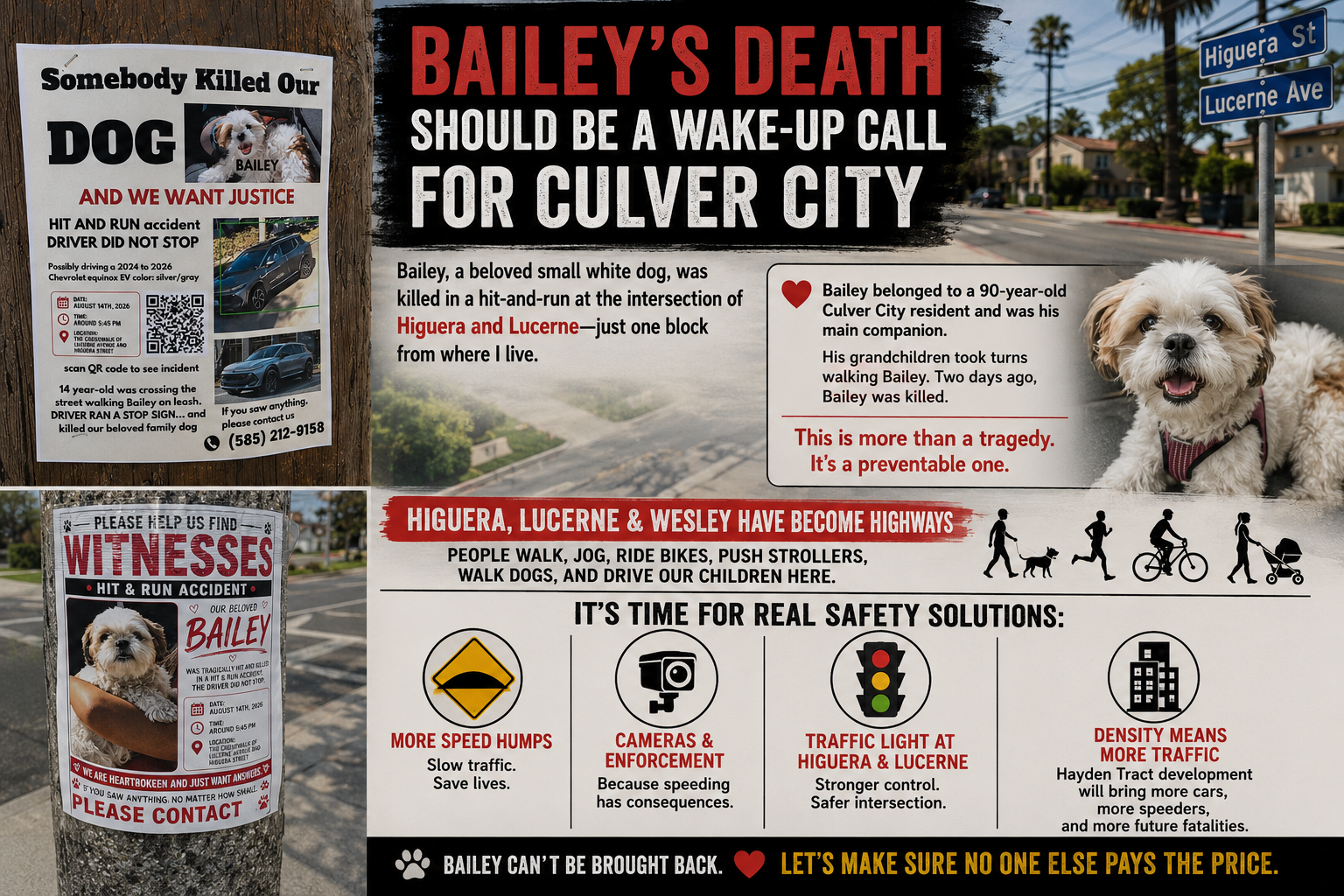
Two days ago, something heartbreaking happened one block from my home.
At the intersection of Higuera Street and Lucerne Avenue, a small white dog named Bailey was struck by a driver who reportedly did not stop. Bailey died shortly afterward.
According to a local resident who witnessed the aftermath, the collision occurred Saturday, August 15, at approximately 5:45 p.m. The teenager walking Bailey was physically unharmed but understandably shaken. Neighbors came out of their homes, offered assistance, searched their cameras and dashcams, and stayed with Bailey during his final moments.
But behind this tragedy is another heartbreaking story.
Bailey was the beloved companion of a 90-year-old Culver City resident. His grandchildren would take turns walking Bailey for him. It was during one of those walks that Bailey was killed.
For some people, a dog is not simply a pet. Bailey was companionship. Routine. Affection. Someone waiting at home.
And now he is gone.
Highways Instead of Streets
I live one block from this intersection, and those of us who live in this neighborhood know the problem.
Higuera, Lucerne, and even Wesley increasingly feel less like neighborhood streets and more like highways.
People drive through while residents are walking their dogs, jogging, riding bicycles, pushing babies in strollers, walking with children, or simply trying to cross the street.
This is not merely a perception that residents suddenly developed after Bailey's death.
Culver City's own traffic studies have documented the problem for years.
A city traffic study found that the highest daily and peak-period traffic volumes in the Rancho Higuera study area were on Lucerne, Higuera, and Hayden. The same study found speeding problems throughout the neighborhood, including 85th-percentile speeds exceeding posted speed limits on observed portions of Lucerne, Higuera, Hayden, Wesley, Helms and other streets.
The city has also acknowledged that Higuera and Lucerne are major cut-through corridors. More recent planning documents describe residents' concerns about excessive traffic volumes and speeds and recommend additional traffic controls on Higuera, raised crosswalks and other measures intended to slow vehicles.
So we cannot say we didn't know.
We Need to Slow the Cars Down
There are many possible solutions, and Culver City should be willing to seriously examine all of them.
We should consider additional speed humps or other vertical traffic-calming devices, particularly where engineering and emergency-access requirements permit them.
We should examine speed-enforcement cameras or other automated enforcement tools wherever legally permissible, with the goal of changing dangerous driving behavior rather than simply generating revenue.
And I believe the city should seriously study whether Higuera and Lucerne needs a traffic signal or another form of stronger intersection control.
That does not mean installing a traffic light tomorrow without analysis. Traffic signals can sometimes create unintended consequences, including backups and diversion onto neighboring streets.
But after what happened to Bailey—and after years of documented concerns about speeding and cut-through traffic—the question deserves a serious engineering evaluation.
The city is currently conducting Phase 2 of its Rancho Higuera Neighborhood Traffic Management Program, specifically to collect new traffic data and develop recommendations for additional or modified traffic-calming measures.
Bailey's death should become part of that conversation.
And Then There Is Hayden Tract
There is another issue we cannot ignore.
Culver City is planning for considerably more residential density in the neighboring Hayden Tract.
Under the city's current zoning, the Hayden Tract already allows residential development at a base density of up to 65 dwelling units per acre. In March 2026, the City Council supported an alternative for the Hayden Tract Specific Plan that would permit increased heights and residential densities, while attempting to transition building scale near the existing Rancho Higuera neighborhood.
Housing is important. Development is important. And Culver City has real obligations to plan for its future.
But density and transportation safety cannot be discussed as though they are separate issues.
More residents do not automatically mean proportionally more automobile traffic—particularly if people walk, bike or use transit. That is precisely why the city's Hayden Tract planning emphasizes pedestrian infrastructure, bicycle connections, transit and connections to the Ballona Creek path.
But planning documents themselves show that residents are worried about what additional development could mean for traffic, especially on Higuera.
That concern deserves to be taken seriously.
If Culver City is going to substantially increase the number of people living and working around Hayden Tract and Ballona Creek, the transportation and safety infrastructure surrounding those developments must grow with them.
We should not build first and discover the consequences later.
Streets Are Not Just for Cars
This is the larger point.
A residential street is not successful simply because automobiles can move through it quickly.
It must also work for the 80-year-old crossing the street.
For the mother pushing a stroller.
For the child riding a bicycle.
For the person jogging after work.
For the teenager walking his grandfather's dog.
And, yes, for Bailey.
There will always be drivers who are impatient. There will always be people trying to shave a few minutes off their commute by cutting through residential neighborhoods.
Good street design assumes that human beings will sometimes make bad decisions and creates an environment that makes those decisions less dangerous.
A speed hump forces a driver to slow down.
A raised crosswalk makes a pedestrian more visible.
A properly designed intersection forces motorists to pay attention.
Appropriate enforcement changes behavior.
Street design can save lives.
We Should Not Need a Human Fatality Before We Act
Bailey's death is tragic in its own right.
But it should also frighten us.
Because next time it could be a cyclist.
It could be someone jogging.
It could be a parent pushing a stroller.
It could be a child.
Culver City already has evidence of speeding and cut-through traffic in this neighborhood. The city is already studying additional traffic-calming measures. And at the same time, we are planning a denser future for the Hayden Tract.
Those facts should lead us to one conclusion:
Safety infrastructure needs to come before—or at least alongside—density.
I want Culver City to examine additional speed humps, safer crossings, automated enforcement where appropriate, and stronger traffic control at Higuera and Lucerne. I also want the city to examine what additional traffic generated by future Hayden Tract development could mean for Higuera, Lucerne, Wesley and the surrounding residential streets before that development arrives.
Development should not simply mean more buildings.
It should mean better sidewalks.
Safer bicycle routes.
Slower neighborhood streets.
Safer intersections.
And infrastructure capable of supporting the additional people we are inviting into the area.
Bailey cannot be brought back.
But perhaps something good can come from something so senseless if his death forces us to ask what kind of streets we want in Culver City.
We should not have to wait until the next victim is a person to decide that Higuera, Lucerne and the surrounding neighborhood need to be safer.
In memory of Bailey.
2 Comments
Comments are reviewed before they appear.Franklin Carvajal
Dani Zandel